
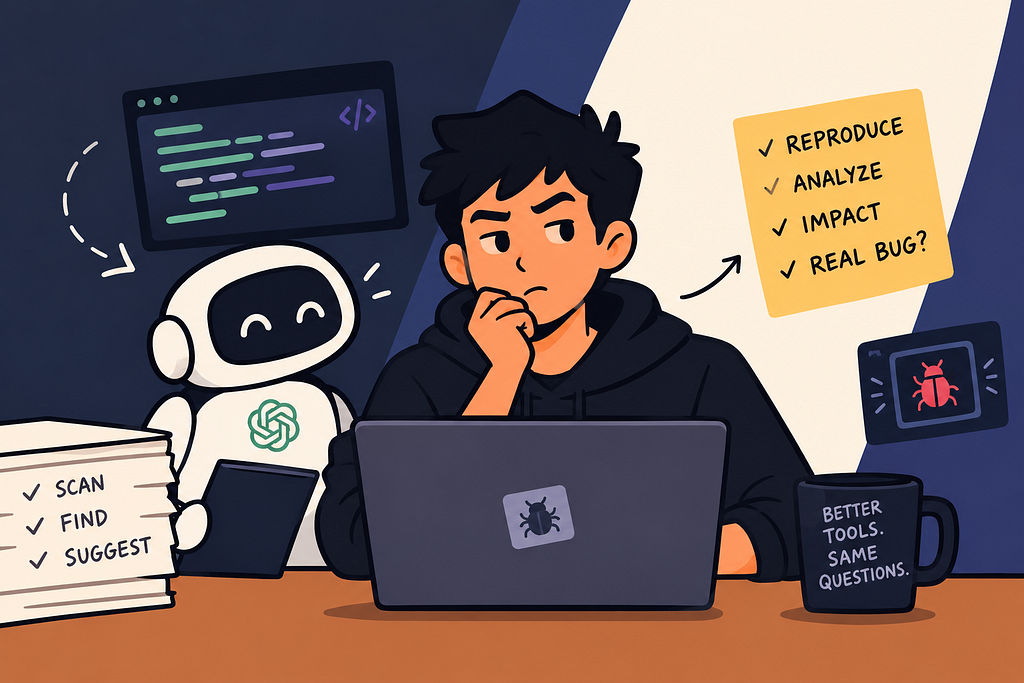
Everyone keeps asking whether manual bug bounty hunting is still worth it.
The answers usually go one of two ways.
“AI is going to replace hunters.”
Or:
“AI can never replace human intuition.”
Honestly, I think both answers are a little lazy.
AI is already very good at a lot of the work hunters used to spend hours doing. Give it a large codebase and it can scan for patterns, trace functions, spot suspicious behaviour, generate test cases and come back with a list of things worth looking at.
So no, I don’t think the future of bug hunting is someone opening a repository and manually reading every contract for eight hours.
That sounds less like a competitive advantage and more like refusing to use better tools.
But here’s what AI still doesn’t solve
Finding something weird isn’t the same as finding a bug.
You can get an AI to point at a suspicious function pretty easily. The harder question is whether an attacker can actually reach that state, whether the behaviour can be exploited, and whether it causes anything meaningful.
This matters even more in Web3.
A contract can look perfectly fine by itself and still have a problem because of how it interacts with an oracle, another contract, liquidity, transaction ordering or some economic assumption.
Sometimes the bug isn’t in the code.
It’s in the assumption behind the code.
That’s the stuff I don’t think you can solve by simply throwing a better scanner at the repository.
I think manual-only hunting is the part that’s in trouble
This is probably the unpopular part of my opinion.
I don’t think manual bug hunting is going away.
I think manual-only bug hunting is going to become increasingly inefficient.
If a tool can scan thousands of lines in minutes, identify interesting paths and generate ten hypotheses for me, I’m going to use it.
Why wouldn’t I?
I’d rather spend that saved time trying to break the protocol than proving that I can manually search through Solidity.
The workflow I’d actually want is pretty simple:
Let AI cover more of the boring surface-level work.Pick the interesting findings myself.Try to break the assumptions behind them.Reproduce the exploit.Figure out the actual impact.Then write the report.
The important part isn’t who typed the first query.
It’s who figured out that the finding was actually worth pursuing.
And there’s going to be a lot more garbage
There’s another thing I think people underestimate.
AI is going to make it much easier to submit bad bug reports.
Not necessarily because people are trying to cheat. Sometimes the model will simply convince them that something is a vulnerability when it isn’t.
So we’re probably going to get more reports, more duplicates and more convincing-looking false positives.
That doesn’t make bug bounty hunting less valuable.
It makes good validation more valuable.
If everyone can generate findings, the interesting person becomes the one who can take a suspicious result and turn it into a working exploit with a clear impact.
That’s a very different skill from just finding something that looks wrong.
So, is manual bug hunting still worth it?
Yes.
But if your definition of manual hunting is “I don’t use AI or automation because real hunters do everything themselves,” I don’t think that’s going to age particularly well.
The best researchers won’t necessarily be the ones doing the most manual work.
They’ll probably be the ones using machines to cover more ground while keeping the actual judgment for themselves.
AI can tell you where something looks wrong.
It still takes a good researcher to decide:
“Okay. Now let’s see if I can actually break it.”
And I think that’s where bug hunting gets interesting.
Manual Bug Hunting Isn’t Dead. But “Manual-Only” Might Be. was originally published in Coinmonks on Medium, where people are continuing the conversation by highlighting and responding to this story.