
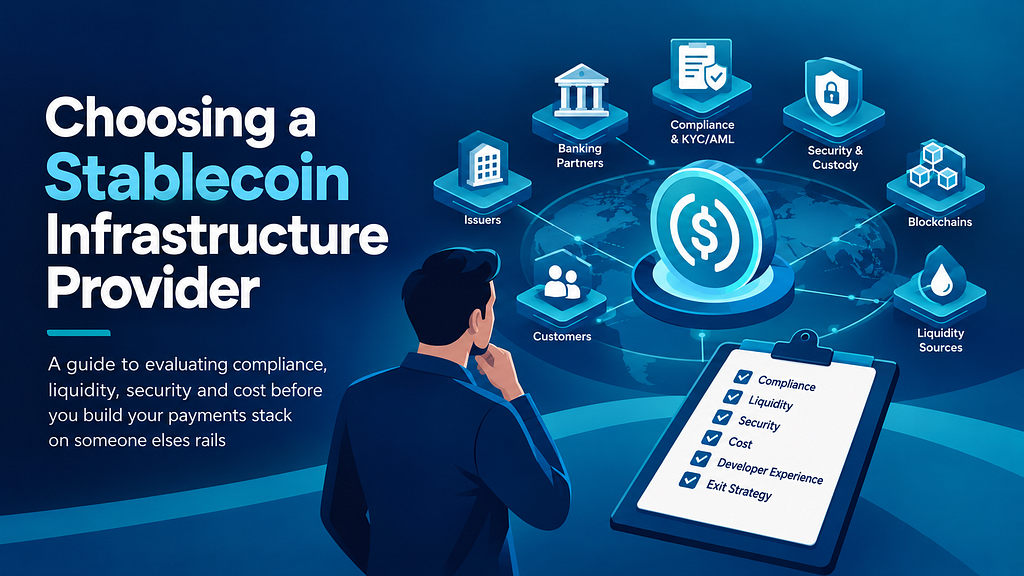
A guide to evaluating compliance, liquidity, security and cost before you build your payments stack on someone elses rails
Imagine a founder who wants to add stablecoin payouts to a cross-border marketplace. The plan is simple: pay freelancers in minutes of days and avoid high wire fees. Then reality hits. The chosen provider changes its supported countries with two weeks’ notice. The launch stalls for three months.
This story happens all the time.. It doesn’t have to. Stablecoins are easy to understand.. Running them is hard. Behind every fast transfer is a network of issuers, custodians, banks, blockchains, compliance systems and liquidity sources. Your infrastructure provider decides how well that whole system holds up under stress.
ChatGPT Generated Image
Here’s a clear way to pick the one.
1. Start with your use case, not their feature list
Providers aren’t one-size-fits-all. Some focus on consumer apps others on business payouts or treasury tools. Before even seeing a demo write down:
Which countries and currencies you must supportHow transactions per month and how big they usually areWhether you need to accept deposits (on-ramps) send money out (off-ramps) or bothWho controls the funds. You, your users or the provider
A clear use case stops you from wasting time on wrong options. It filters the market fast.
2. Ask about compliance and licensing
Regulation is now the difference between trustworthy providers and risky ones. New rules like the EU’s MiCA and the U.S.’s GENIUS Act require transparency, reserves and oversight. Don’t assume. Ask directly:
What licenses do you. Where?Do you handle KYC, AML and transaction monitoring or do I?How do you follow the Travel Rule?Which stablecoins do you support? Are their issuers regulated?
Laws change. Check requirements with legal experts. If a provider answers these questions clearly and in writing they’ve likely done the work.
3. Look into security and custody
Stablecoin payments move money. They can’t be reversed. One mistake means loss. Look for:
Independent audits like SOC 2 Type IIInstitutional-grade custody with customer funds keptKey management using multi-party computation or hardware security modulesRole-based access and approval workflows for sensitive actionsA public history of incidents and how they were handled
Security isn’t optional. It’s part of trust.
4. Test liquidity and settlement speed
Speed claims don’t mean much if the money isn’t available. A provider might promise transfers but large trades could face slippage or delays over weekends. Ask for numbers:
Average and worst-case settlement times by corridorWhich blockchains they support and what their gas fees look likeWhen fiat rails operate. Including weekends and holidaysTheir uptime track record and whether they publish status updates
Real-world testing beats promises.
5. Look beyond the headline pricing
The price listed online rarely shows the cost. Compare cost of ownership not just percentages. Watch for:
Spreads on currency conversionWhether network fees or gas costs get passed throughmonthly commitments or volume tiersExtra charges for onboarding, support or advanced compliance tools
Model the cost at today’s volume and at ten times that. Providers that seem cheap at volume often become expensive when you grow.
6. Judge the developer experience
Your engineers will work with this integration for years. A poor API slows sprints. Increases bugs. During evaluation let a developer spend a day in the sandbox. Then ask:
Is documentation clear and complete?Are code samples helpful and accurate?Do webhooks fire and handle duplicates safely?Does the sandbox match production behavior?How quickly does technical support respond?
This isn’t about code. It’s about team pain.
7. Plan your exit before you sign
Vendor lock-in is a risk. Always ask: How would I leave if needed? Can I export transaction history and user data? Can I move wallets or balances to another custodian? Are contract terms fair? Good providers make leaving easier. Think about having a provider for backup once your volume grows. A single point of failure is a business risk. Not a tech issue.
Use a scoring framework
Turn the checklist into a weighted scorecard. Rate each shortlisted provider one to five in each category. Then assign weights based on what matters. A payments company may value compliance and liquidity at 30% each. A consumer app might care more about developer experience and cost. Share the scorecard with finance and engineering teams so everyone owns the decision.
Common mistakes to avoid
Picking a provider based on price and discovering compliance problems laterSkipping a live pilot before going full scaleAssuming all stablecoins are equally safe or liquidNot knowing who takes responsibility when things breakTreating the contract as a formality
Run a pilot before you commit
No research replaces actual testing. Run a pilot. Four to eight weeks. With clear goals. Process transactions across your key corridors. Track:
Success rate on tryMedian and slowest settlement timesHow fast support responds during an incidentAccuracy of reconciliation and reporting
Pay close attention to how the provider reacts when issues happen. A pilot always uncovers something.. Their response tells you more than any marketing material. Do they communicate early? Do they take ownership. Fix the root cause?. Do you have to chase them?
Questions to ask on the call
What happens to customer funds if you go out of business?How do you notify users about outages or regulatory changes?Which banks support your fiat rails and how concentrated is that exposure?Can you give me references from customers with volume?
The bottom line
Choosing an infrastructure provider isn’t about finding the flashiest tool. It’s about finding a partner. The right one handles complexity keeps funds safe settles consistently and stays out of your way while you build. The wrong one becomes a bottleneck that your users feel long before you do.
Start with your use case. Verify compliance and security in writing. Test liquidity with transactions. Model costs at scale. Evaluate developers firsthand.. Always always plan your exit. Do these things. You’ll make a choice that stands up to your board, auditors and customers.
Disclaimer: This article is, for purposes only and does not constitute legal, financial or investment advice. Always consult professionals before making business decisions.
Choosing a Stablecoin Infrastructure Provider was originally published in Coinmonks on Medium, where people are continuing the conversation by highlighting and responding to this story.