
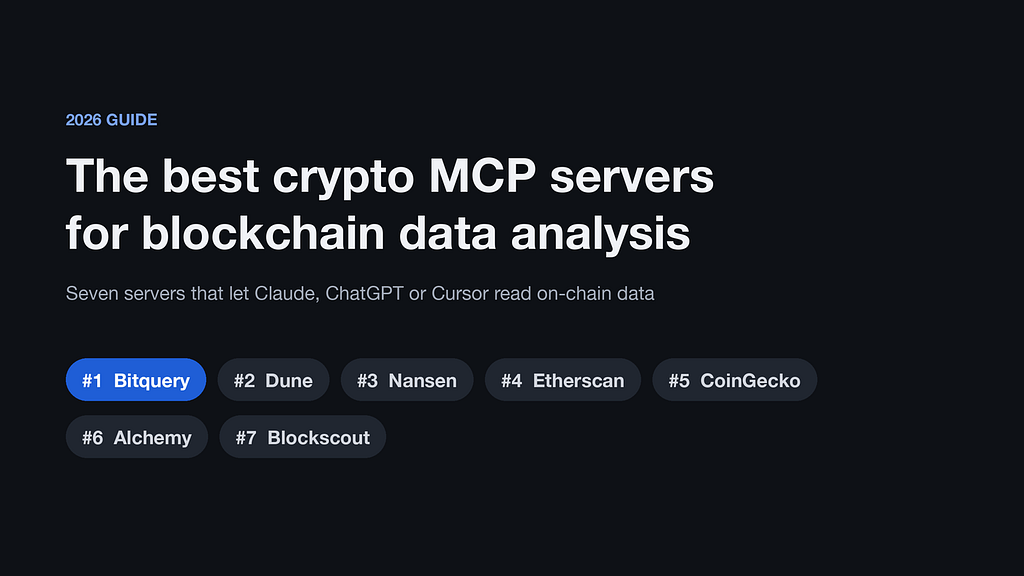
Seven crypto MCP servers that let Claude, ChatGPT or Cursor read live blockchain data, compared on chains, tools and price, with results from a live test.
Ask Claude or ChatGPT who bought a token this morning, or where the money from last week’s hack went. You will get one of two replies. Either the chatbot says it cannot see live data, or it gives a confident answer it made up. The AI learned from a snapshot of the web, and it has never read a block.
Disclosure: I wrote this story with help from an AI writing tool. Figures come from each vendor’s own docs and from my own test runs, all checked on 6 October 2026.
Short answer: the best crypto MCP server for blockchain data analysis in 2026 is Bitquery MCP. It puts DEX trades, trader profit and loss, fund tracing on 19 chains and wallet labels in one server that works in Claude, ChatGPT and Cursor. Pick Dune for custom SQL, Nansen for Smart Money labels, Etherscan for free wallet lookups and CoinGecko for prices.
What is a crypto MCP server?
A crypto MCP server is a plug-in that gives an AI assistant, such as Claude or ChatGPT, live tools for reading blockchain data. MCP stands for Model Context Protocol, an open standard for connecting assistants to outside tools. The server hands the assistant tools such as “list this wallet’s transfers” or “rank the top traders of this token”. You ask in plain English. The AI picks a tool, reads the rows that come back and writes the answer.
The servers differ in what those tools can reach. Some return token prices. Some return raw node data that a developer reads. A few return the analysis itself: who traded a token, who made money on it, where funds moved and who owns the wallet at the other end.
How I ranked them
I scored each server on four questions:
Depth. Does it return the rows behind an answer, each trade and each transfer, or only totals?Analysis tools. Can it follow money, label wallets and rank traders without you writing code?Coverage. How many chains does it reach, and does that include Bitcoin, Solana and Tron?Setup and price. Is it hosted with a browser sign-in, or a local install with keys? What does it cost per month?
I also ran Bitquery on three real questions on 6 October 2026. The answers are in its section below.
The 7 best crypto MCP servers at a glance
Bitquery MCP, best overall for on-chain analysis: 10 chains for DEX data, 19 for fund tracing, 314 tools, browser sign-in, from $19 per month.Dune, best for custom SQL: 100+ chains, 26 tools, OAuth or API key, paid in Dune API credits.Nansen, best for Smart Money labels: 50 tools (12 through a connector), Nansen Pro from $49 per month billed yearly, with 2,000 API credits per month.Etherscan, best free option for EVM lookups: 60+ EVM chains, 21 tools (16 with no key), free to start.CoinGecko, best for prices: 2 tools that reach 100+ API methods, free public server with no key, Pro plans for higher limits.Alchemy, best for app developers: 100+ chains, 168 tools, browser sign-in, free plan with 30M compute units per month.Blockscout, best for explorer data on 100+ chains: 16 tools, free PRO API key with 100,000 credits per day.
1. Bitquery MCP: best overall for on-chain analysis
Bitquery MCP is a hosted server at mcp.bitquery.io. You sign in with a Bitquery account in your browser (OAuth 2.1), so there is no API key to paste. It works in Claude (desktop, web and Claude Code), ChatGPT, Cursor, VS Code, OpenAI Codex and Windsurf.
Most on-chain questions come down to two questions: who is trading this token, and where did the money go? Bitquery sits at number one because it has dedicated tools for both. DEX trades and trader rankings answer the first. Hop-by-hop fund tracing answers the second, with labels on the wallets at the end. No other server on this list has a built-in tool that follows funds hop by hop across Bitcoin, Tron and the EVM chains.
DEX data on 10 chains. Ethereum, Arbitrum, Base, Polygon, Optimism, BNB Chain, Tron, Solana, Robinhood Chain and Arc, Circle’s new chain. Tools cover trending and new tokens, price candles down to one second, pool trades, top traders and trader profit and loss.Fund tracing on 19 chains. The same 10, plus Bitcoin, Litecoin, Dogecoin, Bitcoin Cash, Dash, Zcash, Cardano, the XRP Ledger and Stellar. You can follow funds hop by hop with Bitquery MCP and get a summary of who an address sends to and receives from.Address labels. Exchange deposit wallets, mixers, scams, darknet markets and token clones, so a trace ends at a name instead of a string of hex.Risk screen. Ask whether an address is risky and it returns LOW, MEDIUM or HIGH with the evidence behind the verdict.Polymarket and Hyperliquid. 14 tools for prediction-market odds, trades and holders, and 18 for Hyperliquid prices, funding, liquidations and trader positions.SQL. The $149 plan adds raw SQL over 30 days of per-second trades.
In total, the server listed 314 tools when I counted on 6 October 2026.
What it returned when I tested it. On 6 October 2026, I connected Bitquery to Claude and asked three questions.
“What are the most traded Polymarket markets today?” The top market over the 24 hours to 13:33 UTC was “Will Sweden win on 2026–10–05?”, with $4.17 million traded across 2,846 orders from 274 wallets. The answer also said its order data ran 17 minutes behind the clock.“What are the top Base tokens by DEX volume in the last 24 hours?” Doppler (XDP) led with $260 million traded, more than its $202 million fully diluted value. Volume above a token’s total value is a reason to check for wash trading before you trust the figure. The same list held a copycat token named “OpenAI” that lost more than 99% of its price in those 24 hours.Following stolen funds. I started from a wallet that held SOL drained from TradeWiz users on 30 September. One tracing call showed it sent 191 SOL on 1 October to a single address, and a label lookup tagged that address as a KuCoin deposit address. Bitquery’s TradeWiz drain investigation has the full trail.
Price. The Trading MCP plan costs $19 per month for 32 tools: trending tokens, candles and top traders. The AI Investigation plan costs $149 per month and opens all 314 tools, including labels and raw SQL. Yearly billing brings them down to $13 and $100 per month. A 7-day trial gives you 100 credits.
Watch out for. DEX data covers 10 chains, so a token that trades only on Avalanche or Sui needs another server, such as Dune. The $19 plan is for trading data only; tracing, labels and SQL need the $149 plan.
Best for: investigators, compliance teams and traders who want market data and money trails in the same chat.
2. Dune MCP: best for custom SQL across 100+ chains
Dune launched its official MCP server in early 2026. It connects the AI to Dune’s data warehouse, which holds more than 100 indexed chains, decoded smart contracts and tables built by Dune’s community.
Dune’s docs list 26 tools. They let the assistant search for tables, write and run SQL queries, and turn the results into charts and dashboards. You sign in with OAuth or a Dune API key, and calls draw on your Dune API credits.
Watch out for. Every answer is a SQL query that the AI writes against tables it first has to find. When the query is right, you get any metric you can think of. When it is wrong, you debug SQL. Long queries can also run past a client’s time limit; Dune’s own docs flag the 60-second default in OpenAI Codex.
Best for: analysts who already know Dune and want a custom metric or a dashboard.
3. Nansen MCP: best for Smart Money labels
Nansen’s server is built around its wallet labels. Connect through a connector with your Nansen login and you get 12 curated tools. Connect with an API key and you get the full set of 50, covering Smart Money holdings and trades, token flows, buyers and sellers, wallet profit and loss, related wallets, Hyperliquid positions and prediction markets.
Price. Nansen Pro costs $69 per month, or $49 per month billed yearly, and tops your API credits back up to 2,000 each month. Most tool calls cost 1 to 5 credits. Label lookups cost the most, from 100 to 500 credits per call.
Watch out for. The label tools are Nansen’s main draw, and they cost the most: 2,000 credits buy about 20 common label lookups. On a free key the premium label tools return an upgrade error. Nansen’s docs also say coverage varies by chain and by tool.
Best for: traders who want to see what large, labelled wallets are buying.
4. Etherscan MCP: best free option for EVM lookups
Etherscan’s official server runs at mcp.etherscan.io with 21 tools across more than 60 EVM chains. They cover balances, transactions, token transfers, contract source code, gas prices and event logs. A keyless version runs 16 of those 21 tools with no sign-up. The full server takes a free Etherscan API key, and its PRO tools need the Pro Plus plan.
Etherscan’s docs warn that mcp.etherscan.io is the only official server. Marketplace listings that use the Etherscan name are not from Etherscan.
Watch out for. Etherscan’s tools answer one address or one transaction at a time. Ranking traders or following funds through 50 wallets means dozens of calls against your API quota. It does not cover Bitcoin, Solana or Tron.
Best for: quick, free checks of a wallet or a transaction on Ethereum and its rollups.
5. CoinGecko MCP: best for prices and market data
CoinGecko runs a free public server that needs no API key and shares its rate limits across users. A Pro endpoint gives higher limits and the full tool set. The server exposes two tools: one searches CoinGecko’s SDK docs, and one runs code against more than 100 API methods. Together they cover live and historical prices, market caps, volumes, exchange data, trending coins and DEX pools.
Watch out for. CoinGecko returns market data only. It can tell you a token’s price and where it trades. It cannot tell you who holds the token or where the funds went.
Best for: price checks, portfolio maths and market overviews.
6. Alchemy MCP: best for developers building on-chain apps
Alchemy’s hosted server signs you in with your Alchemy account, with no key and no install. Alchemy lists 168 tools across 100+ chains, split into 8 admin, 132 RPC and 28 data tools. The RPC tools cover transaction simulation, debug traces, account abstraction and Solana. The data tools cover NFTs, prices and portfolios.
Alchemy’s free plan covers 30 million compute units per month. The company has retired its old local server. The npm package stopped working on 30 September 2026, so older setup guides no longer apply.
Watch out for. Most tools are node calls that return raw blockchain data. A developer testing a contract wants exactly that. An analyst needs many calls to build one answer.
Best for: developers who want their coding AI to query and simulate on-chain state.
7. Blockscout MCP: best for explorer data on 100+ chains
Blockscout hosts its own server and publishes the code on GitHub under its own licence, which limits commercial use. Its 16 tools cover addresses, tokens, NFTs, contracts, transactions and blocks on more than 100 chains. It splits long responses into pages, so a busy wallet’s history does not overflow the assistant’s context.
You need a Blockscout PRO API key. The free tier gives 100,000 credits per day, and a shared fallback key works with tighter rate limits.
Watch out for. Like Etherscan, Blockscout serves explorer data, one address or one transaction at a time. It has no tools for tracing funds or ranking traders.
Best for: wallet and contract lookups on chains that Etherscan does not cover.
Other crypto MCP servers worth a look
altFINS MCP is built for technical analysis: screeners, 150+ indicators and trade signals on more than 2,000 coins. It reads charts, not wallets.Tatum’s Blockchain MCP offers 13 tools for balances, transaction history and NFT data across 130+ networks. It needs a Tatum API key and returns raw data rather than analysis.
Which crypto MCP server should you use?
Match the server to the question you ask most:
“Where did this money go, and who received it?” Bitquery.“Is this wallet risky?” Bitquery’s risk screen.“Can you chart this custom metric?” Dune.“What are big funds buying?” Nansen.“What’s in this wallet?” Etherscan or Blockscout.“What’s the price?” CoinGecko.“Help me build and test my app.” Alchemy.
You can connect more than one. Claude and Cursor both accept several servers at once, and the AI picks the tool that fits each question.
How to connect Bitquery MCP to Claude and ChatGPT
In Claude, open Customize → Connectors, click + Add and choose Add custom connector.Name it Bitquery, paste https://mcp.bitquery.io as the server URL and click Add.Ask a question. The first time a Bitquery tool runs, Claude opens a sign-in page. Log in with your Bitquery account.
On Claude Team and Enterprise plans, an owner adds the connector first under Organization settings → Connectors.
ChatGPT, Cursor, VS Code and Windsurf take the same URL in their connector or server settings. Bitquery’s setup docs have the steps for each client.
Before you trust the answer
Ask for the receipts. Have the assistant list the transaction hashes behind its answer, then open one in a block explorer.Check the data delay. Every index trails the chain. In my test, Bitquery’s Polymarket data ran 17 minutes behind, and the answer said so.Read labels as evidence. A label says an address was attributed to an exchange or a scam. Check the evidence before you accuse anyone.Watch your credits. Every server here meters its calls, and a long investigation can make hundreds of them.
FAQ
What is the best MCP server for crypto analysis?
Bitquery, when the question is about who traded a token and where the money moved. It covers DEX trades on 10 chains and fund tracing on 19. For prices alone, CoinGecko’s free server is enough.
Which crypto MCP servers work with ChatGPT and Claude?
All seven are hosted servers, so any client that accepts a remote server URL can try them, though sign-in support varies by client. Bitquery and Dune both name Claude and ChatGPT in their docs.
Is there a free crypto MCP server?
Yes. CoinGecko’s public server and Etherscan’s keyless server need no account at all. Blockscout and Alchemy have free plans, and Bitquery offers a 7-day trial with 100 credits.
Is there an MCP server for Polymarket?
Yes. Bitquery has 14 Polymarket tools for market odds, trades, top traders and outcome holders; see the Polymarket MCP guide. Nansen’s full tool set also covers prediction markets.
What is the best MCP server for Solana data?
Bitquery covers Solana DEX trades, new token launches and fund tracing; see the Solana MCP guide. Dune also holds Solana tables if you would rather write SQL.
Is there an MCP server for Hyperliquid?
Yes. Bitquery has 18 Hyperliquid tools for prices, funding rates, liquidations and trader positions; see the Hyperliquid MCP guide.
Which MCP server is best for Bitcoin analysis?
Bitquery. It traces Bitcoin transfers and groups addresses that are likely controlled by the same owner, and does the same for Litecoin, Dogecoin, Bitcoin Cash and Dash. Dune also holds Bitcoin tables if you would rather write SQL.
Can these servers trade for me?
This list covers servers for reading blockchain data. Bitquery is read-only, so it cannot move funds. Servers that place trades or sign transactions are a separate category.
If your question is about prices, CoinGecko is enough. If it is about who traded a token and where the money went, start with Bitquery MCP and its 7-day trial.
The Best Crypto MCP Servers for Blockchain Data Analysis in 2026 was originally published in Coinmonks on Medium, where people are continuing the conversation by highlighting and responding to this story.