
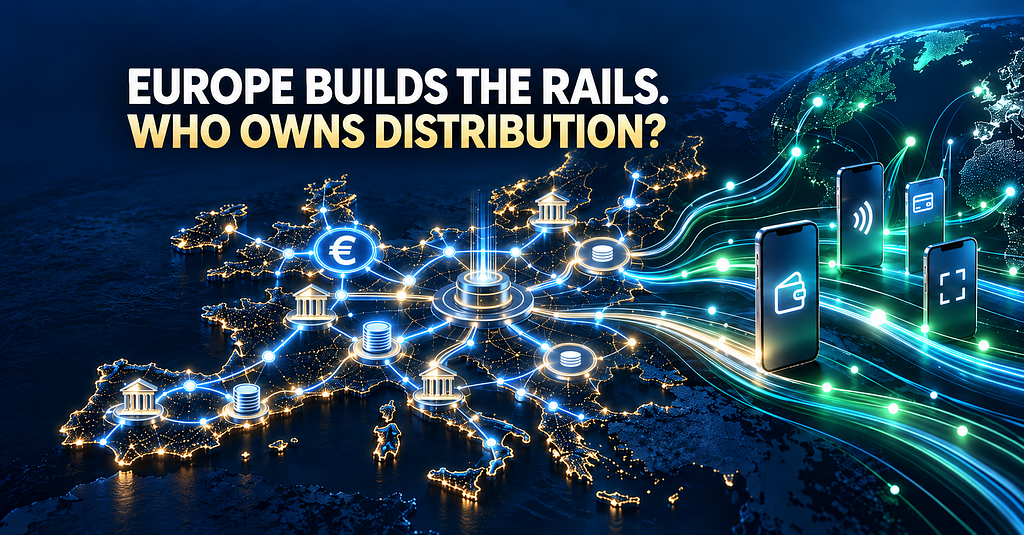
Stablecoins are winning distribution while Europe concentrates on regulation and settlement. The strategic answer is not one rail, but orchestration across many.
Europe is building trusted rails for tokenised finance. The strategic question is who will own the customer, liquidity, and distribution layers.
In 2015, before “Blockchain Island” became a recognised part of Malta’s economic positioning, I joined a pressure group advocating for the country to take distributed-ledger technology seriously.
The opportunity appeared larger than crypto. Malta had spent decades building an international financial-services industry. A clear DLT framework could attract new foreign direct investment, widen the fintech sector and give companies the confidence to establish real operations in the country.
From 2016 to 2018, I became involved more directly as an adviser and consultant, supporting the framework’s development, positioning and communication. The work brought together government, legal advisers and industry participants around a relatively simple proposition: regulatory clarity would allow serious businesses to plan.
I still believe that proposition was right.
But with hindsight, it was incomplete.
Regulation can create permission to build. It cannot create adoption on its own.
Malta did important work in creating a legal vocabulary for a fast-moving industry. Where we could have done more was education: translating legislation into something the public could understand, building trust beyond the professional community and explaining why the technology might matter in everyday life.
That lesson became much more tangible a few years later.
I was recruited by the Calamatta Cuschieri Group to lead its overall marketing and expand its fintech arm, which operated under Moneybase. The mission ultimately included bringing Malta’s first neobank to market.
Inside the business, the technology was central. The product depended on digital onboarding, payments infrastructure, card controls, identity checks, and a regulated operating model working together.
Customers did not describe the value in those terms.
They valued opening an account from home, at a time that suited them, without being constrained by branch hours. They valued controlling their finances from a phone. They could issue, freeze, restrict, or replace a card without waiting for someone else to act.
Trust was the first barrier. Onboarding was the second. Once both were addressed, convenience became the proposition.
The early uptake reinforced that point: new accounts and card creation exceeded their targets during the first six months, and the service reached more than 40,000 monthly active users within its first 90 days.
The technology enabled the experience. It was not the experience.
That distinction now shapes how I view Europe’s position in stablecoins and tokenised finance.
Europe is doing difficult and necessary institutional work. But it risks repeating an old assumption: that credible architecture will naturally translate into customer adoption and market leadership.
Stablecoins have moved beyond the crypto market
The stablecoin story is changing because usage is changing.
Stablecoins remain essential to exchange liquidity and on-chain trading, so raw blockchain volume should never be confused with commercial payments. Transfers between exchanges, minting, decentralised-finance activity and automated transactions can make the headline numbers look more economically significant than they are.
Even after those caveats, however, identifiable payment activity has become substantial.
Visa and Allium estimate annual stablecoin payment volume at between $401 billion and $527 billion. Within that activity, service-fee payments represented $56 billion, payroll $43 billion, and supplier payments $28 billion. Among B2B transactions for which geography could be established, 43% of volume was cross-border.
Visa has also reported that business and commercial programmes represented approximately 17% of stablecoin-linked card volume in its 2026 financial year to date. The company supports more than 160 stablecoin-linked card programmes, whose payment volume grew by almost 200% year on year.
The point is not that stablecoins have already replaced established payment systems. They have not.
The point is that they are solving identifiable operational problems: moving value outside banking cut-off times, reducing some forms of prefunding, reaching markets through digital wallets and simplifying cross-border treasury flows.
As Visa executive Mark Nelsen observed, businesses are not pursuing payment technology for novelty; they want trusted and reliable ways to move money.
Stablecoins are gaining distribution because the value proposition is practical.
Europe is securing the settlement layer
Europe is working on a different part of the problem.
In September 2026, the Eurosystem launched Pontes, an initiative connecting eligible DLT market platforms with TARGET Services so wholesale tokenised transactions can settle in central-bank money.
Pontes uses two settlement routes. Transactions can use cash tokens on the Eurosystem’s DLT platform, or they can settle through T2, Europe’s real-time gross settlement system. Hash-Link technology synchronises the movement of the asset and the cash, enabling delivery-versus-payment and other transactions in which both legs must complete together.
This is easy to reduce to another central-bank technology project. That would miss the significance.
Tokenising a bond does not remove settlement risk if the asset moves on one system while the money moves elsewhere, under different rules and at a different speed. Institutional markets require a credible cash leg, legal finality and confidence that the asset and payment cannot become separated.
Pontes is designed to provide that anchor.
ECB Executive Board member Piero Cipollone described the initiative as bringing “the stability and trust of central bank money to the European tokenised finance ecosystem.”
That is an institutional advantage. It is not yet a distribution advantage.
Europe’s real vulnerability
Europe has many of the components needed for a credible tokenised-finance market: a large regulated economy, experienced banks and payment institutions, MiCA, instant-payment infrastructure and now an operational bridge between DLT markets and central-bank settlement.
But global digital-money distribution is not organised around regulatory credibility alone.
Dollar stablecoins benefit from deep on-chain liquidity, widespread wallet support, exchange integration, developer adoption and the global demand for dollars. US-led platforms and private networks increasingly influence how customers encounter digital money, even when the users and underlying economic activity sit outside the United States.
This creates a strategic possibility that Europe should take seriously.
Europe could write the rules, supervise the institutions and provide trusted settlement while non-European companies own the wallet, interface, transaction data and customer relationship.
MiCA illustrates both the strength and the constraint of Europe’s position. By 1 September 2026, 39 e-money tokens had been issued under the framework, but no asset-referenced token had been authorised. The European Banking Authority has acknowledged that classification complexity can add cost and delay product development, with consequences for competitiveness.
The answer is not weaker regulation.
Trust is an asset, particularly in financial markets. The challenge is converting that trust into products that are easier to use, liquidity that is easier to access, and distribution capable of competing across borders.
Europe cannot regulate its way into distribution.
It has to make regulated infrastructure commercially useful.
The strategic answer is multi-rail
If I were building a European fintech today or advising a crypto founder entering the European market, I would not begin by choosing between stablecoins and bank money.
I would begin with the transaction.
Where does it start? Where must it end? Who carries the risk? What form of finality is required? Which customer or institution must trust the result?
The answer will not always lead to the same rail.
Stablecoins are compelling when 24/7 portability, global liquidity and onchain access matter. Tokenised commercial-bank deposits are stronger where the banking relationship, regulated balance sheet and treasury structure matter. Central-bank money should anchor wholesale settlement where risk-free finality is essential. Existing bank and instant-payment rails remain effective where local reach, familiarity and acceptance are already strong.
This is not indecision. It is architecture.
The customer should not have to choose the rail. The platform should choose the right rail for the transaction.
The most defensible opportunity may therefore sit less in issuing another token than in orchestrating the system around it: identity, compliance, liquidity, foreign exchange, custody, settlement, reconciliation and routing.
Issuance can create visibility. Distribution and orchestration create repeatable utility.
Foundations do not guarantee leadership
My experience with Malta’s DLT framework taught me why clear rules matter before serious institutions can commit.
Helping launch a neobank taught me that customers adopt outcomes, not infrastructure.
Working across global Web3 markets has made the connection between those lessons more visible. Regulation, product, narrative, trust, and distribution are not separate conversations. They are parts of the same strategy.
Europe is building credible foundations. Pontes provides a bridge to central-bank settlement. MiCA creates a common perimeter. Euro stablecoins, tokenised deposits, the digital euro and established payment systems could become complementary parts of a broader digital-money architecture.
But foundations do not guarantee leadership.
Europe’s position will depend on whether it can connect institutional trust with products customers choose, liquidity markets can use, and distribution that travels beyond national boundaries.
If it succeeds, Europe can build a model for tokenised finance that is both regulated and globally relevant.
If it does not, it may provide the safest rails while dollar stablecoins and foreign platforms own the journey.
The strategic question is no longer whether finance will become more tokenised.
It is where, in that multi-rail system, Europe and the companies building within it have the right to win.
About the Author
Joseph Zammit is a CMO and CSO in fintech and crypto, with 25+ years at the intersection of marketing, strategy, and regulation. He helped design Malta’s pioneering DLT framework, launched the country’s first Neobank, and led the global expansion of crypto and Web3 platforms. He works with Europe-based licensed neobanks, EMIs, PSPs, and crypto-native infrastructure teams on strategy, regulation, and go-to-market. He is a member of the Crypto Valley Association.
Europe Is Building the Rails for Tokenised Finance. It Could Still Lose the Customer. was originally published in Coinmonks on Medium, where people are continuing the conversation by highlighting and responding to this story.