
Is Polyfox legit? Here’s how the Polymarket Telegram bot handles copy trading, AFK automation, non-custodial fund control, fees, and risk — plus the security steps worth taking first.
Polymarket turned real-world main events into a tradable asset class. But spotting a good opportunity is only half the job. You also have to watch prices, react quickly, and manage open positions without missing a move. Copy-trading bots try to fill that gap, and right now Polyfox is one of the big talking points. It’s a Polymarket trading terminal that lives inside Telegram.
The obvious question before trusting a bot with real money: is this a legit tool, or just another scheme to drain deposits? Let’s break it down — what it is, how it works, where the real value sits, and where the risks live.
What Polyfox Is and What Problem It Solves
Polyfox is a Telegram-based trading terminal for Polymarket built around copy trading: you pick a trader or wallet with a solid track record, and Polyfox mirrors that wallet’s buys and sells within the limits you set.
The problem is pretty mundane in practice. Manually tracking someone else’s wallet means constantly checking when a position opened, at what price, and when to exit. Active Polymarket traders can run dozens of positions across markets at once — doing that by hand is basically a full-time job.
Polyfox automates that. The bot watches a chosen wallet in real time and mirrors its trades according to your configured limits. Beyond copy trading, it adds stop-loss and take-profit controls, gasless execution, multi-chain deposits, whale alerts, and backtesting. It feels more like a full trading terminal squeezed into a messenger app than a chat bot.
How the Telegram Bot Works: From Depositing to Automated Trading
Here’s the general flow.
Find a trader worth following. The Smart Wallets section highlights wallets with strong recent performance: win rate, number of copiers, profits earned. That saves you from hunting wallet addresses or cross-checking Polymarket’s public leaderboard yourself.Configure copy settings. Decide how closely to mirror the chosen trader’s activity — for example, using a multiplier (like 0.1x of the original position size) and setting an overall budget for the strategy. This step matters a lot: without it, a $500 account could end up matching a wallet trading six-figure sums.Fund the trading balance. Polyfox accepts deposits from Ethereum, Solana, BNB Chain, Base, Arbitrum, and Optimism, automatically converting assets into your trading balance. Withdrawals are available in supported stablecoins on Polygon.Launch and monitor. Once funded, the bot tracks the selected wallet and executes trades that fit your limits. Copying can be paused or stopped anytime — there’s no lock-in.
The Non-Custodial Model: How Much Control Users Actually Keep
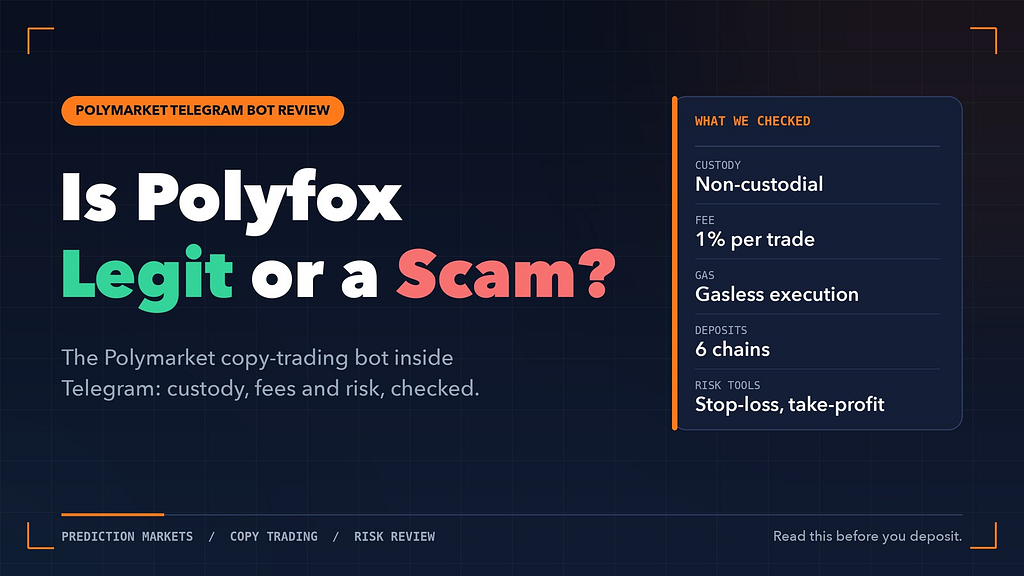
A big plus for Polyfox is its non-custodial design. It doesn’t hold your funds in its own accounts. Keys can be exported to any MetaMask-compatible wallet, and withdrawals remain under your control.
That’s a meaningful difference from setups where you “deposit into” a platform account and trust the operator. A non-custodial model removes one clear risk — the possibility that the service operator absconds with your money.
But don’t read this as a full safety net. Non-custodial doesn’t eliminate smart-contract risk, wallet-security risk, or the trading risk itself. It answers who physically holds the funds, not whether you’ll lose money in the market.
Copy Trading and AFK Trading: How the Bot Runs While You’re Offline
Regular copy trading means you pick a trader or wallet and automatically copy that wallet’s moves. If the wallet opens or closes a position that fits your criteria, Polyfox mirrors that trade in your account.
AFK trading (away from keyboard) is broader. Instead of following another wallet, you set up an automated strategy with its own rules — defining when to open or close positions — and it keeps running around the clock, even when you’re not watching.
The difference matters: copy trading follows a person; AFK logic follows a predefined set of rules. Polyfox frames its 24/7 strategies as a way to keep automation going while you sleep, work, or simply aren’t glued to your phone.
Setting up an AFK strategy isn’t just flipping a switch. It means clearly defining boundaries: how much capital you’re committing, and under what conditions positions open or close. Even after launch, it’s smart to check in on the strategy — open positions, capital usage, and whether the bot’s behavior still matches expectations. You can pause, tweak, or stop the strategy at any time.
Security Considerations: Protecting Your Telegram Account and Using Official Links
Because Polyfox runs through Telegram, the security of the messenger is part of the trading account’s security. This deserves emphasis, because real losses often come from a compromised Telegram account or a fake clone, not from the bot itself.
Practical tips:
Access the bot only via official links from the project’s website or verified channels, not random chats, comments, or sketchy ads.Watch for clones and phishing copies: Telegram sees lots of fake duplicates of popular bots designed to look real.Never share seed phrases or private keys with anyone, anywhere, including “support” in DMs, legitimate services won’t ask for this in chat.
Trading Risks: Picking Traders, Market Moves, and Slippage
Even a flawless bot can’t dodge market risk. Here are a few realities to keep in mind.
Choosing a trader isn’t lottery-winning. Being top of a leaderboard doesn’t automatically mean they’re the right one to copy.
A high win rate by itself isn’t enough. Losing trades can be bigger than winning ones, and that can wipe out the gains. And a lower win rate can still pay off if the wins are big enough. Look at P&L, win rate, how often they trade, position sizes, and how diversified they are across markets.
Market volatility. Markets can swing hard on news, and even fast mirroring won’t always fetch the same entry price as the original trader.
Slippage and execution gaps. From the moment a position is opened to when the bot copies it, prices can move. In thin, less-liquid markets, the difference between expected and actual fill can be noticeable. That’s not a bot flaw — it’s a general feature of copy trading, whether automated or manual.
Past performance ≠ future results. A trader who’s been profitable for months can still be wrong on the next call, switch approaches, or run into a regime where their strategy stops working.
Extra Risks of AFK Strategies Without Real-Time Supervision
AFK is handy because it frees you from staring at charts all day. That convenience has a downside.
An automated rule can execute perfectly — every condition met — but still end up with a bad result if market conditions have shifted while the rule stays the same. A calm-market winner can bleed money during sharp moves, and without checks, you might not notice for too long.
A false sense of security can creep in: the less you check, the easier it is to miss a shift: whether it’s a change in the copied trader’s behavior or a shift in market conditions. AFK handles execution, not risk oversight. Someone still needs to keep an eye on things, just not every minute.
Recommended Safeguards
Before putting real capital in, set up some basic protections — both on the account and the trading settings.
Enable Telegram two-factor authentication. It’s a simple, crucial step to reduce the risk of someone else getting in if your phone or account is compromised.Start with a small test deposit. Try a minimal amount first to see how trades actually execute and how the interface feels.Set position limits and budget caps. The copy multiplier and the strategy budget cap aren’t optional extras — they’re the main risk controls, especially when copying traders who run lots of positions.Use Stop Loss and Take Profit. They help limit losses and lock in gains without waiting for the original trader to exit. Note they aren’t a guaranteed price — fast moves or illiquid markets can cause fills to differ from the trigger price.Regular checks. Even with automation, periodically review open positions, capital usage, and overall strategy behavior, especially after sharp news moves.
How Polyfox Makes Money
Polyfox keeps things simple: a small fee on every trade — 1% — without subscriptions, deposits, or withdrawal fees. Gas costs are handled by the relayer, so there’s no extra network fee to pay per transaction.
For light trading, that fee isn’t noticeable. For heavy, high-frequency copy trading, a 1% per trade fee can bite into returns, worth factoring in when deciding who to copy and how often.
In short, this is a standard infrastructure model: a slice of trading volume funds the server costs, the gasless execution setup, and ongoing development — not an upfront charge or hidden fee.
Why Polyfox Only for Polymarket — Not Kalshi and Others?
People ask why the bot is built specifically for Polymarket, not Kalshi or other platforms.
Practically speaking, the team’s focus is on making a polished product for Polymarket first — deep smart-contract integration, solid wallet and leaderboard data, and all of that. Support for other platforms isn’t off the table later, but starting with one market helps build a stronger product without stretching resources too thin across different architectures.
Finally: Is Polyfox Legit or a Scam?
Short answer: it looks legitimate, not a trap. Non-custodial setup, easy withdrawals, clear fees, and real risk-management tools (stop-loss, take-profit, budget caps) point to a thoughtful trading tool, not a scam.
But legitimacy isn’t the same as guaranteed profit. Polyfox automates execution and removes some manual chores, but it doesn’t erase market risk, doesn’t promise copied traders will keep winning, and doesn’t shield against slippage or rapid price swings. Automation helps with the process, not the outcome.
Bottom line: think of Polyfox as an execution and automation layer on top of Polymarket, not a source of guaranteed signals. It’s handy for folks who already know Polymarket and don’t want to babysit a dozen wallets, and for newer traders who want structured access with built-in risk controls. Still, choosing who to copy, setting sensible limits, and checking in on a strategy regularly — those are on the user, not the bot. And that user judgment matters more than the tool itself.
Is the Polyfox Telegram AFK Trading Bot Legit or a Scam? was originally published in Coinmonks on Medium, where people are continuing the conversation by highlighting and responding to this story.