
Index funds made investing simple. Grid bots made it automated. Agentic AI is trying to make it adaptive. Here’s what actually separates them.
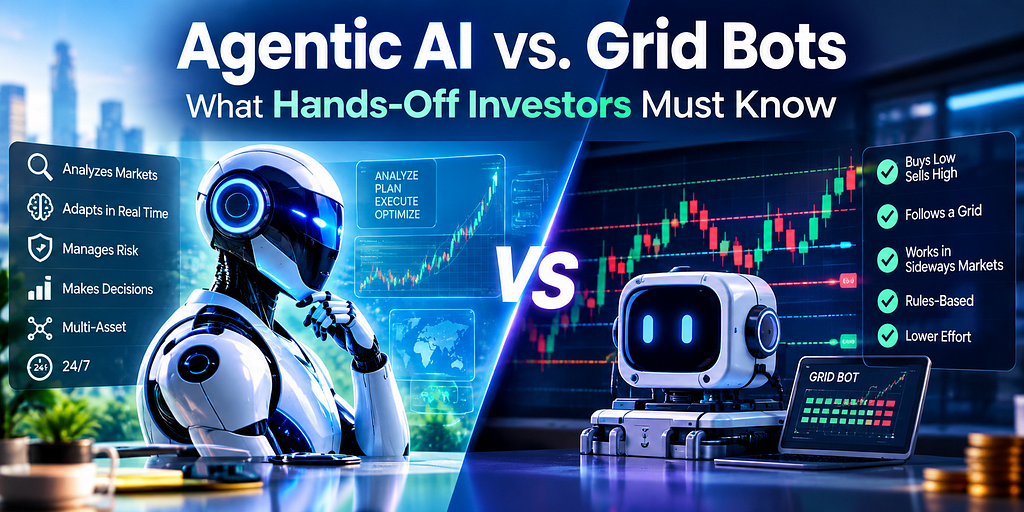
Agentic AI vs. Grid Bots — What Hands-Off Investors Must Know
Your index fund doesn’t know what the market is doing. Neither does your grid bot.
One buys everything and waits. The other places orders on a fixed ladder and hopes price keeps bouncing inside it. Both are automated, and both are blind to context.
That’s the uncomfortable truth behind the most common question passive investors are asking right now: is buy-and-hold indexing still the best risk-adjusted strategy, or is there something smarter for hands-off investors?
Over the past few years, two “smarter” options have competed for your attention: rule-based grid trading bots, and a newer category called agentic AI. They’re often lumped together as “automated trading.” Structurally, they have almost nothing in common.
This article breaks down exactly how they differ, why it matters for your portfolio, and why platforms like Hyperlyx AI are built on the agentic model rather than the rigid bot model.
Grid bots execute fixed rules and can’t adapt when markets change regime. Agentic AI systems observe conditions, reason about risk, and adjust their own behavior within guardrails. For hands-off investors, that difference is the gap between a tool that works only in the market it was built for and one designed to handle the market you actually get.
What Is a Grid Bot? (And Why Did So Many Investors Adopt Them?)
A grid trading bot is an automated program that places buy and sell orders at preset price intervals above and below a set price, forming a “grid.” When price falls to a lower rung, it buys. When price rises to a higher rung, it sells. Each completed cycle captures a small profit.
The appeal is obvious:
It’s automated: Set it and walk away.It’s intuitive: “Buy low, sell high” repeated mechanically.It thrives in sideways markets: Choppy, range-bound price action is a grid bot’s ideal habitat.
For a while, that made grid bots feel like a cheat code. In a range, every wiggle becomes income.
But the strengths of a grid bot are inseparable from its weaknesses. It performs well in exactly one kind of market, and markets rarely stay in one kind of market.
The Structural Flaws of Grid Bots
The word that matters here is structural. These aren’t bugs a software update fixes. They come from how grid bots are designed.
1. They Are Rule-Bound, Not Context-Aware
A grid bot follows the parameters you gave it at setup: range, grid spacing, order size. It doesn’t ask why price is moving. A slow drift down and a panic-driven collapse look identical to it, and it responds identically to both.
2. They Break on Trends
If price breaks out above your range, a grid bot sells everything on the way up and then sits in cash while the trend runs without it. If price breaks below your range, the bot keeps buying the way down, accumulating a growing position in a falling asset. Trending markets, which are where much of the long-term return in investing comes from, are the grid bot’s blind spot.
3. They Require Constant Human Babysitting
The irony of the grid bot is that it markets itself as hands-off but demands supervision. Someone has to redraw the range, resize the grid, and decide when to shut it down. That someone is you, which defeats the entire purpose for a passive investor.
4. They Have No Real Risk Layer
Most grid bots have, at best, a blunt stop-loss. They don’t reason about portfolio-level exposure, correlation, volatility regimes, or drawdown limits. Risk management is something you bolt on manually.
5. They Are Backward-Looking by Design
Grid parameters are typically tuned to recent price behavior. That’s a bet that the near future will look like the recent past. Every experienced investor knows how that bet ends when conditions shift.
None of this makes grid bots useless. It makes them narrow tools being sold as general solutions.
What Is Agentic AI?
Agentic AI refers to artificial intelligence systems that can pursue a goal autonomously: perceiving their environment, making decisions, taking actions, and adjusting based on results, all without step-by-step human instruction.
The key word is agency. A traditional bot follows a script. An agentic system works toward an objective.
In an investing context, an agentic AI system typically does four things a grid bot cannot:
Observes: ingesting market data, volatility conditions, and shifting patterns rather than a single price range.Reasons: weighing whether current conditions favor more exposure, less exposure, or no action.Acts: executing decisions within defined risk boundaries.Adapts: updating its behavior as regimes change instead of waiting for a human to reconfigure it.
That loop of observe, reason, act, adapt is the structural heart of the difference.
Agentic AI vs. Grid Bots: The Core Structural Differences
Here’s the side-by-side view.
Agentic AI vs. Grid Bots — The Core Structural Differences
The through-line is adaptability. Grid bots are engineered around one market assumption. Agentic systems are engineered around the assumption that the market will keep changing.
The Real Question: Is Passive Indexing Still Optimal?
Before pitching anything, it’s worth being fair to the strategy most readers are currently using.
Is standard index investing still a good strategy? For most long-term investors, yes. Broad-market index funds offer low fees, diversification, and tax efficiency, and decades of research (including the SPIVA reports) show that a majority of actively managed funds fail to beat their benchmarks over long horizons. Anyone telling you indexing is “broken” is overselling.
But passive investors ask a more precise question: is buy-and-hold optimal on a risk-adjusted basis? That’s a different question, and it has a more interesting answer.
The Hidden Cost of Pure Buy-and-Hold
Indexing gives you the market’s return, and also the market’s drawdowns. Broad indices have historically dropped 30 to 50 percent in severe bear markets, and recovery can take years. Two things follow:
Sequence risk: If a major drawdown lands right before or during your withdrawal years, the damage can be permanent.Behavioral risk: Many “passive” investors aren’t passive when their portfolio is down 35 percent. They sell. Buy-and-hold only works if you actually hold.
So the real weakness of passive indexing isn’t returns. It’s that it has no mechanism to respond to risk. It’s designed to ignore conditions entirely, which is a feature until it isn’t.
This is where the industry sees an opening: not to replace long-term investing, but to add an adaptive risk layer on top of it.
Where Hyperlyx Fits: The Next-Generation Upgrade
This is the gap Hyperlyx AI is built around.
Grid bots are automation without intelligence. Index funds are discipline without adaptability. Hyperlyx AI positions itself as the third path: an agentic AI approach designed for hands-off investors who want automation that thinks.
Instead of asking you to define a price range and hope for the best, an agentic architecture is built to:
Read changing market conditions rather than a static price bandAdjust exposure dynamically instead of buying and selling on a fixed ladderPrioritize risk management as a core function, not an afterthoughtReduce the maintenance burden that makes traditional bots anything but hands-off
The pitch isn’t “beat the market every year.” No honest platform should promise that. The pitch is that a system capable of adapting is structurally better suited to the real world than one that can only repeat.
If grid bots are a vending machine, agentic AI is closer to a portfolio analyst who never sleeps, never panics, and works within boundaries you set.
Want to see the full framework? Read the Full Agentic AI Blueprint PDF to see how the architecture works under the hood.
5 Questions to Ask Before Trusting Any Automated Investing System
Whether you’re evaluating Hyperlyx, another agentic platform, or a bot, use this checklist. It works for any automated strategy.
1. What happens when the market regime changes?
If the answer is “you’ll need to reconfigure it,” it isn’t hands-off.
2. Where does the risk management live?
It should be inside the system’s logic, not a manual setting you have to remember.
3. How does it behave in a trending market?
Ask specifically about strong uptrends and sustained downtrends, not just sideways action.
4. Is performance shown across multiple conditions?
Beware of backtests cherry-picked from one favorable period. A strategy that only looks good in one regime is a grid bot in disguise.
5. Who’s accountable for the guardrails?
You should be able to set and understand your risk limits in plain language.
A system that answers all five well is worth serious attention. A system that dodges them is selling you a story.
Common Questions About Agentic AI and Grid Bots
What is the main difference between agentic AI and a grid bot?
A grid bot executes fixed, pre-set rules within a defined price range. Agentic AI pursues a goal by observing conditions, reasoning about risk, and adapting its actions over time.
Are grid bots a good strategy?
They can perform well in stable, range-bound markets. They tend to struggle in strong trends and require frequent manual adjustment, which limits how hands-off they really are.
Is passive index investing still the best strategy?
For most long-term investors, low-cost indexing remains a strong, evidence-backed foundation. Its main limitation is that it has no built-in response to drawdowns or changing risk conditions.
Can agentic AI replace index funds?
Not necessarily. Many investors treat agentic strategies as a complement, adding an adaptive risk-management layer to a long-term core strategy rather than abandoning it.
Is agentic AI investing risky?
All investing carries risk, including loss of principal. Agentic systems aim to manage risk more actively, but no system eliminates it or guarantees returns.
What does “hands-off investing” actually mean?
It means minimal ongoing involvement from you. True hands-off investing shouldn’t require you to constantly retune settings, redraw ranges, or monitor positions daily.
The Bottom Line: Automation Isn’t the Same as Intelligence
The confusion driving this whole conversation is simple. People hear “automated” and assume “smart.” They’re not the same thing.
Index funds automate discipline.Grid bots automate repetition.Agentic AI aims to automate judgment, within the limits you define.
For passive investors asking whether the old playbook still holds up, the honest answer isn’t “throw it out.” It’s that the old playbook has a gap, the gap is risk that changes over time, and only an adaptive system is built to address it.
That’s the structural difference, and it’s why the conversation is moving from rigid bots to agentic AI.
Ready to go deeper? The full breakdown of how the agentic architecture works, including the risk framework and how it compares to traditional approaches, is in the free guide.
Read the Full Agentic AI Blueprint PDF
If this article changed how you think about hands-off investing, clap so Medium shows this to more readers and repost or share it with the friend, colleague, or family member who still thinks “passive” means “no thinking required.” They’re exactly who this was written for.
Follow for more on agentic AI, risk-adjusted investing, and the tools reshaping how ordinary people build wealth.
Agentic AI vs. Grid Bots: Structural Differences Every Hands-Off Investor Must Know was originally published in Coinmonks on Medium, where people are continuing the conversation by highlighting and responding to this story.