
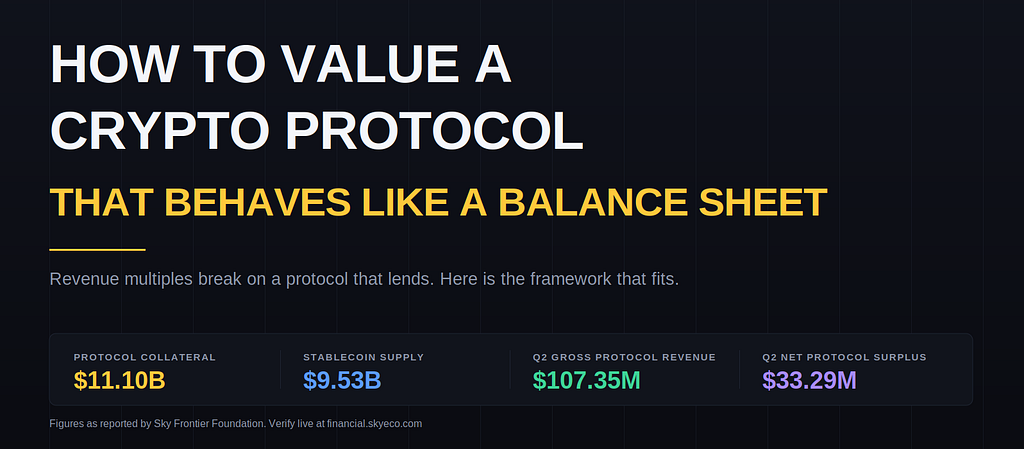
Revenue multiples break on a protocol that lends. Here is the framework that actually fits.
Sky Protocol reports like a lender, not a software company. Figures as published by Sky Frontier Foundation.
On September 23, 2026, a Nasdaq-listed company moved $100 million of its own treasury cash into a stablecoin that pays a yield.
Not a grant. Not an incentive. Corporate cash, on a public company’s books.
Galaxy Digital added $100 million of sUSDS to its corporate treasury and approved the same token as eligible collateral across a trading business carrying a $1.4 billion average loan book. Clients who post it keep earning the savings rate on the full position.
Which raises a question almost nobody answers well.
What is the thing producing that rate actually worth?
Most people reach for a revenue multiple. On a protocol built like this, that is the wrong tool.
Why Does the Standard Crypto Valuation Playbook Break Here?
The default method is simple. Find protocol revenue. Divide market cap by it. Compare peers.
That works for an exchange or a launchpad. Fees come in, fees go out, nothing stays on the books.
A protocol that issues a stablecoin against collateral is a different animal. It holds collateral. It carries liabilities. It absorbs losses first. The income statement is a consequence of the balance sheet, not a substitute for it.
Independent research has been blunt about the gap. Six major protocols, Sky Protocol among them, generated $726 million in revenue in the first half of 2026. Most of their token prices fell anyway.
That link is not loose because the revenue is fake. It is loose because revenue says nothing about solvency, reserve depth, or who holds a claim on what is left.
So start somewhere else.
What Does It Mean for a Crypto Protocol to Behave Like a Balance Sheet?
Three lines. That is the entire idea.
Assets. Protocol Collateral, meaning everything backing the stablecoin. $11.10B at the August 2026 close, up 18.2% year over year.Liabilities. Total stablecoin supply of $9.53B, the claims outstanding against that collateral.Equity. Sky Reserves, the buffer that takes a loss before holders feel one.
The gap between the first two lines is roughly $1.57 billion of collateral sitting above the supply it backs.
Worth saying plainly: Sky Protocol is not a bank and never holds your funds. Users keep control of their assets throughout. But the accounting shape is familiar, and that shape is what you price.
Assets, liabilities, and the cushion between them. The gap is the first thing a credit analyst looks at.If you can read a lender’s books, you can read this one. The difference is that every line here updates in public, block by block.
How Do You Value Protocol Revenue When the Income Is a Spread?
Sky Protocol runs a spread business. Independent capital allocators in the Sky Agent Network borrow USDS at a governance-set Base Rate, deploy it across their own strategies, and pay that rate back through a monthly settlement cycle.
Sky Governance then sets the Sky Savings Rate against total protocol revenue and reserve targets.
Holders of sUSDS receive it, and the position compounds without a claim button or a lockup.
The margin between what allocators pay and what savers receive is roughly 0.3%. Most of it funds distribution. A sliver is retained.
Thin on paper. At this scale, not thin at all:
Q1 2026: $123.79M Gross Protocol Revenue, $46.04M Net Protocol SurplusQ2 2026: $107.35M Gross Protocol Revenue, $33.29M Net Protocol Surplus, the fifth consecutive positive quarter
Two things jump out. Gross revenue fell quarter over quarter. The surplus margin fell harder, from 37.2% to 31.0%, as expenses grew alongside sUSDS.
A revenue multiple would have shown you neither.
What Sky Protocol earned versus what it kept. Margin compression is the story the top line hides.
Which Four Numbers Actually Decide a Stablecoin Protocol’s Value?
When you price something shaped like this, four things carry the weight:
Collateral coverage. How much sits above the liability, and what it is made of.Reserve adequacy. How much loss the equity line absorbs before holders are touched.Revenue durability. Whether the spread is structural or a gift from one rate cycle.Distribution policy. Where surplus goes, and whether the token has any claim on it at all.
Skip one and your model quietly stops working.
What Happened When a Rating Agency Read the Books?
In August 2025, S&P Global assigned Sky Protocol a B- issuer credit rating, the first credit rating ever issued to a DeFi protocol.
The agency did not hand out compliments. It flagged holder concentration, low governance turnout, and a risk-adjusted capital ratio of roughly 0.4%. Thin equity, in plain language.
What happened next is the part worth studying.
Sky Governance voted in March 2026 to redirect the majority of surplus into reserves and set a $150 million Solvency Reserve target. The rebuild has run in public ever since:
Q2 2026 close: $82.40MAugust 30, 2026: $93.53MAugust close: $76.99M, after a $16M Genesis Capital transfer moved funds outside the reserve perimeter with no protocol expense incurred
Roughly half the target. You can watch the balance move on the Sky Ecosystem financial dashboard.
The equity line, rebuilt in the open. Crossing $150M automatically changes how surplus is split.An outside party named a weakness. Governance answered with a rule. The rule is being executed somewhere anyone can check it. That sequence is the signal, not the rating letter.
Where Does the Surplus Go, and Does the Token Capture Any of It?
This is the question most valuation posts skip. It decides everything.
On August 13, 2026, Sky Governance ratified Stage 2 of its capital management framework. Every settlement cycle now splits Net Protocol Surplus:
22.5% to SKY buybacks funding Staking Rewards22.5% to USDS Staking Rewards5% to SKY buy and burnUp to 50% to the Surplus Buffer
That last 5% matters more than its size suggests. For the first time in years, protocol income permanently removes SKY from circulation.
Daily open-market buybacks roughly doubled through August, from about $38,000 a day to around $73,000. Around 74% of circulating SKY was staked at month-end.
The surplus waterfall, written down before the money arrives. Reserves first, holders second.
Once reserves cross $150 million, the buyback share scales up on its own. A distribution rule fixed in advance is rarer than it should be.
Who Is Actually Holding the Collateral Behind USDS?
Diversification is a claim. Counterparties are a fact.
As of September 1, 2026, Sky Agents held roughly $1.23B with Janus Henderson, $618.32M with BlackRock, $304M with Galaxy, $239.60M in PayPal USD, $220M with Anchorage, and $103.11M with Securitize.
Token Terminal data from August 21 placed Sky Protocol at $4.6B in tokenized funds, the largest single share of a $34.4B category, ahead of Securitize, Circle, Franklin Templeton, and Ondo Finance.
Named counterparties, published at token level. Galaxy went from $27M at the Q2 close to roughly $304M.
For context, the value of onchain real-world assets excluding stablecoins passed $33 billion in July 2026, roughly four times its level in early 2025. This kind of collateral base is not an outlier any more.
So How Do You Value a Crypto Protocol Like This? Five Steps
Read the collateral, not the headline TVL. Composition beats size every time.Divide equity by liabilities. That single ratio is your loss buffer.Use net surplus, not gross revenue. Then check whether the margin is widening or compressing.Read the distribution rule before you price the token. No claim, no value capture.Benchmark against lenders, not software. A spread business does not earn a SaaS multiple.
Run that on public numbers. SKY’s market cap sat near $1.44 billion in September 2026, against gross protocol revenue running in the hundreds of millions on an annualized basis.
Traditional software changes hands at 10x to 20x sales. Several onchain protocols with real fee income change hands at 1x to 4x.
Whether that gap is a mispricing or a fair discount for governance concentration and regulatory risk is the real argument. The numbers above are enough to form your own view.
Nothing here is financial advice, and every figure moves.
Price the balance sheet first. The income statement is just what the balance sheet did last quarter.
Your Turn: Two Questions for the Comments
Which line do you weigh most heavily: collateral coverage, reserve adequacy, or distribution policy?At what reserve level would you stop discounting a protocol like this for capital thinness?
Every figure here can be checked against the Q2 2026 Quarterly Report and the live dashboards. If one is wrong, say so in the comments and I will correct it.
The rate this whole structure produces is displayed live on skyeco.com.
How to Value a Crypto Protocol That Behaves Like a Balance Sheet was originally published in Coinmonks on Medium, where people are continuing the conversation by highlighting and responding to this story.