
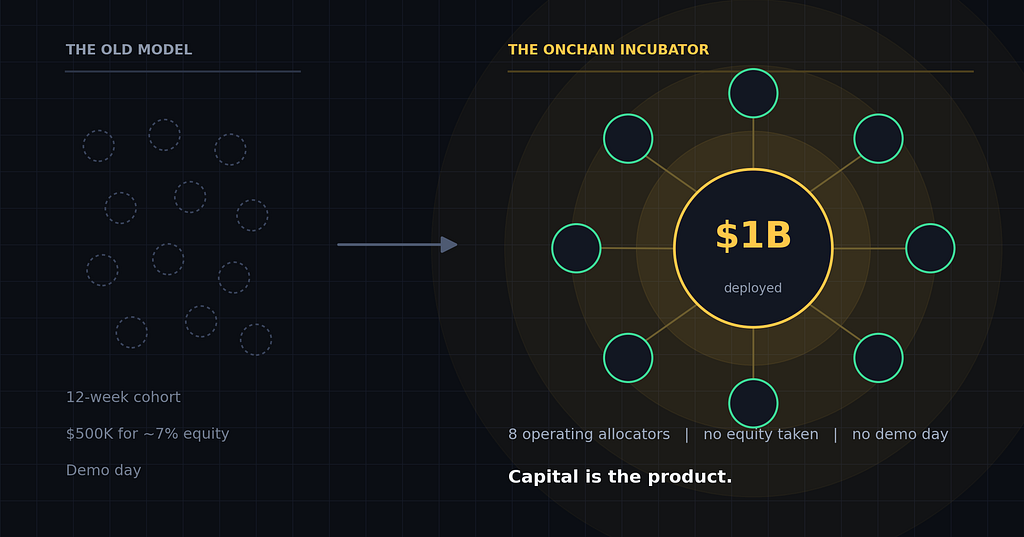
Eight companies. One billion dollars. No demo day.
The unit of support changed. That is the whole story.
In March 2026, a crypto incubator wrote a cheque for $1 billion.
No demo day. No pitch competition. No 7% of a cap table traded for advice and a Slack channel.
Just eight operating companies, and a mandate to push stablecoin capital into mortgages, rooftop solar, AI data centres and structured credit.
If your mental picture of a crypto incubator is still twelve weeks and a Zoom demo day, this one will feel odd.
That is the whole point.
What is a crypto incubator, and how is it different from a crypto accelerator?
An incubator joins earlier and stays longer. An accelerator runs a fixed cohort and ends with a demo day.
The standard setup across blockchain incubator and Web3 accelerator programs in 2026 looks like this:
Accelerators run three to six month cohorts, with a curriculum and a demo day at the endIncubators work with earlier ideas, over a longer and looser timelineBoth usually take equity, a token allocation, or botha16z CSX and Alliance DAO both write around $500K; Techstars Web3 writes $120K for 6%Alliance DAO alone reportedly reviews more than 1,700 applications per cohort
It is a good model. It was never built for companies that already have customers, revenue, and a balance sheet problem.
Same word, completely different product.
Why did the crypto accelerator model stop working?
Because the bottleneck moved.
A founder in 2021 needed introductions and a first cheque. An operator in 2026 needs deployable capital, and a lot of it.
The crypto VC funding data shows the squeeze clearly:
Crypto venture funding reached $4.04B in Q1 2026, less than half of what each individual quarter of 2025 raisedThere were 385 disclosed rounds by mid-2026, against 1,646 across the whole of 2025Monthly fundraising fell from roughly $3.84B in October 2025 to about $662M by April 2026
Deal count fell faster than deal value, which tells you something specific. Investors did not stop writing cheques. They stopped writing so many of them, and concentrated what was left into fewer names.
Capital did not leave crypto. It stopped spreading itself thin.Two charts, one message. Fewer deals, bigger cheques, higher bar.
Meanwhile, the money founders actually wanted was sitting still. Total stablecoin market cap sat near $303B in September 2026, and most of that supply earns its holder nothing at all.
So you have two piles. One is idle stablecoin capital. The other is companies that know how to put capital to work. The incubator became the bridge between them.
What does an onchain crypto incubator actually do differently?
It lends instead of buying equity.
Obex is the incubator that sits inside the Sky Agent Network. The shape of it:
Raised $37M in November 2025, in a round led by Framework Ventures, LayerZero and Sky EcosystemSky Governance authorised up to $2.5B in USDS for deployment through itRuns a twelve week programme out of San Francisco, administered by Framework VenturesDeployed up to $1B across its first cohort on 25 March 2026
Sky Ecosystem described that cohort as the largest single capital deployment from a decentralised protocol into a coordinated group of capital allocators. Six sectors entered the network for the first time on the same day.
Four things break from the accelerator playbook:
The product is capital, not mentorshipThe participants are operating businesses, not seed-stage teamsCapital is borrowed under risk parameters set by governance and published onchainGraduation means becoming an independent capital allocator in the network, not raising a Series A
Nobody buys a slice of anyone’s company. Each allocator pays a Base Rate on the capital it draws, settled onchain every month. That is the fee. That is the whole commercial relationship.
Who is in the first onchain crypto incubator cohort?
Eight allocators, spanning sectors that had never touched the network before.
Mortgages, solar, AI compute, structured credit. Not a testnet among them.
A few worth knowing:
Better (NASDAQ: BETR) runs a $500M mortgage credit facility, and is the first publicly listed US company to deploy capital as a Sky AgentUSD.ai finances AI compute hardware housed in insured data centresDaylight turns residential solar and battery subscriptions into an onchain yield sourceRiver is already transitioning to standalone agent status, which makes the graduation path more than a slide in a deck
Parker Edwards of Framework Ventures put the thesis plainly at launch: the industry is moving away from circular DeFi yield, toward yield from fintech lending, energy infrastructure, AI capital expenditure and real estate.
No 2021 accelerator was writing sentences like that.
There is a second obligation that rarely gets mentioned. Cohort members also commit to launching products that use USDS inside their own platforms.
Capital goes out, usage comes back. That two-way flow is what separates this from a plain credit line.
For scale, the agents already inside the network are not small. Spark has scaled to roughly $5.1B in total value locked.
Grove reached about $1.97B and executed a $50M tokenised CLO with Galaxy Digital, one of the first deals of its kind in DeFi.
Where does the money come from, and how does it reach sUSDS holders?
The rate is not a marketing number. It is paid out of this.
It starts as USDS and ends as a rate.
The loop has four steps:
USDS is the fully backed unit of account, convertible 1:1 through the Peg Stability ModuleCapital allocators borrow USDS and pay a Base Rate on everything they deployThat revenue accrues to Sky Protocol, alongside Stability Fees and other protocol-level fee flowsSky Governance sets the Sky Savings Rate against that revenue, and holders access it through sUSDS, the world’s largest yield-generating stablecoin
sUSDS auto-compounds. No lockups. No exit fee. Convertible back to USDS whenever you want.
That design is why it keeps winning share. In April 2026, Coinbase completed the migration of DAI to USDS, the largest stablecoin migration recorded to date.
At the time of writing, skyeco.com shows the Sky Savings Rate at 3.52% APY, with $14.15B in total Protocol Collateral standing behind $11.48B in stablecoin supply.
The rate is variable and set by governance, and every figure is verifiable on the public financial dashboard.
The demand side is moving too. In Q1 2026, yield-bearing stablecoins contributed more than half of the entire category’s net supply growth.
sUSDS alone added over $2.5B, more new capital than the next four yield-bearing tokens combined.
Sky Protocol then posted $107.35M in Gross Protocol Revenue in Q2 2026, a second consecutive quarter above $100M, on an annualised run-rate of $429.4M.
What happens if an incubated allocator fails?
Losses are absorbed in a fixed order, decided before anything goes wrong.
Four layers, in order, written down in advance.
Two details matter more than the diagram:
Every allocator posts its own risk capital, sized by asset class using a Basel III (CRR) method. Underperform, and you hold more capital before you can draw more USDS.sUSDS holders access the Sky Savings Rate. They are not a claimant on any single allocator, pool, or strategy.That distinction is structural, and it is the part most people get backwards.
On track record: the core protocol has recorded zero exploits across seven years of operations, and S&P Global assigned it a B- rating in 2024, the first structured finance credit rating given to an onchain protocol.
Is the onchain crypto incubator model here to stay?
The direction of travel says yes.
Tokenised real-world assets tripled to roughly $26B in a year, with RedStone projecting $50B to $60B by the end of 2026Sky Frontier Foundation introduced Laniakea in its Q2 2026 report, a framework for standardising how capital allocators plug inThe graduation path has its first live candidate in RiverThe old accelerator sold access. The onchain incubator sells capacity.
In a market where money has turned selective and competent operators are the scarce resource, capacity is worth considerably more than a demo day slot.
If you want the full mechanics underneath all of this, the Sky Ecosystem explainer walks through the protocol, the agent network and the rate in one place, and the ecosystem overview maps how the pieces connect.
One honest question to end on
I keep going back and forth on this.
Is a $1B credit facility with no equity taken actually an incubator? Or have we just found a nicer word for wholesale lending with a cohort attached?
I lean toward the former, because the risk framework, the graduation path and the twelve week programme are all doing real incubator work. But I can argue the other side.
Tell me where you think this breaks. I read every comment.
Onchain Incubators: The Crypto Incubator Model That Quietly Replaced the Accelerator was originally published in Coinmonks on Medium, where people are continuing the conversation by highlighting and responding to this story.