
Chain of Thoughts 2026–09–15
The benchmark US yield touched a level it had not printed since before the financial crisis, the S&P closed lower, and bitcoin rose 1.9% — because crypto’s marginal buyer spent Monday watching a whip count instead.
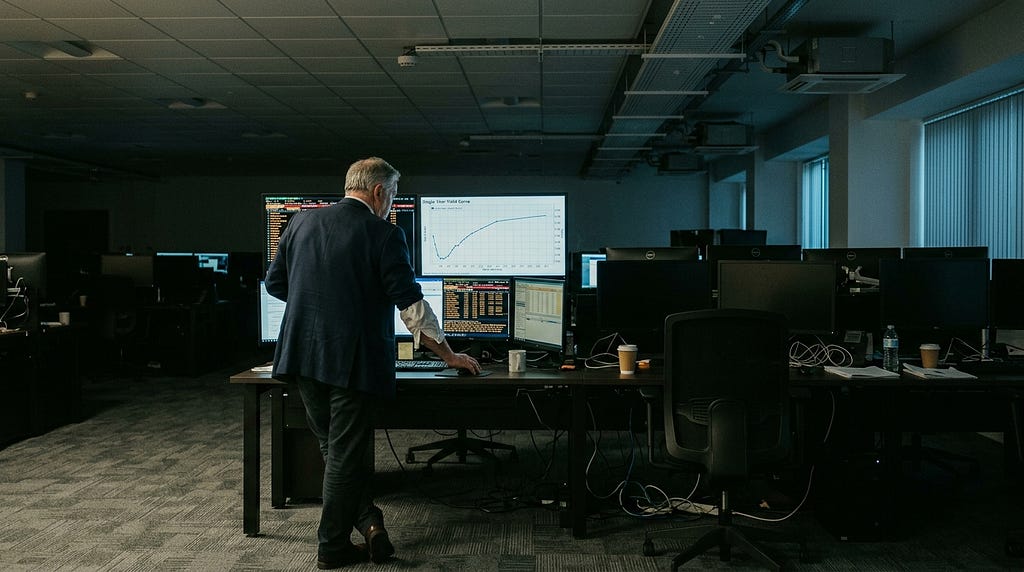
Generated using Nano Banana 2
The Verdict
Bitcoin — short term (3–5 months). $78,684, up 1.89%, the first session with real direction in four. That lifts spot off the floor of the CryptoQuant distribution band and into the middle of it: $77,100–$80,200 is where long-term holders shed as much as 539,000 coins across a 30-day stretch earlier this year, so this is a rally into supply, not away from it. Confirmation is still $81,700 on a daily close, now 3.8% above. Beneath, $70,000–$72,000 is one support zone and $62,000–$65,000 is the shelf where roughly 476,000 coins were accumulated.
Bitcoin — long term (1–3 years). Monday’s bond move was not an inflation move. Yields backed up on supply — swelling government and corporate borrowing needs colliding with a shrinking pool of buyers willing to fund them at these levels. That matters more for bitcoin’s three-year case than any CPI print, because the instrument being repriced is the one that anchors every portfolio’s “safe” allocation. For forty years the term structure was the risk-free leg and everything else was measured against it. If the market is now charging a premium for sovereign issuance volume rather than for expected inflation, the risk-free leg is being re-underwritten as a credit. Bitcoin’s long-run case is a claim on that re-underwriting being permanent rather than cyclical. The honest counter is that 5% was touched and immediately rejected, which is what a functioning bond market looks like, not a failing one.
Ethereum — short term. $2,521.84, up 0.79% — the handle back, and the second-weakest performer on a board where everything was green. ETH underperformed bitcoin by 1.1 points in a week when its own ETFs took in $197 million while bitcoin’s bled $463 million. A fund complex buying while spot lags is a distribution pattern worth watching, not a bullish one. The $2,300 invalidation sits 8.8% below, a cushion that widened by a point.
Ethereum — long term. The institutional pitch for ETH has been the internet bond: a productive asset that pays you to hold it. Monday put a number against that. Bitmine projects $334 million in annual staking revenue on a $15.8 billion treasury #14 — roughly 2.1%, from the largest and most professionalised ETH staking operation in existence. On the same day the ten-year touched 5%. Over three years, an allocator comparing those two lines is taking full price risk on a volatile asset to earn less than half what the sovereign pays for none. The yield did not disappear; it lost the comparison it was sold against. What redeems the case is not the yield — it is whether fee revenue grows fast enough that the yield stops being the reason anyone owns it.
Cardano — short term. $0.2109, up 2.03%, mid-pack on a green board and slightly ahead of bitcoin. A thin book lifting with everything else.
Cardano — long term. Cardano runs one of the highest staking participation rates of any major chain, usually filed as a strength — alignment, security, committed holders. Look at what it describes. A supply overwhelmingly delegated, and comparatively little of it deployed into lending, collateral, or trading, is a supply being held rather than used. The gap between those two numbers is the structural question: delegation pays a yield funded by issuance, deployment generates fees funded by demand. One is a transfer among existing holders, the other is revenue from outside the system. At $7.9 billion of market value, the network is priced off an ecosystem whose activity metrics have not tracked its delegation metrics for years. That gap is the data. What you conclude from it is yours.
Solana. $102.46, up 1.76%, back above $100 with room rather than a decimal. DeFi Development Corp expanded its treasury to 2.39 million SOL and set up a $300 million at-the-market offering for its preferred stock #17 — Strategy’s financing template, now on a third chain.
BNB and XRP. $724.01 (+0.46%) and $1.41 (+4.81%). XRP was the board’s best performer by a wide margin and the cleanest read in the market on what actually moved crypto Monday — it is the major with the most direct exposure to a market-structure bill, and it outpaced bitcoin by 2.9 points. BNB was the worst, a third consecutive session of swinging from one end of the board to the other.
Why The Market Is Here
The ten-year Treasury yield briefly topped 5% on Monday, its highest intraday level since 2007 #1. That is the headline everyone wrote. Here is the part that got less attention: the yield closed at 4.947%, down 0.56% on the day. The 5% print was touched and bought within hours. Both things are true and the reconciliation matters — the last time the ten-year actually crossed 5% was October 2023, and what happened next was a stock rally and yields back in the high 3s within months #2. A level that gets rejected on the day it prints is a level with two-way interest, not a regime change. The equity market treated it accordingly: S&P down 0.21%, Nasdaq down 0.21%. What did move was the price of insurance — VIX up 5.74% to 16.75, giving back half of Friday’s 11% crush inside one session.
The supply-side leg kept compounding underneath all of it. Brent closed at $107.20, up 2.48%, with WTI up 2.69% to $102.74. Saudi Arabia’s East-West pipeline — the kingdom’s only remaining export route with Hormuz closed — is still shut, and it carries up to 5% of global oil supply #3. UK pump prices hit their highest since 2022 #4. And the diesel squeeze has now become explicit policy: Trump is publicly warning Zelenskyy to stop striking Russian refineries, blaming Ukraine’s campaign for the global shortage #5. The food leg fired hardest of all — corn up 4.41% on the session, soybeans 2.15%, wheat 1.91%. None of that is demand.
Then look at what crypto did with its day. Bitcoin up 1.89%, XRP up 4.81%, on a session when equities fell and the long bond touched a nineteen-year high. The catalyst was not macro. Senate Republicans released a revised CLARITY Act with more than 120 changes, and Trump agreed to permanent conflict-of-interest restrictions covering every federally elected official, judge, and their spouses — enforceable by state attorneys general #6. The prediction markets repriced immediately: Polymarket from 14% to 30%, Kalshi from 18% to 44%, and Galaxy’s Alex Thorn lifted his 2026 passage odds from 10% to 25% #7. Bernstein’s read going in was that the market carried a bearish bias and “any positive surprise is definitely not priced in” #10.
Here is what that sequence measures. Yesterday this digest argued crypto is a policy-risk asset with a legislative window shorter than its pricing implies. Monday confirmed it — by going up. A fifteen-point move in one bill’s odds was worth roughly 2% on bitcoin and nearly 5% on XRP, on a day when the largest macro print of the year pushed in the other direction. That is not a bullish datapoint. It is a coefficient. It tells you how much of the price is a bet on one vote, and it tells you the same number applies if the vote goes the other way.
And the vote is genuinely live in both directions. Cloture needs 60; Republicans hold 53, so seven Democrats must cross #8. Against that, seventeen bipartisan state attorneys general led by New York’s Letitia James wrote urging the Senate to reject the bill over federal preemption of state authority #9. Kalshi’s 44% is still a coin flip that pays out to the “no” side more often than not. Crypto spent Monday buying a 30-to-44% probability at what looks like closer to full price — which is the part to hold onto when the vote lands at 2:15pm ET, and again when the Fed speaks the next afternoon #18.
Institutional Pulse
The weekly ETF number resolved with a detail that was not available over the weekend: bitcoin funds shed $462.7 million across four sessions while ether funds took in $196.9 million over exactly the same window #11. ARK led the bitcoin outflows at $234.2 million, Grayscale $129.1 million, BlackRock $52.5 million. Bitcoin ETFs are still net positive for September at roughly $307 million. The rotation is within crypto, not out of it — and XRP and Solana funds pulled in about $3 billion while Dogecoin ETFs struggled to find buyers at all #16.
The corporate bid tells the same story more bluntly. Strategy skipped bitcoin for a second consecutive week, leaving 845,050 coins untouched, and spent $139 million buying back its own STRC preferred instead #12. Strive bought $36.6 million to cross 25,000 BTC, down from $109 million the week before #13. Bitmine went the other way, adding 27,180 ETH to reach 5.96 million #15.
Which gives the OTC point a shape it has not had before. The largest corporate holder of bitcoin has decided, twice now, that its own paper is a better buy than the asset it exists to accumulate. That is a relative-value judgment made by the single most informed buyer in the market, executed at OTC size, and it shows up in flow data as zero — no spot print, no ETF creation, no exchange volume. The capital was real and the demand for the coin was not. When you read that bitcoin ETFs lost $463 million last week, the more useful number is the $139 million that never reached the tape.
Calendar Watch
CLARITY cloture, Sept 15, 2:15pm ET. The count is the event, not the outcome. Seven Democratic crossings clears it.
FOMC, Sept 15–16. Roughly 85% priced for 25bp. The statement language is the variable that matters more than the decision.
Bank of Japan, Sept 16–17. This has been a calendar line for three editions and deserves better today, because the arithmetic is about to get strange. USDJPY is at 154.38, through 154 and weaker on the week. If the Fed hikes Wednesday and the BoJ holds Thursday, the differential widens again — which makes yen funding cheaper relative to dollar returns, not dearer. A hike aimed at tightening financial conditions arrives alongside a carry trade that gets more attractive the moment it lands, and that is not a contradiction the Fed can fix. The number to watch is not the decision. It is whether USDJPY runs at 156 and forces an intervention conversation into the same week as two central bank meetings.
Signals Worth Watching
Monday’s open test — graded, and closed. This digest set a test over the weekend: did crypto price the chokepoint news while it was the only open venue, or wait for the desks? The answer is unambiguous. Crypto moved 0.28% across two weekend sessions holding live geopolitical information, then moved 1.89% the moment US markets opened. Brent gapped 2.48% in the same window. The timing evidence is now three sessions deep and consistent — bitcoin trades around the clock, its marginal owner does not. The test is contaminated for attribution (a crypto-specific catalyst landed the same morning) but clean for timing, and three consistent sessions is where this digest’s own tracking rule says to state the conclusion and stop carrying it. Concluded. Retired.
The cloture count today. Mid-50s and the legislative window is closing, which re-prices Monday’s 2% in reverse. Sixty or better and the policy-risk frame comes off the board for the year.
Wednesday’s statement language. Financial conditions, valuations, froth — any of those in the text confirms a reaction function whose input is the market’s own level, with no data release that switches it off. Inflation expectations and labour slack mean the conventional read still governs.
The 5% that did not hold. The signal is not the touch, it is the close. A daily settle above 5.02% on the ten-year would be the first since July 2007 and would mean the rejection failed. Until then, Monday was a level being defended, not broken.
A data correction, and a retirement. Yesterday this digest reported that Friday’s CME gold settle had been revised up to $4,408.90 from $4,366.20, and reversed the prior day’s conclusion on that basis. A fresh pull now returns $4,366.20 for the same session. The revision did not survive, which means yesterday’s correction was itself wrong and the original reading was closer to right. The useful conclusion is not about gold — it is that the daily settle series is not stable enough within 48 hours to carry an argument. The gold-settle micro-signal is retired. Levels and weekly ranges only from here.
If I Had $100 This Month
A cloture vote at 2:15pm and a rate decision the next afternoon, in a market that just told you exactly how much of its price is riding on the first of those. This is a week where the schedule does the work and the conviction does none of it.
$60 → BTC. Spot is mid-band in the zone where half a million coins were distributed this year, bought on a political catalyst that resolves within a day.$25 → ETH. The fund complex is buying and spot is lagging, which is a divergence to accumulate into slowly rather than to read as a signal.$15 → ADA. A network whose supply is held rather than deployed is a small-position asset until that gap starts closing, and the sizing says so.
Hold actual coins. Not ETF shares, not equity proxies.
This is how I’d think about it. Make your own call.
Sources
#1–10-year Treasury yield briefly tops 5%, hitting its highest level since 2007 — MarketWatch#2–10-year Treasury yield hits 5% for first time since 2023 as traders brace for Fed decision — CNBC#3 — Why Saudi Arabia’s East-West pipeline matters for global oil — Al Jazeera#4 — Petrol and diesel prices hit highest since 2022 — BBC Business#5 — Why is Trump warning Zelenskyy not to hit Russian diesel refineries? — Al Jazeera#6 — Why Trump Backed Tougher Ethics Rules in Clarity Act — Decrypt#7 — Clarity Act odds soar as Trump approves new ethics provisions — Fortune#8 — Clarity Act odds surge on prediction markets, but crypto bill still faces long road — CoinDesk#9 — NY Attorney General James leads bipartisan push against the Clarity Act — The Block#10 — Bernstein sees more Clarity Act progress than markets expected — The Block#11 — Bitcoin ETFs shed $463M in weekly reversal as Ether ETFs gain $197M — FXStreet#12 — Strategy Buys Back $139 Million of STRC, Bitcoin Stack Frozen for Second Week — Decrypt#13 — Strive reaches 25,000 BTC milestone with latest $36.6 million purchase — The Block#14 — Bitmine projects $334M in annual staking revenue from $15.8B crypto treasury — CoinTelegraph#15 — Bitmine adds 27,180 ETH as adviser Tom DeMark sees sharp move in coming weeks — The Block#16 — Dogecoin ETFs struggled for buyers while rival XRP and Solana funds pulled in $3 billion — CoinDesk#17 — DeFi Development Corp expands Solana treasury to 2.39 million SOL — The Block#18 — CLARITY Act vote meets Fed rate hike: Five things to know in Bitcoin this week — CoinTelegraph
Market Data
Asset Price 24h
──────────────────────────────────────
Bitcoin (BTC) $78,684 +1.89%
Ethereum (ETH) $2,521.84 +0.79%
Cardano (ADA) $0.2109 +2.03%
Solana (SOL) $102.46 +1.76%
BNB $724.01 +0.46%
XRP $1.41 +4.81%Fear & Greed: 57 — Greed (was 61 yesterday)
S&P 500: -0.21% · Nasdaq: -0.21% · DXY: 99.46 (+0.35%) · Gold: $4,342 (-0.55%)
Brent: $107.20 (+2.48%) · WTI: $102.74 (+2.69%)
US 10Y: 4.947% (-0.56%, intraday high >5.00%) · US 30Y: 5.321% · VIX: 16.75 (+5.74%)
USDJPY: 154.38
Grains: corn +4.41% · soybeans +2.15% · wheat +1.91%Data note: a fresh pull returns Friday Sep 11’s CME gold settle as $4,366.20,
not the $4,408.90 revision reported here yesterday. See Signals. Fear & Greed
fell 4 points on a session when every major closed green.
Chain of Thought is a daily crypto and macro market digest. Not financial advice.
Five Percent on the Ten-Year, Sixty Votes in the Senate was originally published in Coinmonks on Medium, where people are continuing the conversation by highlighting and responding to this story.