
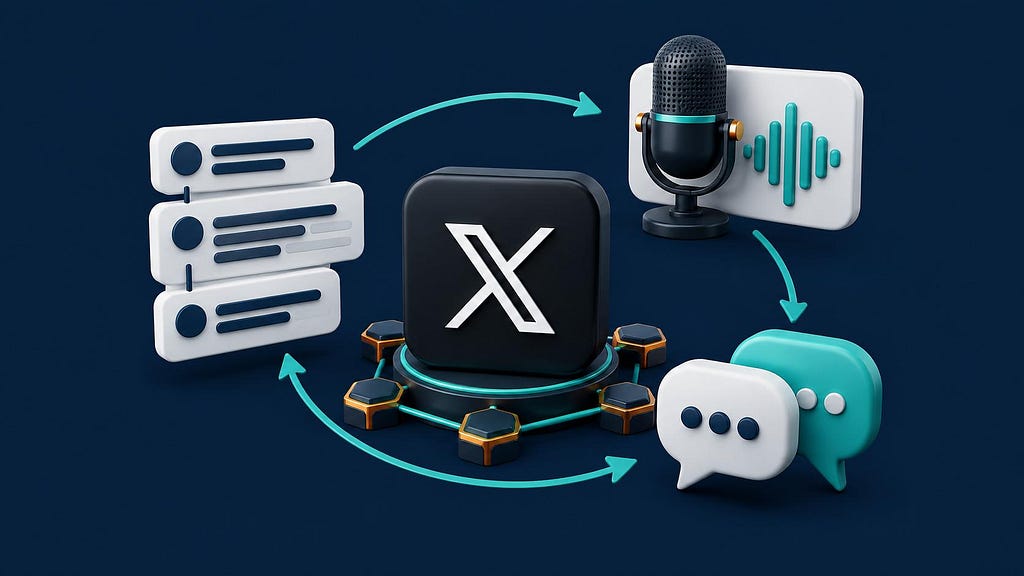
Creation by Vimal Joseph Using Flow and Photoshop
Most crypto accounts publish into a vacuum. A thread collects impressions and three replies from anonymous accounts. A Space shows four hundred listeners and produces no follow-up. Replies stack up under large accounts, and nobody remembers who wrote them.
The audience math explains part of the frustration. Pew Research Center, surveying 8,512 US adults in January 2026, found that about 19% had ever invested in, traded or used cryptocurrency. Use clustered among men aged 18 to 49, at 38% and 40% by age band, and fell to 10% among adults aged 50 and over. Your buyers, builders and contributors are a small, identifiable group. Volume aimed at everyone reaches almost none of them.
Reporting adds a second problem. X’s own Spaces documentation states that listener counts “may not match the actual number of listeners,” so the number you screenshot for a founder update is an estimate, not a headcount.
The useful question is not how to post more. It is how to make each format feed the next.
Decide whom the account serves before deciding what to post
Positioning on X is narrower than a brand statement. It is a promise about which questions you answer better than anyone else.
Three decisions make the rest of the work easier:
Name one primary reader. A solo developer integrating your SDK is not the same reader as an allocator sizing a position. Write for one and let the others listen in.List the eight questions you keep answering. Pull them from support tickets, Discord, investor calls and your own replies. That list becomes your content calendar for a quarter.Name the evidence only you hold. Contract data, node telemetry, audit findings, failed experiments, fee history. Opinion is abundant in crypto. First-hand data is not.
An account without these three answers produces posts that could belong to any project. That is the root cause of most inconsistent crypto feeds, not posting frequency.
Thread strategy: turn recurring questions into structured answers
A thread earns its length when it explains something a single post cannot. Good candidates are questions you have already answered three or more times in replies.
Topic selection. Prioritize explanations that stay true for months: how a mechanism works, what a parameter change does to user costs, what a risk actually is. Reserve announcements for single posts.
The opening post. State the claim and the reader in one or two lines. “Our sequencer costs dropped 38% after the blob change. Here is what that means for teams paying gas on our chain” tells a reader whether to continue. Curiosity bait tells them nothing.
Structure. One idea per post. Put evidence directly beside the claim it supports, ideally as a screenshot of a block explorer, dashboard or governance forum, with the source named in the text. Close with what you do not yet know.
Calls to action. Point to the next useful thing, such as documentation, a governance proposal or an upcoming Space. Asking for follows converts poorly and signals nothing to a technical reader.
For explanations that outgrow a thread, X offers Articles, which its help documentation limits to Premium and Premium+ subscribers, Premium Businesses and Premium Organizations, with published pieces appearing on an Articles tab on your profile.
Illustrative thread outline (hypothetical)
For a liquid staking protocol publishing its slashing policy:
Claim and reader: what changed in the validator set and who is affected.The old policy in two sentences.The new policy, with the specific parameter and its value.Screenshot of the governance vote and its result, named and dated.Worked example: what a 32 ETH position experiences under each policy.The honest limitation: what the policy does not cover.Where to read the full spec and when the next Space discusses it.
Adapt the shape, not the topic. Claim, mechanism, evidence, worked example, limitation, next step.
Spaces strategy: use live audio for what threads cannot settle
Spaces are for disagreement, nuance and unscripted questions. If a Space could have been a thread, publish the thread.
Per X’s Spaces documentation, up to 13 people can speak at once, including the host and up to two co-hosts, listeners are uncapped, and hosts can schedule a Space up to 30 days in advance with a maximum of 10 scheduled at a time. Captions are not currently available, which matters if accessibility or non-native listeners are part of your audience.
Guests. Invite people who will disagree with you on something specific. A researcher who has published a critique of your design is worth more than three friendly founders.
Preparation. Write five questions and send them to guests beforehand. Assign one co-host to moderate and one person to capture questions in a document as they arrive.
Moderation. Open with a 90-second framing, not a founder monologue. Cut promotional tangents quickly. Bring listeners up as speakers only when they have a question, not to fill airtime.
Follow-up. This is where most teams lose the value. Within 24 hours, post a recap with the replay link, then reply individually to the accounts that asked questions.
Repurposing. Each unanswered question becomes a reply, a thread or a documentation page. Agencies working with token teams describe the same coordination: Blockchain App Factory, for example, publicly frames its Crypto Twitter work as launch threads, reply-led engagement and Spaces operating together rather than as separate deliverables.
Sample 45-minute agenda (suggested timings)
Creation by Vimal Joseph Using Flow and Photoshop
Reply strategy: where relevance actually gets built
Replies are the cheapest way to become familiar to people who matter, and the easiest place to waste an hour a day.
X publishes how conversations are ordered. Its recommender systems documentation says replies are shown in this order: replies from accounts the viewer follows and replies the original post’s author has replied to, then verified accounts, then everyone else, with machine-learned scoring inside each group. The practical reading is narrow but useful. A reply that prompts the author to respond sits in a better position than one that does not. That is a placement effect, not a growth guarantee.
Finding conversations. Keep a private list of 40 to 60 accounts: researchers, competing protocol leads, auditors, journalists covering your sector, active governance delegates. Check it twice a day. Search your protocol’s name and your category’s recurring problem terms.
Contributing. A strong reply adds one of three things: an observation the author did not have, evidence they can check, or a question that sharpens the thread.
Three replies, weaker and stronger
Creation by Vimal Joseph Using Flow and Photoshop
Notice what the stronger versions avoid: no engagement bait, no token pitch, no repeated link. Unsolicited shilling under someone else’s post is the fastest way to get muted by exactly the accounts you want.
Connecting the three formats
One question can run the whole system.
A developer asks in a reply why your withdrawals take longer than a competitor’s. You answer in-thread that day. The same question appears twice more that week, so it becomes a thread with a worked example and a screenshot of the challenge window. Two of the accounts who engaged with that thread join a Space where an auditor argues the window is too short. Their objection produces three new questions, which become next week’s replies and the month’s documentation update.
What accumulates is not reach. It is a growing store of answers, a set of people who recognize your account, and material you can reuse.
A weekly rhythm for a small team (recommendation, not a benchmark)
Daily, 30 to 45 minutes: replies from your curated list, split between two people.Monday, 45 minutes: collect the week’s recurring questions into a shared list.Tuesday: publish one thread answering the most repeated question.Every other Wednesday: host a 45-minute Space.Thursday: recap post plus individual replies to everyone who asked a question live.Friday, 30 minutes: review which questions repeated and which replies drew author responses.
Treat the volumes as a starting allocation. Adjust them against your own results rather than against published posting rules.
Measurement: separate attention from relationships and business outcomes
Check what each metric can actually support before you put it in a report.
Creation by Vimal Joseph Using Flow and Photoshop
Two limits deserve stating plainly to stakeholders. First, X’s own non-public metrics expire after 30 days, so unexported history disappears. Second, a click is a click. It does not prove wallet ownership, token purchase or product adoption, and wallet connections cannot be reliably tied back to a social identity without consent-based identifiers.
The most useful weekly review question is not “what performed.” It is “which questions did we hear twice, and which accounts came back.”
Common mistakes
Inconsistent positioning. The account answers DeFi questions one week and posts market commentary the next. Readers stop knowing what they follow you for.Disconnected formats. Threads, Spaces and replies run on separate calendars, so nothing accumulates.Irrelevant guests. Booking large accounts for reach rather than people your reader would actually learn from.Empty replies. Compliments and emoji add nothing and train people to scroll past your name.Premature promotion. Pitching before you have answered anything reads as extraction.Reporting impressions alone. Impressions rise with reposts from accounts you will never sell to.
Where to start this week
Open your replies from the past month and write down every question you answered more than once. Pick the one that took longest to explain. Publish that as a thread on Tuesday, then schedule a Space two weeks out with one guest who disagrees with your answer. That single loop, repeated, is the whole method.
FAQs
How often should we publish threads?
One well-evidenced thread a week is a reasonable starting point for a small team. Frequency matters less than whether each thread answers a question your audience actually asked.
Are Spaces worth hosting with small attendance?
They can be, if the right 20 people attend. Judge a Space by the questions it produces and the follow-up conversations it starts, keeping in mind that X says listener counts are approximate.
Can replies alone grow a new account?
Replies build familiarity and relationships, which is different from growth. X’s documentation shows reply placement is influenced by follow relationships and author responses, so consistent, useful replies improve your visibility inside conversations without guaranteeing followers.
How do we connect X activity to product usage?
Use UTM parameters on every link, track qualified visits and downstream signups in your own analytics, and record named accounts and returning attendees manually. Accept that attribution stops at the visit; on-chain behavior cannot be matched to social identity without consent.
Should the founder or the brand account reply?
Usually the founder or a named engineer. Technical audiences respond to people with accountable opinions. The brand account can carry announcements, documentation and Space scheduling.
Crypto Twitter (X) Growth: Threads, Spaces and Reply Strategy That Compound was originally published in Coinmonks on Medium, where people are continuing the conversation by highlighting and responding to this story.