
Pontes went live today, 21 September 2026. It’s the least glamorous digital euro story you’ll read this year, and probably the most important.
Everyone hears “digital euro” and pictures a phone, a café counter, a little beep.
Today’s news isn’t that.
This morning the European Central Bank launched Pontes. The name is Latin for “bridges,” which is a nice touch for something so dry. It’s built for banks and market infrastructure. You can’t download it, and you won’t have a wallet. If you’re a regular person, it will never show up on your screen.
I still think it’s the bigger story. Let me show you why.
So what does it do?
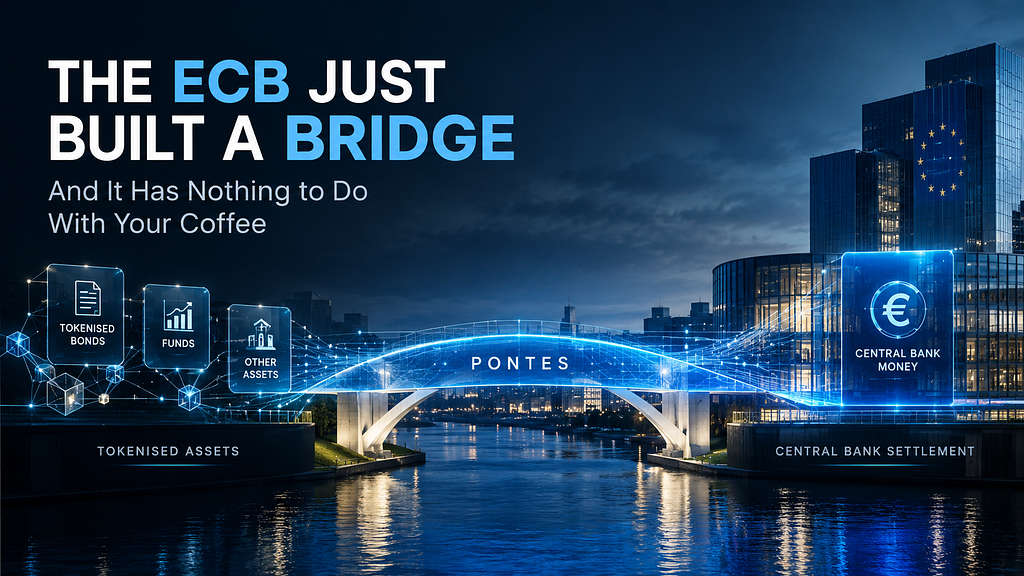
Some financial firms are now running platforms on distributed ledger technology, which is the blockchain family of tech. They use it to issue and trade tokenised things: bonds, funds, that sort of asset. Pontes connects those platforms to TARGET Services, the ECB’s existing payment system.
The point is that when a tokenised bond trades, the cash side can settle in central bank money. Actual ECB money. Not a stablecoin, not a bank’s own token.
That’s the entire trick. It sounds tiny. It isn’t.
Image Generated by ChatGpt
The part people skip over
Tokenising an asset is the easy bit. Plenty of people have done it, and the demos look great. The asset moves in seconds, it can carry rules inside it, and it can update itself.
Then someone has to pay for it.
If the payment still lives in an older system, or in a private settlement asset, you’ve made half of a fast trade. It’s like building a motorway that ends at a level crossing. The Eurosystem says it plainly: tokenised securities still need a trusted settlement asset for the cash leg. Pontes is its answer, and the answer is to keep central bank money in the middle of everything and let the new tech plug into it.
I think that’s a smart move. It’s also a defensive one, and I’d be lying if I said otherwise. The ECB clearly doesn’t want stablecoins and private tokens to become the default way Europe settles its big trades. Pontes is a way to stay relevant.
Who showed up
The names attached to the launch are not small. Deutsche Bank, Santander, Société Générale, the EIB, KfW and Clearstream are among those that have finished onboarding, plus other institutions and DLT operators.
I pay attention to that list more than to any speech. Banks this size don’t wire themselves into new infrastructure because it’s fashionable. It takes months of legal, compliance and tech work. They do it when they expect to use the thing.
And this isn’t a cold start. An ECB presentation from earlier this year said the Eurosystem’s wholesale tokenisation trials had settled close to €1.6 billion across 64 market participants. Pontes is the first properly live version of work that’s been going on for a while.
Let’s not get carried away
I’ve seen a few posts today that read like the old system is already dead. It isn’t.
Pontes is starting as a limited pilot, with restricted operating hours. The ECB is still finalising who and what can join, meaning which assets, which participants and which DLT operators. More features and longer hours will arrive in stages, and full implementation is expected around 2028.
So nobody is moving trillions onto blockchains next week. If someone tells you that, ask what they’re selling.
And one more thing, because people keep blurring these together. Pontes is not the retail digital euro. That one is a separate project, still waiting on EU legislation. A pilot is planned for the second half of 2027, and if everything goes through, the first issuance could come around 2029. Different audience, different timeline, different fight.
Why should a fintech person care?
For years the tokenisation question has been “can we tokenise this?” And yes. We can. That question got answered a while ago.
The one that’s left is harder: what infrastructure will let tokenised assets move, settle and scale?
That’s the real bottleneck if you’re building anything here. A bank wants to know the settlement is trustworthy before it commits real volume. A fintech wants to know which rails will exist in five years, so it doesn’t build on something that quietly disappears. A developer wants a fixed point to design against. Pontes is that fixed point, or at least the start of one.
The promise of all this is markets that are faster, more connected, more programmable and more efficient. Maybe. That promise stands or falls on settlement, and nothing else in the stack matters as much.
The bigger shift
Think about what fintech has mostly been so far. Paper forms became web forms. Branches became apps. We took the same processes and gave them nicer screens.
What’s starting now looks different to me. It’s about rebuilding the plumbing so that assets and money can be programmable from the beginning. Pontes is one of the first places where a central bank has put its own money into that picture.
There’s no viral moment in it. Infrastructure almost never has one. You only notice it years later, when everything runs on it and nobody remembers the old way.
What I’ll be watching
Four things, in no special order:
The eligibility rules, because who gets in decides how useful this is. The operating hours, since round-the-clock settlement is the real test. The volumes, because trial money and live money are very different animals. And Appia, the ECB’s longer-term wholesale tokenisation programme, which will shape where Pontes goes next.
One last thing
The most important financial news is often the least exciting to look at. Pontes won’t change how you pay for coffee. It might change how the institutions holding your savings and pension settle their trades.
That’s a bigger story than a wallet app, even if it makes a worse thumbnail.
If you want plain-English takes on fintech, tokenisation and the digital euro, follow along. I’ll keep them short.
The ECB Just Built a Bridge, and It Has Nothing to Do With Your Coffee was originally published in Coinmonks on Medium, where people are continuing the conversation by highlighting and responding to this story.