
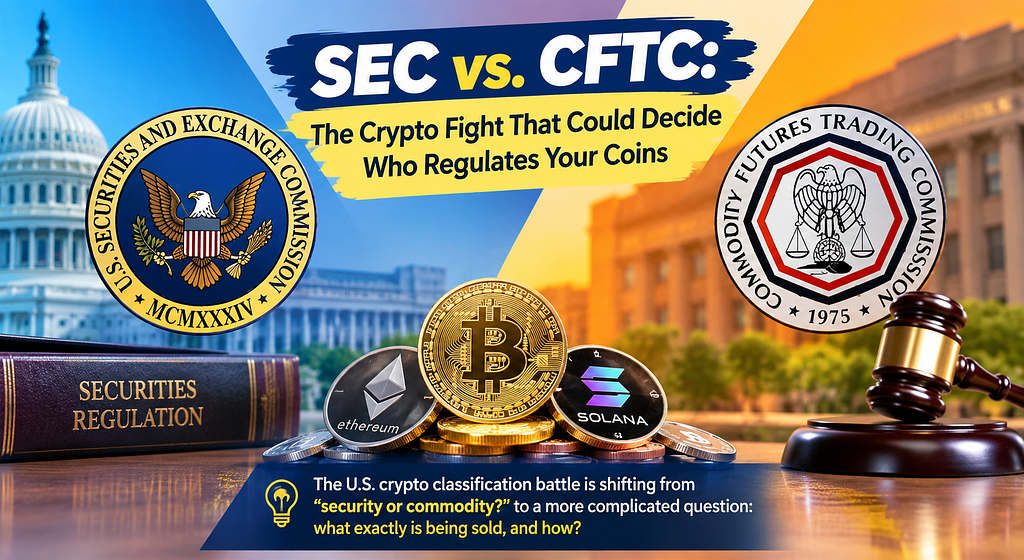
SEC vs. CFTC: The Crypto Fight That Could Decide Who Regulates Your Coins
Forget “Security or Commodity.” That’s Not Even the Right Question Anymore
Image Is Generated By ChatGPT
For years, everyone arguing about U.S. crypto law kept circling back to the same binary:
is this token a security, or is it a commodity?
Pick one.
Lawyers built entire careers on that question. Companies got sued over it. Billions of dollars in market value swung on how a judge felt about it on a given Tuesday.
Except by 2026, that framing has basically stopped making sense.
The SEC and CFTC have quietly moved past it. Not by resolving the old fight, but by admitting it was the wrong fight to begin with.
The real question, they’re now saying, isn’t what a token is, it’s what’s actually happening when someone sells it.
Why two agencies keep fighting over the same coins
The SEC does securities. The CFTC does derivatives, futures, options, swaps, that kind of thing. On paper, that’s a clean division of labor.
Then crypto shows up and ruins it.
Bitcoin’s been treated as a commodity for a while now under the Commodity Exchange Act. The CFTC has authority over derivatives tied to it, but when it comes to the actual spot market, people just buying and holding BTC, its reach is a lot thinner. Mostly it can go after fraud and manipulation, not much else.
The SEC comes at things from a completely different angle, using the old Howey test: money in, common enterprise, profits expected from someone else’s effort. If a crypto deal checks those boxes, the SEC says it’s playing in securities territory.
Here’s the part that trips people up: just because a token gets used in something that looks like an investment contract doesn’t mean the token itself is a security. The transaction and the asset aren’t the same thing. Everybody used to talk about them like they were.
Ripple is the case that blew this whole thing open
If you want to understand why “is XRP a security” turned into such a mess, look at SEC v. Ripple. Judge Analisa Torres split the baby in a way nobody fully saw coming: sales of XRP to institutional investors?
Those looked like investment contracts. But the programmatic sales happening on exchanges, where buyers had no idea who was on the other end? Those didn’t hold up the same way under Howey.
Same token. Same company. Two totally different legal outcomes depending on how the sale actually happened.
That’s the moment the industry realized the old “just tell me if it’s a security” question was never going to give a clean answer.
The Terraform Labs case, the one that ended badly for Do Kwon, pointed in the same direction. Courts aren’t grabbing a token and stamping it with a permanent label. They’re digging into the actual economics of each transaction, every time.
March 2026 changed everything
Then came the big one. In March 2026, the SEC dropped an interpretive release laying out how securities law actually applies to crypto and the CFTC followed with its own matching guidance.
Instead of one bucket, they created several: digital commodities, digital collectibles, digital tools, stablecoins, digital securities. Bitcoin, Ether, XRP, Solana, Cardano, Litecoin, all named as examples of digital commodities based on how they function.
Sounds like a clean win for the “not a security” crowd. It isn’t, quite.
Buried in that same release is the catch: even a token that isn’t a security can still be sold in a way that is a securities transaction. The asset and the deal are judged separately. So no, XRP being labeled a commodity doesn’t mean every XRP sale ever is automatically safe from the SEC. It depends on the deal.
What the CFTC actually touches (and what it doesn’t)
People throw around the phrase “CFTC-regulated asset” constantly, and it’s usually wrong.
The CFTC regulates derivatives, futures and options tied to commodities, crypto included. It does not regulate someone buying Bitcoin and sitting on it in a cold wallet the same way it regulates a futures exchange. It can still step in for fraud or manipulation in spot markets, but that’s a narrower lane than most people assume.
Buying Bitcoin and trading a Bitcoin futures contract are, legally speaking, two different animals wearing the same coat.
The SEC isn’t sitting still either
In August 2026, the SEC floated something called “Regulation Crypto Assets”, essentially a custom-built offering framework for certain crypto investment contracts, rather than forcing everything through traditional securities registration.
The proposal carves out exemptions:
offerings up to $5 million over four years, or up to $75 million in a 12-month stretch, with strings attached. There’s also a conditional safe harbor tied to how “investment contract” gets defined.
Worth repeating: this is a proposal, not law. Comments are due October 20, 2026. Don’t treat it like it’s already on the books, because it isn’t yet.
The bigger fight was never “SEC vs. CFTC”
The old debate assumed every crypto asset needed to fit into exactly one box, forever. That assumption was always shaky, and now it’s basically dead.
A token can be a non-security and still get sold through a deal that counts as a security. A digital commodity can sit underneath derivatives that fall squarely under the CFTC. Some products manage to touch both worlds at once, which is exactly the kind of overlap regulators used to pretend didn’t exist.
There’s also a gap nobody loves talking about: historically, no single federal agency had clear authority over spot trading of digital assets that weren’t securities.
The Congressional Research Service has flagged this. Bills like the CLARITY Act are an attempt to hand the CFTC more explicit jurisdiction over digital commodities and patch that hole.
So the real question was never just “SEC or CFTC.” It’s closer to: what’s the asset, what’s the deal, what did the seller promise, what market is this happening in, and which law actually applies to this specific transaction.
Courts aren’t going anywhere
Even with all this new agency guidance, judges still have the final word, regulators can issue all the interpretive releases they want, but they can’t rewrite the statutes Congress passed.
Howey is still the backbone of investment-contract law, and courts keep reinterpreting it as digital-asset structures get weirder and more complex. One ruling on one token sale doesn’t automatically settle how every future sale of that same token gets treated. Crypto keeps innovating faster than the law can keep up, and courts are stuck playing catch-up, case by case.
Where this is actually headed
What’s genuinely interesting here is that the fight is finally outgrowing its old binary shape. The March framework carved out multiple categories instead of one.
The August proposal suggests the SEC is willing to build crypto-specific rules instead of jamming everything into decades-old securities frameworks.
None of this makes the uncertainty go away. It’s still messy. But it’s a more precise kind of messy.
Maybe that’s the actual shift happening in U.S. crypto law right now, regulators and courts finally admitting that “is it a coin or a security” was never the right question. The question was always about the transaction: what got promised, to whom, and under what terms.
Coin used to be the word that mattered most in crypto law.
These days, it might be transaction.
SEC vs. CFTC Crypto Jurisdiction Explained was originally published in Coinmonks on Medium, where people are continuing the conversation by highlighting and responding to this story.