
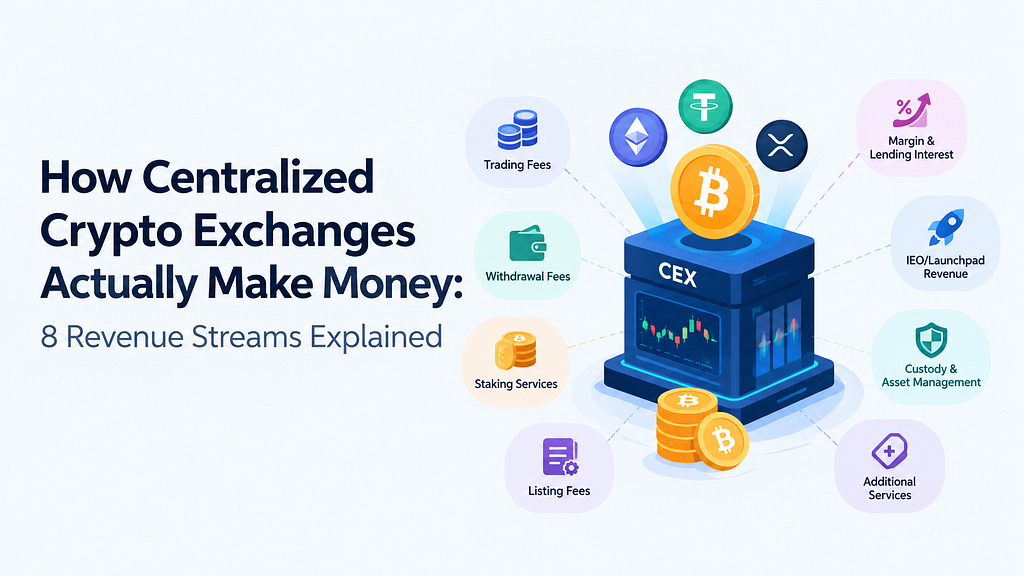
Ever wondered how centralized crypto exchanges make money while running zero fee promotions and free withdrawal days? Most traders assume it all comes down to trading fees. Founders who try to build an exchange learn fast that it runs deeper than that.
A CEX does not need a single revenue source. Many exchanges spread out across trading fees, withdrawal charges, listing fees, margin interest, derivatives commissions, staking margins, launchpad fees, and premium data services. This piece covers all eight. It also covers what actually decides whether a CEX turns a profit in 2026.
What Is the Business Model of a Centralized Crypto Exchange?
At its core, a CEX offers trading, custody, and liquidity. It earns through transaction fees, plus extra services layered on top. Users bring volume. Volume deepens liquidity. Liquidity pulls in serious traders. Those traders bring even more volume. Revenue rides that loop.
Why Do Centralized Exchanges Need Multiple Revenue Streams?
Rules can shift by jurisdiction. Competitors race each other on fees until margins thin out. Trading activity can fall hard in a bear market. None of this is hypothetical. It has already happened to plenty of platforms. Exchanges that lean into lending, derivatives, staking, and data services keep earning even when spot trading goes quiet.
8 Revenue Streams of a Centralized Crypto Exchange
1. Trading Fees: The Core Revenue Stream
Most platforms run a maker taker model. Makers rest orders on the book and add liquidity. They pay less for it. Takers execute against those orders right away. They pay a bit more for the convenience.
Fees usually drop as a trader’s monthly volume climbs. VIP tiers reward the heaviest traders with fractions of a percent per trade. It sounds small. Multiply it by a busy exchange’s daily volume and it adds up fast.
2. Withdrawal and Deposit Fees
Crypto deposits are often free at the exchange level. Users can still run into network or payment provider costs, though. Withdrawals are the quieter earner. Crypto withdrawals usually include a network transaction fee. Depending on the exchange, a service margin gets added on top.
Not every blockchain prices this the same way. Bitcoin and Ethereum handle network fees differently, and other chains differ again. Fiat withdrawals often carry a banking partner fee too. Push withdrawal costs too far, and active traders quietly move to whoever charges less.
3. Token Listing Fees
Getting listed costs money. How much depends on the exchange, the project, and what the listing package covers. Some platforms charge modest amounts. Others charge far more. Several major exchanges have said publicly that they charge no listing fee at all.
Listing costs vary too widely to pin down a single number. What draws projects to a high volume exchange is exposure. A strong listing can bring real liquidity and visibility. It is not guaranteed, though.
4. Margin Trading and Lending Interest
Margin lets a trader borrow funds to size up a position. The exchange earns interest on that loan. If a position falls below the required maintenance margin, the exchange may liquidate it. This follows the platform’s own risk rules.
Some platforms also charge a liquidation fee on top of the interest already earned. This revenue pays well. It also leans hard on a liquidation engine that works when markets move fast.
5. Futures and Derivatives Trading Fees
Futures and perpetuals run on their own fee track, separate from spot trading. Perpetual contracts use a funding rate. It transfers payments between long and short traders directly. The exchange does not take a cut of that transfer. Instead, it earns from trading commissions, other derivatives related charges, and settlement fees when contracts expire.
6. Staking and Yield Based Services
Running a validator node is not for most people. Staking through an exchange skips that step. Users lock their tokens with the exchange. The exchange stakes them, often through its own setup or a partner’s. It keeps a portion of the rewards as a service fee.
That share varies by platform, asset, and jurisdiction. This is not a hands off business either. It involves validator management, custody, slashing risk, and compliance. Done well, it builds steady recurring revenue and keeps users on the platform longer.
7. Launchpad and Token Sale Commissions
Launchpads give early stage projects fast access to an exchange’s user base. Revenue models here vary. Some exchanges charge a project fee. Others take a token sale commission or sell promotional packages. A launch that performs well often pulls in new signups too. That ripple effect can outlast the launch itself.
8. Premium API, Data, and Institutional Services
Trading bots and institutional desks need higher rate limits and faster data than a free API tier offers. Exchanges package this into premium API plans, institutional desks, OTC services, and data subscriptions.
For some platforms this stays a small add-on. For others built around institutional flow, it becomes a real, high margin revenue line that goes well beyond retail trading fees.
How Much Revenue Can a Centralized Crypto Exchange Generate?
How Trading Volume Affects Exchange Revenue
Here is a simple estimate. Multiply monthly trading volume by a blended fee rate to get gross trading fee revenue. A platform running 500 million dollars a month at a blended 0.08 percent fee works out to roughly 400,000 dollars monthly from trading alone. Real revenue usually lands lower than this simple math suggests. VIP discounts, maker rebates, zero fee campaigns, and fee exemptions all chip away at the blended rate.
Example of a CEX Revenue Calculation
Treat these as illustrations, not benchmarks. Real fee rates and volume mixes shift by exchange and by region.
Which Revenue Streams Can Generate the Most Income?
For many retail focused exchanges, trading fees carry the biggest share of revenue. They scale directly with activity. That is not universal, though. Some exchanges lean more on institutional services, lending, or custody instead. Listing fees and launchpad commissions show up in large, irregular bursts. Staking and lending grow slower. They compound quietly as more users opt in.
CEX Revenue Streams Compared: Which Model Is Best?
These ratings are directional, not fixed. They shift by exchange model, market, and jurisdiction. No single row wins on its own. The exchanges with the strongest margins run several at once. They do not bet the business on one.
What Determines the Profitability of a Centralized Crypto Exchange?
Trading Volume and User Activity
A million dormant accounts earn less than a few thousand daily traders. Revenue follows activity, not headcount.
Liquidity and Market Depth
Thin order books widen spreads. Serious traders notice fast and leave. Deep liquidity keeps execution clean, and that is what keeps volume coming back.
Fee Structure and Competitive Pricing
Fee tiers are not really a pricing decision. They are a retention tool wearing a pricing decision’s clothes. Exchanges that forget this lose traders to whoever undercuts them next.
Security, Compliance, and Operating Costs
Custody systems, KYC and AML checks, security audits, and licensing are not optional line items. Cutting corners here can cause security incidents and regulatory penalties. In serious cases, it can cost the license to operate at all.
User Acquisition and Retention
One high volume institutional client can outearn many inactive retail accounts combined. Growth numbers look good in a pitch deck. Retention is what actually pays the bills.
How to Build a Revenue Generating Centralized Crypto Exchange
Choose the Right CEX Revenue Model
Map the revenue streams to the actual target users first. Do this before a single line of code gets written. Retail beginners respond to trading fees and staking. Professional traders respond to derivatives, margin, and API access. Building for the wrong audience wastes both.
Essential Features That Support Exchange Monetization
Most of these revenue streams need strong infrastructure underneath them. That means a matching engine, wallet and custody infrastructure, a configurable fee engine, liquidity integrations, an admin dashboard, KYC and AML workflows, risk management tooling, security infrastructure, and payment integrations.
Skip any of this early, and monetization gets bolted on later, badly. Working with an experienced centralized exchange development company from the start usually saves that rebuild.
Build Flexible Fee and Commission Structures
Hardcoded fees are a trap. Fee tiers, VIP pricing, promotions, and withdrawal charges all need to flex without a dev sprint. Markets move faster than most release cycles.
Integrate Multiple Revenue Streams From the Start
Bolting derivatives or staking onto a spot only exchange is slow and expensive. It usually costs more than designing for growth from day one. Build for multiple modules early. Adding a new revenue stream later becomes a configuration change, not a rebuild.
Common Mistakes When Monetizing a Centralized Crypto Exchange
Relying Only on Trading Fees: One revenue line, one bear market, one collapse.
Setting Fees Too High for Users: Aggressive fees chase away the exact traders generating the most revenue in the first place.
Ignoring Liquidity and Market Making Costs: No amount of fee tuning matters if the order book is too thin for serious volume to show up.
Adding Revenue Features Without Regulatory Review: Skip legal review before launching margin or derivatives. A single fine can undo months of revenue.
Focusing on Revenue Before User Trust and Security: Get hacked once, and most users never come back. It does not matter how well the revenue model was designed on paper.
Future Revenue Opportunities for Centralized Crypto Exchanges
Recent data backs this up, this is not guesswork. Institutional trading now makes up most crypto volume, not a niche slice of it. One 2026 industry report put institutional participation above 70 percent of total trading volume in the first half of the year. Tokenized real world assets are following a similar path. Tokenized Treasuries alone showed sharp year to date growth in 2026. Stablecoin settlement is moving the same way on the payments side.
Real economy stablecoin payment volume roughly doubled year over year, according to recent analysis. AI powered trading tools are also showing up on more platforms. This one is earlier stage and harder to size with hard numbers yet. Exchanges building toward institutional access, tokenized assets, and stablecoin rails now are setting up for revenue that outlasts the old fee only model.
Is a Centralized Crypto Exchange Profitable in 2026?
A centralized crypto exchange can be profitable in 2026. Profitability is far from guaranteed, though. It rests on trading volume, liquidity depth, competitive positioning, compliance, security spend, and how far an exchange pushes past basic trading fees.
Exchanges leaning on one revenue lever tend to struggle the moment that lever weakens. The ones still standing when the market cycle turns usually built a layered model and earned real user trust along the way.
Frequently Asked Questions
1.How do centralized crypto exchanges make money?
Mostly trading fees. Withdrawal charges, listing fees, margin interest, derivatives commissions, staking margins, launchpad fees, and premium API services fill out the rest.
2.What is the biggest source of CEX revenue?
For many exchanges, trading fees from spot and derivatives markets bring in the largest share. This varies by platform and business model.
3.How much does a crypto exchange earn per trade?
It varies widely by exchange, user tier, market, and order type. Many platforms use maker taker pricing with lower rates for higher volume traders.
4.Do centralized exchanges charge withdrawal fees?
Most do. They cover network transaction costs plus a margin. Promotions with reduced or waived fees show up often too.
5.How do crypto exchanges make money from token listings?
Projects pay for access to the exchange’s user base and liquidity. Whether a fee applies, and how much, varies significantly by exchange.
6.Are centralized crypto exchanges profitable?
Plenty are. It comes down to volume, liquidity, fee structure, compliance costs, and how well the revenue is spread out.
7.How do CEXs make money from staking?
The exchange keeps a portion of the staking rewards earned on a user’s behalf as a service fee. The exact amount varies by platform and asset.
8.How can I build a centralized crypto exchange with multiple revenue streams?
Design for trading, derivatives, staking, launchpad, and API modules from day one. Do not bolt them on after launch.
If you are past understanding these revenue streams and actually planning to build one, the real work sits in how the fee engine, liquidity layer, and compliance stack come together from day one. That is usually where an exchange either sets itself up for revenue that lasts, or ends up rebuilding its core a year in.
How Centralized Crypto Exchanges Actually Make Money: 8 Revenue Streams Explained i was originally published in Coinmonks on Medium, where people are continuing the conversation by highlighting and responding to this story.