
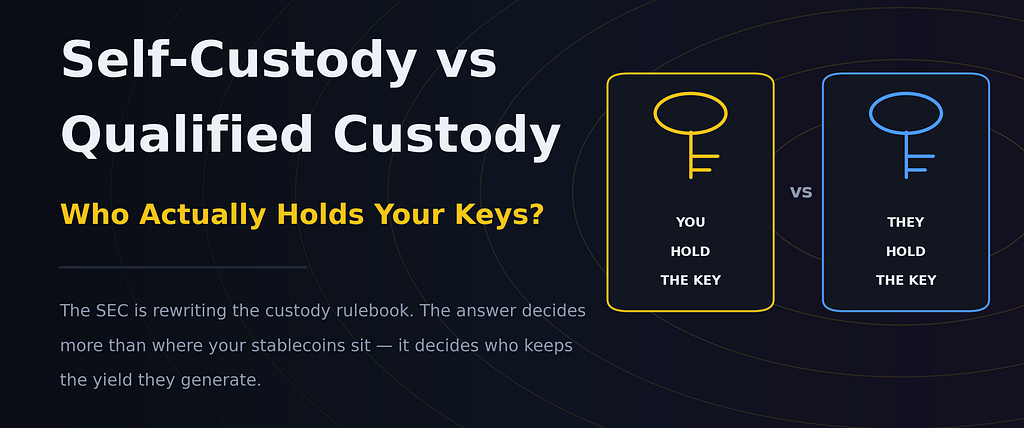
The SEC is rewriting the custody rulebook right now. The answer decides more than where your stablecoins sit — it decides who keeps the yield they generate.
Self-custody vs qualified custody: two keys, two very different outcomes.
On 25 August 2026, the SEC sent a crypto custody proposal to the White House Office of Management and Budget. The text is sealed. No public comment yet.
One phrase inside it matters more than the rest: qualified custodian.
How the agency defines those two words will decide who is legally allowed to hold digital assets in the United States, and under what conditions. Congress has stalled. The regulator is filling the vacuum.
Meanwhile most people still can’t answer a simpler question. When your stablecoins sit somewhere and quietly accrue a return — who actually holds the keys?
That is not a technicality. It decides what happens in a bankruptcy. It decides whether a balance can be frozen. And since July 2025, it decides something almost nobody talks about: who keeps the yield.
Custody stopped being a storage question. It became a market-structure question — and then a yield question.
Your Private Keys Just Became a Regulatory Category
“Not your keys, not your coins” started as a slogan. It is now written into law on two continents.
MiCA places self-custodial wallets outside its scope, while imposing segregation and reserve requirements on custodians.A January 2025 US executive order affirmed the right to self-custody digital assets and transact peer-to-peer.The SEC’s 2023 Safeguarding Rule — which would have swept nearly all client crypto under qualified custodians — was withdrawn in 2025 after industry pushback.The replacement sits at OMB now. A formal proposal could land as early as October 2026.
The direction of travel is clear enough. Custodians are being professionalised. Self-custody is being protected. Both are being defined — and definitions have consequences.
Self-Custody vs Custodial: What Actually Changes Hands
Strip the vocabulary away and one thing separates the two models. The private key.
Self-custody (non-custodial):
The key lives on your device. You sign every transaction yourself.No withdrawal queue. No permission. No counterparty.Nobody can freeze your balance or lose it in an insolvency.You are also the last line of defence against phishing, malicious approvals, and your own mistakes.
Custodial:
A company holds the key. You hold a claim on that company.Recovery, support and insurance exist — that is genuine value.But your balance is a line in someone else’s ledger, and their solvency is now your risk.Freezes, seizures and bankruptcy claims all run through them.
Chainalysis logged $3.4 billion stolen in 2025. Centralised services took the largest single hits — the Bybit breach alone was roughly $1.5 billion.
Private key compromise, not exotic smart-contract bugs, remains the dominant attack vector.
Qualified Custody Explained: Regulated Is Not the Same as Safe
A “qualified custodian” is a legal designation, not a security guarantee.
Under Rule 206(4)-2, US registered investment advisers must generally hold client funds with one: a bank, a broker-dealer, a futures commission merchant, or certain trust companies.
In September 2025, SEC staff issued no-action relief letting advisers treat state-chartered trust companies as banks for crypto custody purposes.
What qualified custody buys you:
Segregation, audited financials, SOC 2 reportingInsurance and a defined incident-response processA compliance path advisers can actually use
What it does not buy you:
Control. Someone else still signs.Immunity. Qualified custodians have been breached.Certainty. The rulebook is mid-rewrite.
That distinction is the whole article. Regulated custody manages how counterparty risk is handled. Non-custodial architecture removes that specific risk entirely.
Belief and behaviour have split. 66% say self-custody matters. 88% still leave assets on an exchange.
The Conviction Gap: 66% Say It Matters, 88% Don’t Do It
Here is the uncomfortable data. A survey of more than 3,000 US crypto users found:
66% consider self-custody important46% fear a major exchange breach88% still keep assets on centralised exchanges33% actually use a cold wallet
Globally, roughly 59% of wallet users say they prefer self-custodial wallets. Behaviour disagrees with belief by a wide margin.
The gap is not ignorance. It is friction. Self-custody has historically meant a seed phrase you guard forever, no support line, and no way to put idle dollars to work without becoming a part-time DeFi analyst.
Remove the friction and the gap closes. That is why MetaMask shipped a self-custodial Money Account in June 2026 bundling stablecoin yield, payments and trading. The market is chasing the same insight.
Same dollar. Different key holder. Opposite destination for the yield.
The Yield Twist: Whoever Holds the Keys Keeps the Return
Now the part that should change how you think about all of this.
The GENIUS Act, signed 18 July 2025, prohibits permitted payment stablecoin issuers from paying holders any interest or yield simply for holding the token. The reserves still earn. The issuer keeps it.
That is the original stablecoin bargain, now written into statute. You hand over dollars. They hand you a token. They put the reserves in Treasuries. The return stays on their balance sheet.
The fight over the edges is loud:
The OCC’s February 2026 proposal presumes affiliate- and third-party-paid rewards are also prohibited unless justified.Bank groups want the scope widened. A Treasury advisory council flagged $6.6 trillion of US transactional deposits as at risk from stablecoins.Exchanges argue the statute bans issuer-paid yield only, and nothing else.
Strip the politics and one fact survives. In a custodial model, the return your dollars produce belongs to whoever holds them. Custody and yield are the same decision wearing two hats.
Non-Custodial by Design: How USDS and sUSDS Flip the Model
Sky Protocol runs the opposite premise.
USDS is the fully backed unit of account of Sky Ecosystem — the stablecoin independent capital allocators draw against governance-approved collateral. It converts 1:1 with major stablecoins through the Peg Stability Module, with no fees and no slippage.
Convert USDS to sUSDS and you hold the world’s largest yield-generating stablecoin. sUSDS accrues the Sky Savings Rate programmatically, inside your own wallet.
Four mechanics matter here:
Non-custodial throughout. No third party can move your balance, freeze it, or lose it in an insolvency.The rate is governance-set, voted onchain by SKY holders through Sky Governance — not decided by a company’s growth team.It is funded by Protocol Revenue. The largest source is USDS lent to the independent Sky Agent Network, plus Stability Fees and Peg Stability Module flows.No lockups. Redeem sUSDS for USDS plus accrued yield at any time, 24/7.
The demand is measurable. In Q1 2026, sUSDS attracted more than $2.5 billion in new capital — more than the next four yield-generating stablecoins combined.
In Q1 2026, sUSDS took in more new capital than the next four yield-generating stablecoins combined.
Verify, Don’t Trust: What Backs sUSDS and What Breaks First
Non-custodial does not mean risk-free. It means the risks are visible.
At the time of writing, Sky Protocol shows $14.15B in Total Protocol Collateral against $11.48B in stablecoin supply.
Overcollateralised, and auditable line by line at financial.skyeco.com — not attested quarterly by a firm you have never met.
Losses absorb in a fixed, published order:
The Agent’s own risk capital, sized by asset class under a Basel III (CRR) methodologyThe Surplus Buffer, where Protocol Revenue accumulates before distributionRecapitalisation via SKY issuance, requiring an Executive Vote with a mandatory delayEmergency Shutdown, letting every USDS holder redeem directly against remaining collateralsUSDS holders access the rate. They are not claimants on any single Agent, borrower or strategy. That distinction is structural — and most people get it backwards.Sky Protocol answers “what if an Agent fails?” structurally, in a published order.
The record is checkable too. Seven years of operations with zero exploits at the core protocol. Solvent through Black Thursday.
Zero exposure to UST or FTX, because governance never approved either as eligible collateral.
S&P Global assigned a B- rating in 2024, the first structured finance credit rating given to an onchain protocol.
And the Sky Frontier Foundation reported Gross Protocol Revenue of $123.79M in Q1 2026, the highest in protocol history.
If you want the full architecture, start here.
Overcollateralised and auditable line by line — not attested quarterly by a firm you have never met.
So Who Should Actually Hold Your Keys?
Self-custody has a bill too, and it is worth naming honestly.
Chainalysis recorded $58 million stolen in violent “wrench attacks” in 2025 — the highest annual total on record — with more than $30 million already taken in the first half of 2026.
Home invasions rose to 37% of incidents. A lost seed phrase has no support line and no appeals process.
So the honest answer depends on you, not on a universal ranking:
Small balances you move weekly? Custodial convenience is a defensible trade.Large, long-horizon holdings? Counterparty exposure compounds quietly. Self-custody earns its friction.Somewhere in between? Match the storage model to the size and the time horizon, not to the ideology.
But treat this as two questions, not one. Who holds the keys and who keeps the return used to be separate concerns. Since the GENIUS Act, they are the same concern.
Self-custody used to mean choosing control over yield. The non-custodial savings model exists so you don’t have to choose.
If you can’t name who holds the key, you already know the answer.
Over to you. Where do your stablecoins actually live right now — an exchange, a self-custody wallet, or split between both? And if the SEC’s definition of qualified custodian lands narrow, does that change your answer?
Drop it in the comments. Curious how many people are in the 88%.
Self-Custody vs Qualified Custody: Who Actually Holds Your Keys? was originally published in Coinmonks on Medium, where people are continuing the conversation by highlighting and responding to this story.