
Image created by Quinn Donovan
Choosing the right token standard is one of the most important technical decisions in blockchain and token development. A token standard defines how a digital asset behaves, how it interacts with wallets and decentralized applications, how ownership is represented, and how easily it can integrate with exchanges, marketplaces, smart contracts, and other Web3 infrastructure.
The wrong standard can create unnecessary development costs, compatibility problems, limited functionality, or migration challenges later. The right standard, however, can give your project a strong technical foundation and make it easier to scale across wallets, platforms, and blockchain ecosystems.
Whether you are developing a utility token, governance token, stablecoin, security token, NFT, gaming asset, real-world asset token, or a multi-token ecosystem, selecting an appropriate standard should happen before smart contract development begins.
This guide explains how to choose the right token standard for your project, compares the major token standards, and provides a practical framework for making the decision.
What Is a Token Standard?
A token standard is a set of technical rules and functions that define how tokens are created, transferred, managed, and integrated with blockchain applications.
Instead of every project creating completely different token logic, standards provide commonly accepted specifications that developers, wallets, exchanges, marketplaces, and decentralized applications can support.
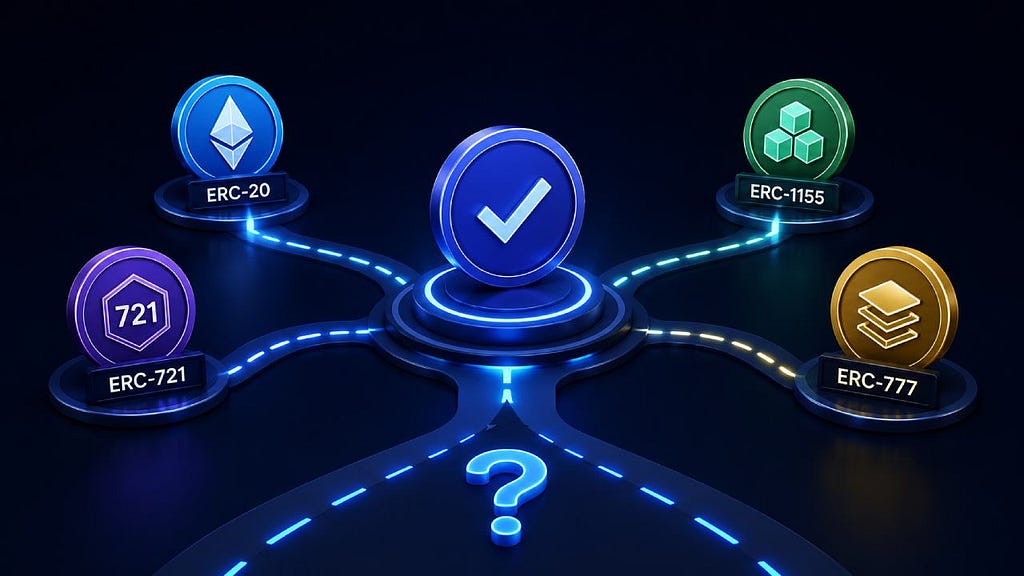
For example, on Ethereum and Ethereum-compatible networks, ERC-20 is widely used for fungible tokens, while ERC-721 is commonly associated with unique NFTs. ERC-1155 supports multiple token types within a single contract and is useful for gaming and digital asset ecosystems.
Token standards can therefore be viewed as a common language between your token and the broader blockchain ecosystem.
The standard you select depends on several factors, including:
Token typeFungibility requirementsTransfer requirementsSmart contract functionalityWallet compatibilityExchange integrationNFT or gaming requirementsSecurity requirementsGas efficiencyScalabilityMulti-token requirementsRegulatory and compliance considerationsFuture expansion plans
Why Does Token Standard Selection Matter?
Token standard selection affects much more than the initial token creation process.
A token may need to interact with decentralized exchanges, wallets, staking platforms, lending protocols, NFT marketplaces, bridges, DAOs, payment applications, or enterprise systems. If the selected standard does not support the required functionality, additional development work may be necessary.
For example, a project creating a traditional fungible utility token generally does not need the unique ownership capabilities of an NFT standard. Similarly, an NFT marketplace may require a standard that can represent individually identifiable assets rather than interchangeable units.
Choosing the right token standard can help improve:
Interoperability: Widely adopted standards can make integration with established Web3 infrastructure easier.
Development efficiency: Developers can build on established interfaces instead of designing token functionality from scratch.
Security: Well-established standards have been extensively reviewed, tested, and implemented across the ecosystem, although the specific smart contract still requires professional security review.
User experience: Compatible wallets and applications can recognize and interact with standardized tokens more easily.
Scalability: Some standards are better suited to applications that need to manage large numbers of assets or different token types.
ERC-20: A Standard for Fungible Tokens
ERC-20 is one of the most widely recognized token standards in the Ethereum ecosystem. It is primarily designed for fungible tokens, where every unit is interchangeable with another unit of the same token.
For example, one project token is generally equivalent to another project token of the same type.
ERC-20 is commonly used for:
Utility tokensGovernance tokensDeFi tokensReward tokensPayment tokensStablecoin implementationsDAO tokensEcosystem tokens
An ERC-20 token typically includes functions for transferring tokens, checking balances, approving spending, and transferring tokens on behalf of an owner.
When Should You Choose ERC-20?
ERC-20 is generally a strong option when your project requires a standard fungible asset with broad ecosystem compatibility.
If you are launching a DeFi protocol, DAO, Web3 platform, crypto utility token, or blockchain-based rewards system, ERC-20 may be one of the first standards worth evaluating.
However, ERC-20 is not designed to represent inherently unique assets. If every asset needs its own identity, metadata, ownership history, or individual characteristics, an NFT-oriented standard may be more appropriate.
ERC-721: A Standard for Unique NFTs
ERC-721 is designed for non-fungible tokens, meaning each token can represent a distinct digital or physical asset.
Unlike fungible tokens, individual ERC-721 tokens are not necessarily interchangeable because each token can have unique ownership and metadata.
Common applications include:
Digital collectiblesNFT artworkVirtual landDigital identitiesEvent ticketsGaming assetsCertificatesMembership NFTsUnique real-world asset representations
For example, a digital artwork collection can use ERC-721 when each NFT represents a unique asset with its own token ID and metadata.
When Should You Choose ERC-721?
Choose an ERC-721-style approach when uniqueness is central to the project.
If Asset #100 and Asset #101 have different characteristics, ownership records, or metadata, a non-fungible token standard may be more suitable than ERC-20.
Its primary limitation is that projects managing large collections of different asset types may benefit from a more flexible multi-token standard.
ERC-1155: Multi-Token Functionality
ERC-1155 was designed to support multiple token types through a single smart contract architecture.
It can represent both fungible and non-fungible assets, making it particularly useful for ecosystems that manage different categories of digital assets.
ERC-1155 is frequently considered for:
Blockchain gamesGaming inventoriesDigital collectiblesMetaverse assetsIn-game currenciesMulti-asset marketplacesLoyalty ecosystems
For example, a blockchain game could have a fungible gold currency, limited-edition weapons, collectible characters, and other assets. A multi-token architecture can make managing these different assets more practical.
When Should You Choose ERC-1155?
Consider ERC-1155 when your platform needs to manage multiple token types or large quantities of assets efficiently.
It can be especially valuable when a single application contains both fungible and non-fungible assets.
ERC-777 and Advanced Fungible Token Requirements
ERC-777 was designed to extend the functionality available for fungible tokens and introduce features such as more advanced token handling mechanisms.
However, greater functionality can also introduce additional implementation considerations. Projects should evaluate ecosystem compatibility, security implications, and whether the additional capabilities are actually required.
For many conventional token launches, a simpler and more widely supported fungible token standard may be preferable.
The key lesson is that more features do not automatically mean a better token standard.
Token Standards on Other Blockchain Networks
Ethereum is not the only blockchain ecosystem with token standards.
Different networks use their own technical architectures and token models. For example, ecosystems such as Solana, BNB Chain, Polygon, Avalanche, and other EVM-compatible or non-EVM networks may use different token frameworks.
A project selecting a token standard should therefore begin with the question:
Which blockchain network will host the token?
If the project requires deployment across multiple chains, the architecture becomes more complex. Developers may need to consider bridge infrastructure, wrapped assets, cross-chain messaging, liquidity fragmentation, security assumptions, and token supply synchronization.
A token standard should therefore be selected together with the project’s broader blockchain architecture.
How to Choose the Right Token Standard
Choosing a token standard should be based on the project’s actual requirements rather than popularity alone.
1. Define the Purpose of the Token
Start by clearly defining what the token does.
Is it a:
Utility token?Governance token?Payment token?Stablecoin?Security token?NFT?Gaming asset?Loyalty token?RWA token?Membership token?
A fungible utility token and a unique digital collectible have fundamentally different requirements.
2. Determine Whether the Token Is Fungible
Fungibility is one of the most important selection criteria.
A fungible asset has interchangeable units. For example, one unit of a particular utility token is generally equivalent to another unit.
A non-fungible asset is individually identifiable.
If your project needs identical units, evaluate fungible token standards such as ERC-20.
If each token needs unique identity and metadata, evaluate NFT standards such as ERC-721.
If you need multiple asset types, ERC-1155 may be appropriate.
3. Evaluate Required Smart Contract Features
List every function the token needs before selecting the standard.
Your requirements might include:
MintingBurningPausingStakingToken lockingVestingDelegationGovernanceWhitelistingTransfer restrictionsRole-based administrationSupply capsAutomated distribution
Some functions may be implemented around the standard rather than being inherent to it.
This distinction is important because the token standard provides the foundation, while project-specific smart contract logic provides additional functionality.
4. Consider Wallet and Exchange Compatibility
A technically sophisticated token is not useful if your target users cannot easily interact with it.
Evaluate whether your selected standard is supported by the wallets, exchanges, marketplaces, DeFi protocols, and applications relevant to your target market.
Compatibility should be evaluated before deployment rather than after launch.
5. Consider Gas Efficiency
Transaction costs can influence the user experience, especially for gaming, NFT, and high-volume applications.
If your platform requires users to perform many transactions or manage large collections of assets, evaluate how the chosen standard and smart contract architecture affect gas consumption.
Remember that gas efficiency depends not only on the token standard but also on the blockchain network, contract implementation, transaction design, and application architecture.
6. Plan for Scalability
Think beyond the initial token launch.
Your project may eventually add:
NFTsStakingGovernanceGaming assetsRewardsCross-chain deploymentRWA tokenizationMarketplace functionalityInstitutional integrations
The best token standard is one that supports the project’s current requirements while fitting into its long-term architecture.
7. Evaluate Security Requirements
Token standard selection should always be accompanied by smart contract security planning.
A recognized token standard does not automatically make a contract secure.
Projects should consider:
Smart contract auditsAccess controlAdmin privilegesUpgradeabilityReentrancy protectionInteger and arithmetic safetyToken transfer logicMinting permissionsBurning permissionsEmergency mechanismsOracle dependenciesCross-chain risks
Independent security audits and professional testing can help identify vulnerabilities before deployment.
Token Standard Comparison
Image created by Quinn Donovan
This table provides a starting point, but the final decision should be based on technical requirements, ecosystem compatibility, security, and business objectives.
Token Standard vs Token Contract: What Is the Difference?
A token standard defines a common interface and expected behavior.
A token contract is the actual smart contract deployed for your project.
Two projects can use the same token standard but have completely different implementations, permissions, tokenomics, and security characteristics.
For example, two ERC-20 tokens may have different:
Total suppliesMinting mechanismsBurning mechanismsOwnership modelsTransfer restrictionsVesting systemsGovernance systemsAdministrative controls
Therefore, choosing an established standard is only the beginning of token development.
How Token Standards Affect Tokenomics
Tokenomics and token standards should be designed together.
Your token distribution model may include allocations for:
TeamInvestorsCommunityTreasuryAdvisorsEcosystem rewardsLiquidityMarketingPartnerships
The token contract must then support the mechanisms required to distribute and manage those allocations securely.
For example, vesting contracts may control team allocations, while staking contracts may manage ecosystem rewards.
The token standard provides the basic asset interface, while additional contracts can manage sophisticated tokenomics.
Token Standards for RWA Tokenization
Real-world asset tokenization introduces additional considerations.
A token representing real estate, bonds, commodities, private credit, or other off-chain assets may require ownership restrictions, compliance mechanisms, identity verification, transfer controls, or jurisdiction-specific rules.
Therefore, simply choosing ERC-20 because an RWA token is fungible may not be enough.
RWA projects should evaluate:
Investor eligibilityTransfer restrictionsKYC/AML requirementsLegal ownership structureAsset custodyCompliance rulesPermissioned transfersReporting requirementsOn-chain/off-chain data connections
For regulated tokenization projects, legal and compliance professionals should work alongside blockchain developers before the token architecture is finalized.
Common Mistakes When Choosing a Token Standard
One common mistake is choosing a standard simply because it is popular.
Another is selecting a technically complex standard without a real business requirement.
Projects should also avoid:
Ignoring the target blockchain: A token standard must match the technical ecosystem where the asset will operate.
Ignoring integrations: Wallet, exchange, marketplace, and DeFi compatibility should be assessed early.
Underestimating security: Standardized interfaces do not eliminate smart contract vulnerabilities.
Overlooking future requirements: A token may need additional functionality as the project grows.
Mixing tokenomics and technical design too late: Supply, distribution, vesting, and governance requirements can affect contract architecture.
Assuming one standard works for everything: A large Web3 ecosystem may use multiple token standards for different asset classes.
A Practical Decision Framework
A simple decision process can help narrow the options.
If your project requires a fungible utility, governance, payment, or DeFi token, start by evaluating ERC-20 or the equivalent standard on your selected blockchain.
If you are creating unique digital assets or collectibles, evaluate ERC-721 or an equivalent NFT standard.
If your platform manages multiple fungible and non-fungible assets, evaluate ERC-1155 or equivalent multi-token architectures.
If your project involves regulated assets, add compliance and transfer-control requirements to the technical evaluation before selecting the final standard.
For multi-chain projects, evaluate the standards and interoperability mechanisms on every target network rather than assuming that one implementation will translate directly across chains.
Frequently Asked Questions
What is the best token standard for a cryptocurrency?
For a conventional fungible cryptocurrency or utility token on Ethereum-compatible infrastructure, ERC-20 is often the starting point. The final choice depends on the project’s functionality, blockchain, integrations, and compliance requirements.
Which token standard is best for NFTs?
ERC-721 is widely used when every NFT needs to be individually identifiable. ERC-1155 can be preferable when a platform needs to manage multiple types of fungible and non-fungible assets.
Can one project use multiple token standards?
Yes. A Web3 ecosystem can use different standards for different asset classes. For example, a project might use a fungible token for governance and ERC-721 or ERC-1155 assets for NFTs or gaming items.
Can I change the token standard after deployment?
Changing a deployed token’s fundamental standard is generally not a simple modification. Depending on the architecture, migration, wrapping, bridging, or deployment of a new contract may be necessary. This is why token architecture should be carefully planned before launch.
Does the token standard determine tokenomics?
No. Token standards define technical behavior and interfaces, while tokenomics determines supply, allocation, distribution, incentives, vesting, and economic mechanisms. However, the two should be designed together.
Is ERC-20 suitable for RWA tokenization?
ERC-20 can be technically suitable for fungible RWA representations, but regulated RWA projects may require additional compliance, identity, transfer restrictions, and permissioning mechanisms. The legal structure must be evaluated alongside the blockchain architecture.
Is an audited token standard automatically secure?
No. A standardized interface does not guarantee that an individual smart contract is secure. Custom contract logic, access controls, upgrade mechanisms, dependencies, and integrations can introduce vulnerabilities. Professional testing and auditing remain important.
Final Thoughts
Choosing the right token standard is a foundational decision in token development. The goal should not be to select the most popular standard but to select the architecture that best matches your asset type, functionality, blockchain ecosystem, security requirements, integrations, and long-term growth strategy.
ERC-20 remains a strong starting point for many fungible token projects, while ERC-721 is well suited to individually identifiable NFTs. ERC-1155 offers flexibility for applications that manage multiple token types, particularly gaming and digital asset ecosystems. Specialized projects may require additional standards, extensions, or custom smart contract architecture.
The most effective approach is to define your business and technical requirements first, compare the available standards, evaluate ecosystem compatibility, assess security and compliance requirements, and then design the token contract and supporting infrastructure.
For businesses planning a crypto token development project, working with an experienced blockchain development team can help reduce architectural mistakes and ensure that the token standard, smart contracts, tokenomics, security model, and deployment strategy work together.
How to Choose the Right Token Standard for Your Project was originally published in Coinmonks on Medium, where people are continuing the conversation by highlighting and responding to this story.