
Are Stocks Still the Most Bullish Asset in the RWA Verse?
Crypto has a habit of finding one thing that works and flooding it until the yield compresses to nothing. Nobody rings a bell at the top of a narrative, but they do leave footprints.
And the footprints in RWA are everywhere right now — in BlackRock board memos, in Nasdaq regulatory filings, and in the quiet repositioning of every major asset manager who spent 2021 calling crypto a Ponzi and is now racing to tokenize their flagship fund.
Something structural has shifted, and the people who move capital for a living can feel it even when they won’t say it publicly. The rails work, and now comes everything else.
That Quiet Moment Before Boom?
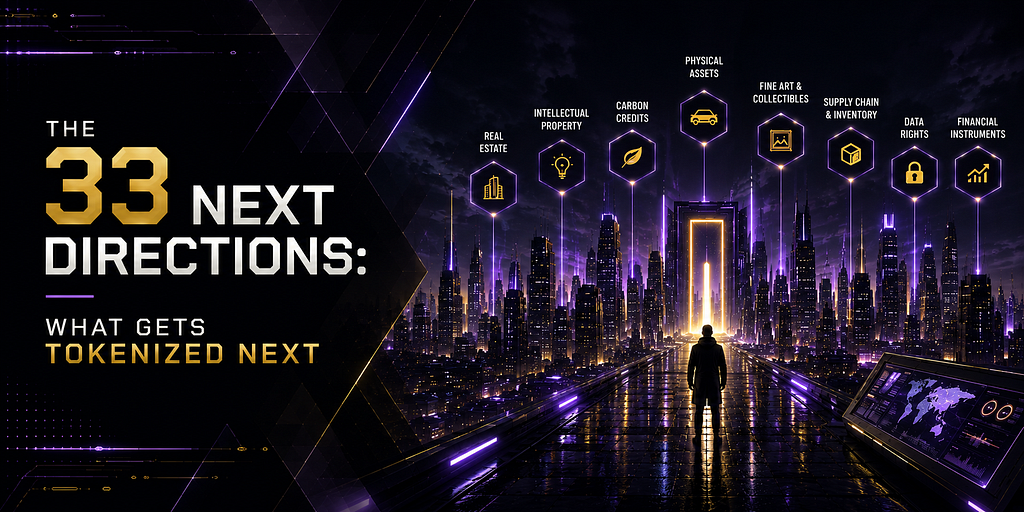
We’re at the exact inflection point that always precedes an asset class explosion — the very juncture where early infrastructure has been stress-tested, institutional legitimacy has arrived, and the addressable opportunity is so absurdly large that even capturing a single-digit percentage of it would dwarf everything built so far. There are hundreds of distinct sources of real-world yield, but the gap between those two numbers is where the next decade of RWA gets built.
Capital flows toward yield with the same inevitability that water flows downhill, and on-chain infrastructure now offers yield, liquidity, and composability that traditional rails simply can’t match.
The future isn’t just exciting because of the rising TVL numbers, but the actual things that will get tokenized. Need a forecast, ser?
Chapter One: How We Got Here — And Why Treasuries Were Just the Entry Drug
The stablecoin chart tells it all: for years, the supply moved in near-perfect inverse correlation with interest rates. Rates went up, stablecoins bled out. Made sense — why sit in USDC when you could earn 5% in a money market fund?
Then January 2024 happened: rates were still above 5%, and stablecoin supply started growing anyway. The decoupling wasn’t random, as the risk-free rate had finally arrived on-chain. Ondo, BlackRock’s BUIDL, and Centrifuge — issuers gave stablecoin holders somewhere to go without leaving crypto. Stablecoin supply grew from $130B to over $280B once real-world yield existed on-chain.
The market concentrated fast, and that concentration is now creating its own gravitational pull. The top 10 assets hold 64% of total RWA value, and 18 of the largest offers yield between 3% and 5%.
That’s the current monopolistic setup: a $280B stablecoin base earning below 5%, increasingly aware that better yield exists on-chain — and a DeFi infrastructure stack that can now absorb it. The next wave will be the mechanical consequence of capital chasing yield up the risk curve.
Chapter Two: Hundreds of Yield Sources. The Rest is the Opportunity
Of everything mappable, most hasn’t moved yet. The reasons vary, but the core tension is always the same: on-chain capital moves 24/7, settles in seconds, and can be redeployed on the same block. Off-chain assets can’t act like that.
This timing mismatch is the fundamental engineering problem of the RWAs. Deployment lag means capital sitting on-chain earns nothing until it reaches the underlying, which for private credit takes weeks, for real estate, months. Redemption lag means you can’t liquidate a commercial property on a Sunday morning because a holder wants out.
The workarounds all cost yield, and buffer pools compress blended returns. Market makers like Wintermute and Keyrock absorb the wait — and (little wonder) charge accordingly. Every bridge across the timing gap redistributes the cost of illiquidity to whoever is willing to bear it.
The assets that tokenize next won’t be the easiest, but they’ll be the ones where someone makes the timing mismatch cheap enough to ignore.
Chapter Three: Every Other Asset Class Has a Ceiling. Equities Don’t.
Here we come to the uncomfortable reality that most RWA coverage dances around: not all tokenizable assets are equal opportunities. Private credit is large but illiquid and opaque; real estate is enormous but operationally brutal to tokenize at scale. Long story short, trade finance needs an aggregation infrastructure that barely exists yet.
Equities have none of these problems. And they have something none of the others can claim: being the most democratically desired asset class on Earth. There are 8 billion people on this planet. And a meaningful percentage of them know what Apple, NVIDIA, and Tesla are. They’ve watched those stocks compound through every recession, every geopolitical shock, every rate cycle.
So now some of them understand that owning a piece of the world’s most productive companies is how wealth gets built over a generation. They just couldn’t access it! Many lacked capital or some conviction. But the main hurdle is that the infrastructure was deliberately designed to keep them out! Get a US Social Security Number, a domestic bank account, and a brokerage relationship. Then, get around the business hours in a time zone that isn’t theirs.
The global equity market is around $120 trillion. The S&P 500 alone has returned an average of 10.5% annually for the last 50 years — the most consistent, documented, and broadly understood wealth compounding machine in financial history. And most of the world has been locked out of it by paperwork! That’s the market play.
Chapter Four: Stocks On-Chain Are an Infrastructure Story
The access angle is compelling enough on its own, but it understates what stocks on-chain actually unlock. Hint: when an equity becomes a composable on-chain asset, it stops being just a stock and becomes a financial primitive — something the entire DeFi stack can build on top of. That’s a categorically different value proposition than anything available in traditional markets.
Once a tokenized RWA is listed as collateral on a lending market, holders can DO a lot. They loop in: deposit the RWA, borrow stablecoins against it, buy more of the same RWA, repeat.
For equities, this mechanic doesn’t need dividend yield to make sense — since the underlying appreciation of NVDA or SPY is itself the yield. On-chain leverage against a tokenized S&P 500 position, rebalancing continuously, composable with lending protocols and yield vaults, accessible to anyone with a wallet — that product doesn’t exist in TradFi: it simply can’t. The settlement rails are too slow, the market hours are too limited, and access is too restricted.
This is why stocks on-chain are more than that; they are a surface-area story. Every tokenized equity that lands on-chain with proper composability becomes the foundation for dozens of products that couldn’t exist before. The leverage loops, the tranched structures, the yield decomposition, the cross-collateralisation — none of it works without the underlying asset being on-chain first. And no underlying asset has more natural demand than the stocks people already want.
Chapter Five: the Architecture That Makes It Real
RWA stocks done right are what this infrastructure looks like when it’s actually built correctly. 1:1 backed, audited at a 100% score with no critical issues, on track to be the first MiCAR-compliant built natively for DeFi.
The distribution problem that haunts every other RWA category — 33 of 35 non-stablecoin RWAs above $50M have fewer than 2,000 holders — is structurally inverted for tokenized equities. The demand base is the billions of people already on-chain, already holding stablecoins, already one product away from holding NVDA, SPY, or MSFT.
Non-US residents represent the largest addressable market for tokenized equities, and they’re not waiting for a traditional brokerage to expand their compliance program. They don’t need onboarding, but strive to try out the product.
That’s what makes stocks the most bullish item in RWA, because the demand already exists, pre-formed, on-chain, waiting. Every other tokenizable asset class has to find its holders. Tokenized equities already have theirs.
The One Out of 33
Every asset that comes on-chain makes the next one easier to bring, and the infrastructure to support it more valuable.
Treasuries proved the rails, and private credit proved you could handle complexity. Now comes the asset class that was always the most obvious candidate — the one billions of people already want, and have been systematically prevented from accessing for decades.
Stocks were always meant to go on-chain. Of the 33 ways this plays out, most of them have equities at the center. When you strip away the noise, the cycle rotation, and the narrative churn, stocks were always the most important financial asset in human history.
Putting them on-chain doesn’t alter what they are, but it changes who gets to own them. That’s the whole game.
The 33 Next Directions: What Gets Tokenized Next was originally published in Coinmonks on Medium, where people are continuing the conversation by highlighting and responding to this story.