
Chain of Thoughts 2026–09–01
Bitcoin’s correlation with gold just set a record while the price went nowhere. The bond market explains both.
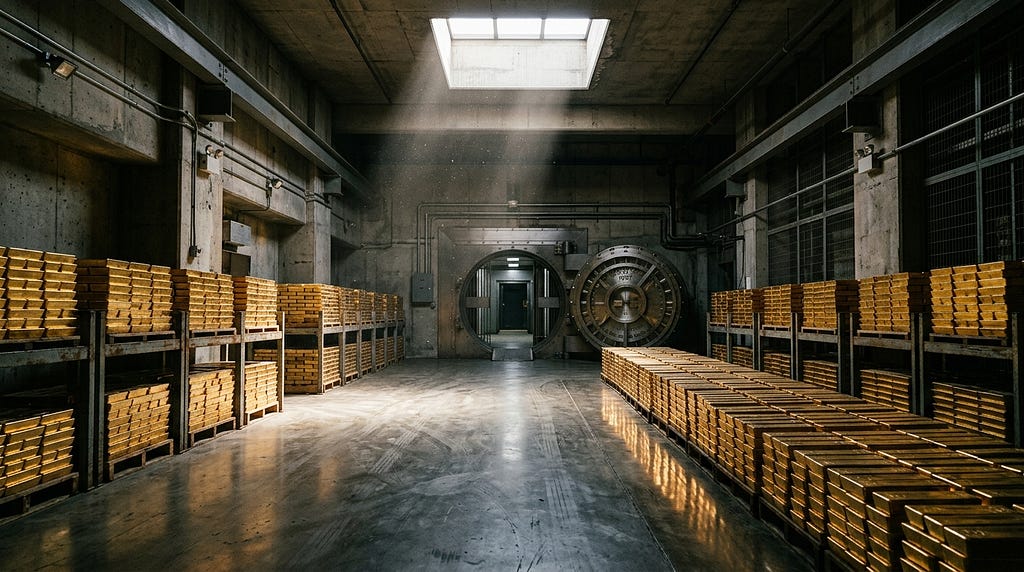
Generated using Nano Banana 2
The Verdict
Bitcoin — short term (3–5 months). $77,923, down 0.84% on a day Brent rose 2.34% to $92.61 and the rates market pushed further toward a September hike. The $75,000–$85,000 range holds. What changed is the character of the tape rather than the level: realized volatility is compressing while every macro input around it gets louder. Compression like that does not decay quietly — it resolves. A daily close above $83,000 confirms the base, now 6.5% away. A daily close below $72,000 ends the thesis.
Bitcoin — long term (1–3 years). Bitcoin’s 90-day correlation with gold reached an all-time high on the same day Japan’s ten-year yield touched a thirty-year peak. That is one trade wearing two tickers. The world spent fifteen years funding itself against a bond market that would absorb anything at any price, and that market is now repricing in every jurisdiction at once. Bitcoin’s long-term case does not require it to become money, or to win a payments war, or to be adopted by anyone in particular. It requires only that governments keep needing to issue debt into a market that has stopped buying it at yesterday’s yield. Everything else is timing.
Ethereum — short term. $2,445.55, down 0.96% and now below the $2,468 that anchored yesterday’s flow argument. The ETH ETF inflow streak has produced no new print in two sessions, which means the strongest leg of the ETH case is currently unverified rather than intact. $2,300 on a daily close is where it fails.
Ethereum — long term. Ethereum is the settlement layer that every serious institutional experiment still anchors to, and its float keeps shrinking into treasuries and staking contracts. But the leg of the bull case that assumed Ethereum captures the economics its rollups generate is leaking in public. Robinhood’s new chain is producing real fee revenue, and the token that rallied on it was Arbitrum’s, not ether’s #16. Own ETH for settlement demand and a shrinking float. Do not own it expecting the fees generated one layer up to arrive downstairs.
Cardano — short term. $0.1991, up 1.61% — the only major asset green while bitcoin was red, and the first positive divergence in weeks. It walked back to the $0.20 line it lost yesterday without taking it.
Cardano — long term. Four separate venues announced tokenized equity products in a single session: a London Stock Exchange partnership, a Bitfinex Securities listing, a Binance options expansion, and an RFQ venue on Hyperliquid. None of them chose Cardano. That absence is not an argument about the engineering, which is real, or about the price, which is a separate question. It is a measurement: when institutions pick a settlement venue for real-world assets in 2026, Cardano is not on the shortlist. The long-term bet is that this changes before the shelf space is permanently allocated.
Solana — short term. $101.92, down 0.92%, moving in lockstep with the majors rather than telling its own story.
XRP — short term. $1.38, up 0.31%, with nine consecutive days of spot ETF inflows totalling $1.6 billion behind it #14. Nine days of buying that has produced almost no price is its own kind of information.
Why The Market Is Here
The most important number printed today was not a price.
Bitcoin’s 90-day Pearson correlation coefficient with gold hit an all-time high #1. Two assets with nothing in common — no shared holders of consequence, no shared venue, no shared regulatory treatment, opposite volatility profiles — are now moving together more tightly than at any point in bitcoin’s existence.
Correlations do not rise because assets become similar. They rise because a single factor starts dominating everything else.
Here is the factor. Global bond yields hit multi-decade highs today, with Japan’s ten-year JGB reaching a thirty-year peak #2. Japan was the last cheap funding source on earth. The entire architecture of the post-2008 period — the carry trade, the reach for duration, the assumption that somebody would always bid the long end — was built on the premise that Japanese money was free and would stay free. It is not free anymore.
When the price of government money goes up everywhere simultaneously, every asset that cannot be printed gets bid by the same flow. That is why gold and bitcoin are converging. It is not a narrative. It is a factor loading.
Now layer the day’s noise on top, because it explains the price action that the correlation does not.
Two tankers were reportedly struck in the Strait of Hormuz, pushing Brent above $92 and both benchmarks to two-week highs #3. Qatar said mediation efforts are under way to end the Iran–US war and reopen the strait #4. Those two sentences describe the same conflict at two different speeds, and markets are trading the fast one.
The most striking read came from an unexpected desk. Bank of England governor Andrew Bailey told the G20 that AI could trigger a global economic downturn, citing volatility driven by energy shocks from the US–Iran war #5. Read that transmission chain carefully: a shooting war in the Gulf raises the cost of electricity, electricity is the input constraint on AI capex, and AI capex is currently holding up a meaningful share of global equity valuations. A central bank governor has now said out loud that the Hormuz risk and the Nasdaq risk are the same risk.
Every extra dollar on the barrel lands on a rates market that has spent the week moving toward pricing a September Federal Reserve hike #6, with seasonality analysts already reaching for the “Rektember” label to describe what usually follows a strong August #7. Keep the distinction clean: that is the market’s positioning reaction to an oil price, not a change in what the Fed has said. The chair’s stated bias remains toward cutting. The gap between the market’s pricing and the Fed’s guidance has generated most of this month’s volatility, and Friday’s jobs report is the next thing capable of closing it.
And the resolution of all that was a 0.84% decline.
Look at the full row. Bitcoin down 0.84%, gold down 0.26%, S&P down 0.37%, Nasdaq down 0.56%, dollar up 0.23%. Nothing moved. That is not a market absorbing a war headline and an oil spike and a rate-hike repricing. That is a market where the only thing changing is the cost of funding, and every asset is being marked down by the same small amount as a result.
The sentiment gauge did something worth noting inside that stillness. Fear and Greed rose seven points to 69 on a day when five of six majors were red — the exact inverse of yesterday, when it fell seven points on a similarly red tape. A gauge that moves in both directions on the same kind of day is not reading direction. It is reading volatility, and low volatility scores as greed. The market is being told it is confident because it is not moving.
Institutional Pulse
An index committee just became the third force in the treasury-company trade. MSCI opened a consultation targeting companies whose operating assets are below 50% of total assets #8. If adopted, it removes three companies from MSCI’s Global Investable Market Indexes in November, with Strategy the largest by a distance #9. Saylor called the rule discriminatory.
The label matters less than the mechanism. Index deletion is not a sentiment event, it is a forced-flow event: every passive fund tracking those indexes must sell, on a schedule, regardless of view. Yesterday’s read was that the corporate treasury cohort had stopped moving as a bloc and started trading against itself. Add this and the picture gets sharper — the cohort’s marginal buyer is now partly a passive allocator who did not choose bitcoin exposure and can be instructed to exit it by a committee vote in November. That is a shorter and more mechanical fuse than anything in the fundamentals.
Meanwhile, traffic in the opposite direction hit a record. Kraken parent Payward will tokenize 100 London-listed stocks, with the LSE planning 24-hour trading support #10. Bitfinex Securities listed five equity-backed notes tied to Strategy and Metaplanet, trading against dollars, USDT and bitcoin #11. Binance added options on 1,000 US stocks and ETFs, with monthly TradFi perpetual volume reaching $433 billion in August — roughly fifteen times January’s figure #12.
Hold those two paragraphs side by side. Equities are migrating onto crypto rails at industrial scale in the same week that the crypto proxies are being escorted out of the equity indexes. Traditional finance has decided it wants the plumbing and does not want the balance sheets. There is a tokenized note on Strategy’s equity now — you can get the exposure onchain at the exact moment you may no longer get it in your index fund.
The banks brought the settlement layer in-house. Citi, Goldman Sachs and a group of global banks and asset managers announced a joint stablecoin venture #13. Consortium projects fail routinely. What does not fail is the signal: the largest dollar intermediaries on earth have concluded that tokenized settlement is infrastructure they need to own rather than rent.
Flows. No new US spot bitcoin ETF print landed in this window — the last remains August 28’s $201.9 million outflow, and the two-consecutive-outflows test that would mark a regime change is still untriggered. The ether streak also went unreported for a second session. The only live flow story is XRP, at nine days and $1.6 billion, and it is producing almost no price.
Treasury buying continued at a worse price. Strive added $143 million of bitcoin at an average of $79,431, lifting its stack to 23,156 BTC #15 — another treasury purchase now underwater against spot. Separately, BlackRock published a re-underwriting of the bitcoin thesis, concluding that modest allocations still improved risk-adjusted portfolio returns historically #17.
Where the coins come from still matters. Strive’s average price sits above every level bitcoin traded in this window, which is what happens when size is sourced off-book. Treasury purchases are filled by desks, not order books — the print you see is a settlement, not a bid. That is why a purchase this size can land without moving the tape, and why the absence of price impact is never evidence that the buying was small.
Calendar Watch
Friday’s US jobs report is the near-term event, because it is the first hard data capable of resolving the hike-versus-cut argument that oil keeps restarting. The September FOMC is the formal resolution. The September 9 Treasury buyback remains the cleanest read on whether the long end is being managed, and it now matters more than it did a week ago given what Japanese yields did today. MSCI’s consultation closes into a November decision. The Clarity Act stays on the September calendar with a narrowing legislative window behind it.
Signals Worth Watching
Volatility compression is the trade. Bitcoin absorbed an oil spike, a tanker attack, a thirty-year high in Japanese yields and a hike repricing, and moved less than one percent. Ranges that tight around inputs that loud do not persist. Position for the resolution, not the direction — and note that the sentiment gauge is currently scoring the compression as confidence.
MSCI’s November decision is now the top dated catalyst. It is binary, scheduled, and mechanical. If the rule is adopted, the forced selling is calculable in advance. Watch for Strategy’s response filing and for any second index provider opening a similar consultation, which would turn a one-committee problem into a standard.
Metaplanet’s 10,270 BTC on Coinbase Prime. Second session, no movement print. The coins remain an option rather than a decision. Retires after five sessions without news.
Korean retail is back. The kimchi premium has returned to the Korean market #18. It is a small, unreliable, and historically late signal — which is exactly why it belongs on the list. Retail premia in Korea have marked local tops as often as they have marked accumulation.
Hyperliquid’s compliance surface is widening. Addresses linked to the OFAC-sanctioned Lazarus Group moved $30 million through Hyperliquid #19, weeks after regulators discussed a path to bringing the venue into US markets. The venue appeared three separate times in today’s news as infrastructure. This is the thing that could remove it.
Alt beta inverted. ADA rose 1.61% while bitcoin fell 0.84% — the first session in weeks where the highest-beta major went the other way. One session is noise. Two is a rotation.
Invalidation levels. BTC daily close below $72,000, now 7.6% away. ETH daily close below $2,300, now 5.9% away. Upside confirmation: BTC $83,000 on a close, 6.5% above — wider than yesterday for the first time in three sessions.
If I Had $100 This Month
The macro factor is doing all the work and the price is doing none of it. That is a compression setup, and compressions are bought on a schedule rather than a call.
$60 → BTC. The correlation with gold says you are buying the same trade the bond market is already pricing, at $77,923.$25 → ETH. Below yesterday’s level with the flow story unverified — a worse entry with a smaller crowd in it.$15 → ADA. The only major that went up on a red day, still under $0.20, still absent from every tokenization announcement — size it as the option it is.
Hold actual coins. Not ETF shares, not equity proxies.
This is how I’d think about it. Make your own call.
Sources
#1 — Bitcoin and gold move in lockstep as debasement trade gains more steam — The Block#2 — Bitcoin stays flat as global bond bear market rages on, pushing JGB to high — CoinTelegraph#3 — Global oil prices surge above $92 a barrel after report of strikes on two tankers in the Strait of Hormuz — MarketWatch#4 — Qatar says efforts under way to end Iran-US war and reopen Strait of Hormuz — Al Jazeera#5 — AI could cause global economic downturn, Andrew Bailey warns G20 — BBC Business#6 — Bitcoin defies oil price spike and rising Fed hike bets after best August since 2017 — The Block#7 — Bitcoin enters ‘Rektember’ as rate-hike risk combines with seasonality to threaten rally — CoinDesk#8 — Strategy hits back at MSCI proposal, calling it ‘discriminatory’ against DATs — The Block#9 — Saylor Urges MSCI to Drop ‘Discriminatory’ Rule That Would Delete Strategy — Decrypt#10 — Kraken parent Payward to tokenize 100 London-listed stocks, with LSE 24 trading planned — The Block#11 — Bitfinex Securities lists tokenized notes tied to Strategy, Metaplanet — CoinTelegraph#12 — Binance adds options on 1,000 US stocks and ETFs as monthly TradFi perpetual volume hits $433 billion — The Block#13 — Citi, Goldman, other global banks and asset managers team up on stablecoin venture — CoinDesk#14 — XRP ETFs Extend Inflow Streak to 9 Days, Pulling In $1.6 Billion Since Launch — Decrypt#15 — Strive Adds $143 Million in Bitcoin as Treasury Firms Pile Back In — Decrypt#16 — Robinhood’s new crypto network is printing cash, and it’s sending Arbitrum’s token soaring — CoinDesk#17 — BlackRock Re-Underwrites Bitcoin, and the Portfolio Math Still Holds — Bitcoin Magazine#18 — South Korea’s Bitcoin ‘Kimchi Premium’ Returns — Bitcoin Magazine#19 — Lazarus Group-linked addresses move $30M through Hyperliquid — CoinTelegraph
Market Data
Asset Price 24h
──────────────────────────────────────
Bitcoin (BTC) $77,923 -0.84%
Ethereum (ETH) $2,445.55 -0.96%
Cardano (ADA) $0.1991 +1.61%
Solana (SOL) $101.92 -0.92%
BNB $686.51 -0.41%
XRP $1.38 +0.31%Fear & Greed: 69 — Greed (was 62 yesterday)
S&P 500: -0.37% · Nasdaq: -0.56% · DXY: 99.66 (+0.23%) · Gold: $4,420 (-0.26%)
Chain of Thought is a daily crypto and macro market digest. Not financial advice.
The All-Time High Nobody Traded was originally published in Coinmonks on Medium, where people are continuing the conversation by highlighting and responding to this story.