
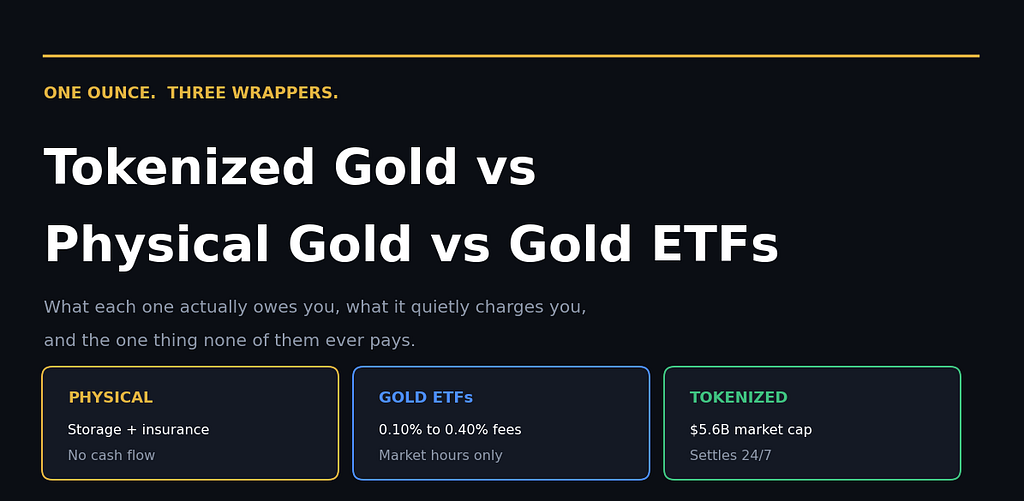
Gold printed $5,589 in January 2026 and traded near $3,963 by June. What you kept had less to do with the metal than with the wrapper you picked.
Tokenized gold vs physical gold vs gold ETFs. One ounce, three wrappers, three very different bills.
Gold did something strange this year.
It printed an all-time high of $5,589.38 in January 2026. By June it was trading near $3,963. In August it rallied about 10% off that base, its best month since January.
Same metal. Same bars. Same vaults in London and Zurich.
What changed for holders was not the gold. It was the wrapper.
Physical bullion, gold ETF shares and tokenized gold are three claims on the same ounce.
They carry different costs, different rights and completely different settlement rules. Most comparisons stop at “which one is best.” That question has no answer.
The better question is quieter. What does each wrapper actually owe you, and what is it charging you to hold it?
Gold’s 2026 round trip. The metal moved the same way for everyone. The wrapper decided what that move cost you.
Tokenized gold went from rounding error to real market in fifteen months
The category stopped being an experiment somewhere around Q1 2026.
Tokenized gold closed Q1 2026 at roughly $5.6 billion in market cap, up 30% in a single quarter.That is about 5.5 times faster than physical gold holdings grew over the same period, the quickest pace on record.Q1 spot volume hit roughly $82 billion, a jump of around 1,300% year over year.More than 44,500 new wallets joined the category in the quarter, its largest holder growth ever.Value deployed into DeFi rose 123%, meaning gold started being used as collateral rather than just held.
Two issuers carry almost all of it. Tether Gold (XAUT) and Pax Gold (PAXG) account for somewhere between 90% and 96% of the category depending on the week.
That concentration is the part most explainers skip. A young market with two dominant issuers is a custody and redemption question first, and a liquidity story second.
Tokenized gold category market cap. Roughly 289% growth in fifteen months, and 30% in Q1 2026 alone.
Physical bullion: no counterparty, no cash flow, very real carry
Physical is the purist option and the most expensive one to run.
You pay a dealer premium on the way in and eat a spread on the way out.Vaulting and insurance cost real basis points every single year you hold.Selling means finding a buyer, shipping metal, or trusting a dealer’s bid on the day.There is no cash flow. Not now, not ever.
Sovereign buyers want it anyway. Central banks purchased a record 288.9 tonnes in Q2 2026, up 62% year over year, taking first-half buying to 345 tonnes, according to the World Gold Council.
The European Central Bank noted in June that gold has now overtaken US Treasuries as the largest reserve asset held globally.
Read the behaviour gap there. Sovereigns bought while the price fell. Fund holders sold into the same weakness.
Q2 2026 in one chart. Central banks bought a record quarter of gold while ETF holders redeemed.
Gold ETFs: the cheapest access, and an exit door that shuts at 4pm
ETFs solved gold’s storage problem and quietly introduced a different one.
Expense ratios run about 0.40% for GLD, 0.25% for IAU and 0.10% for GLDM.You hold fund shares, not allocated metal with your name on a bar list.Trading stops when the exchange closes, and settlement is T+1 or T+2.Gold ETFs recorded 45 tonnes of net outflows in Q2 2026, concentrated in North America.
Here is the uncomfortable number. Standard Chartered’s Suki Cooper estimated in June that roughly 298 tonnes of ETF gold was sitting at a loss at prices near $4,000. Those are not long-term holders. That is exit liquidity waiting for a price.
Worth noting the split inside that headline. Western funds drove the redemptions while Asian gold ETFs took inflows, because in much of Asia these products are used as savings vehicles rather than rate bets.
Tokenized gold: 24/7 settlement, and a brand new counterparty to underwrite
Tokenized gold is a genuine upgrade to the plumbing.
PAXG is issued by Paxos, backed by LBMA Good Delivery bars, with zero storage fees and monthly attestations.XAUT is backed by allocated gold in Swiss vaults, with deep liquidity on offshore venues.Both settle near instantly, trade every hour of every day, and divide into fractions no bullion dealer would entertain.Both can be posted as onchain collateral, which neither a bar in a safe nor an ETF share can do.
One January episode showed why that plumbing matters. XAUT pushed through $5,100 during a stretch of overlapping macro shocks, and a good part of that move happened outside US market hours. Token holders could act on it that night. ETF holders waited for the bell.
Then read the fine print, because it is short and it matters.
Redemption for metal carries minimums. PAXG requires over 430 tokens for Good Delivery bars.Issuers retain the ability to freeze addresses.You take smart contract risk and gas costs on top of gold’s own volatility.Regional restrictions still apply, and they differ by issuer.
Tokenization did not remove the trust problem. It relocated it, from a vault operator to a token issuer, and it made the audit trail public in the process.
“Tokenization changed where gold lives. It did not change what gold does, which is nothing.”
The number every gold comparison leaves out
Strip all three wrappers back and one property survives every one of them.
Gold does not pay you.
Physical pays nothing and costs storage. ETFs pay nothing and charge an expense ratio. Tokenized gold pays nothing and charges gas.
The only version that produces income is one you lend out, and that is a credit decision wearing a gold costume.
None of that is an argument against gold. Purchasing power protection is a real job and gold has done it for centuries. It is an argument against pretending the carry is zero.
Annual carry on $10,000 of gold. The bar that reads zero still pays nothing, which is the cost nobody charts.
Which raises a more useful question than the wrapper debate ever will. If the gold sleeve of a portfolio is doing the hedging job, what exactly is the dollar sleeve doing?
Where the Sky Savings Rate, sUSDS and USDS actually fit
This is a different job, and it deserves a different tool.
Sky Ecosystem is a global savings and capital allocation network. Sky Protocol connects stablecoin liquidity to independent allocators who put it to work under risk limits set in public through Sky Governance and enforced automatically by smart contracts.
The mechanics, in plain terms:
USDS is the fully backed stablecoin and the unit of account, convertible 1:1 through Peg Stability Modules with no slippage and no fees.Supplying USDS returns sUSDS, a yield-generating stablecoin that accrues the Sky Savings Rate programmatically.The Sky Savings Rate is variable and set by SKY token holder governance, not by any single company.No lockups, no exit fees, and users retain non-custodial control of their holdings throughout.
The scale behind it is public and checkable:
Protocol Collateral stands at roughly $14.15 billion, with stablecoin supply near $11.48 billion.Sky Frontier Foundation reported $107.35 million in Gross Protocol Revenue and $33.29 million in Net Protocol Surplus for Q2 2026, a fifth consecutive positive quarter.Protocol Collateral rose 45.5% year over year, and sUSDS supply grew 149% to $5.52 billion.
Where a gold holder has to manufacture income by lending the metal out, the Sky Savings Rate is funded from revenue the Sky Agent Network generates by deploying USDS liquidity into institutional-grade strategies.
Every figure above can be checked against the live dashboards rather than taken on faith.
Sky Protocol scale as of August 2026, with the Q2 revenue and surplus figures reported by Sky Frontier Foundation.“Gold is a hedge against the currency. sUSDS is a way to stop the currency sleeve from sitting still.”
Five questions worth more than the wrapper debate
Before arguing about bars versus shares versus tokens, get honest about the job.
Am I protecting purchasing power, or trying to produce cash flow? Gold only does one of those.Do I need redemption for actual metal, or only price exposure? That single answer settles physical versus everything else.What is my all-in annual carry, including spread, storage, expense ratio and gas?Which counterparty am I really underwriting: a vault operator, a fund sponsor, or a token issuer?What is the idle dollar portion of the portfolio doing while gold does its job?
Most people get the first four roughly right and never ask the fifth.
The wrapper is the decision
Gold’s 2026 has been a lesson in structure over story. The metal moved. The wrapper decided what that movement actually cost.
Tokenized gold is the most flexible version of a very old asset. It is still that old asset.
The dollar side of the same portfolio is a separate question, and it has a separate answer.
So which wrapper are you actually holding, and what is it costing you to hold it? Drop it in the comments. If you think the zero-carry claim on tokenized gold is generous, say so, I want to hear the argument.
Disclaimer: This article is for informational and educational purposes only. It is not financial, legal or tax advice, and it is not a recommendation to buy, sell or hold any digital asset.
Tokenized Gold vs Physical Gold vs Gold ETFs: One Ounce, Three Wrappers, Three Very Different Bills was originally published in Coinmonks on Medium, where people are continuing the conversation by highlighting and responding to this story.