
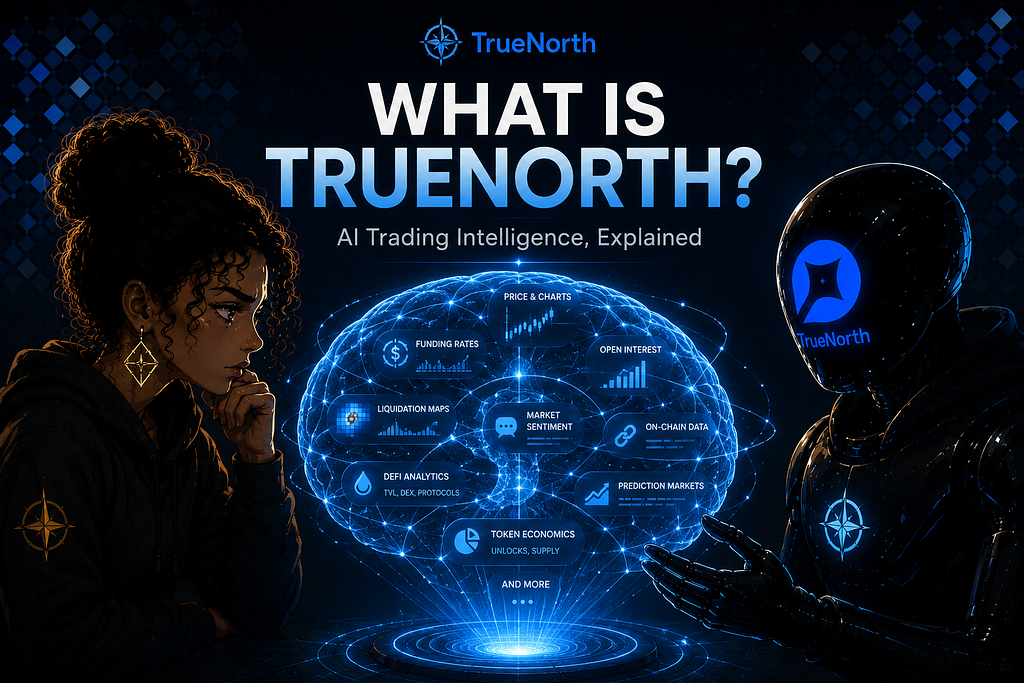
What it does, what data it can analyze, how its trading intelligence works and where it actually fits into a trader’s workflow
My crypto research usually doesn’t happen in one place. I might open a chart to look at price structure. Then check funding. Then open interest. Then liquidation levels. Then on-chain data. Then prediction markets.
Then go back to the chart because something I found changed the original thesis.
And somewhere around tab number ten, the actual question I started with becomes:
Wait… what was I trying to figure out again?
TrueNorth approaches this problem differently. Instead of making you search through the data first, it lets you start with the question.
Then the system goes looking for the data needed to answer it.
I’ve been testing TrueNorth for a while now, from simple market questions to multi-agent experiments, news analysis and actual trading setups.
So this isn’t going to be another:
“AI will change trading forever.”
Let’s look at what TrueNorth actually is, what it can do today, and just as importantly, what it can’t do.
What Is TrueNorth?
TrueNorth describes itself as an AI trading intelligence platform.
A simple way to think about it is somewhere between an AI research assistant and a trading terminal.
But the important distinction is that this isn’t just a chatbot that happens to know something about crypto.
TrueNorth connects AI to real-time financial data and specialized analytical tools.
Its current documentation lists 30+ real-time data sources, including CoinGecko, DeFiLlama, Hyperliquid and Polymarket, among others.
And while most of my own testing has focused on crypto, TrueNorth’s current scope goes beyond it: its market scanners cover crypto, equities, prediction markets and commodities.
That means instead of asking an LLM:
Is SOL bullish?
you can ask something much closer to:
Where are the largest liquidation clusters around SOL right now, what is funding doing, how is open interest changing, and does positioning support the current price trend?
That’s a very different problem. The AI isn’t useful because it can generate another opinion.
It’s useful when it can assemble the evidence behind that opinion.
From Ten Tabs to One Question
Crypto traders don’t suffer from a lack of data. We probably have too much of it.
A serious market read can involve:
Price -> technical structure -> volume -> funding -> open interest -> liquidations -> on-chain activity -> relative strength -> prediction markets -> news.
Those signals often live in different places. But collecting them isn’t even the hardest part.
The harder question is:
What does all of this mean together?
Imagine BTC is rising.
Bullish?
Maybe.
But what if open interest is exploding at the same time? What if funding is extremely positive? What if a large concentration of long liquidations sits directly below price?
Suddenly the exact same bullish chart has a very different risk profile.
TrueNorth’s approach is to put an intelligence layer on top of these datasets.
Instead of:
find data ->compare data ->construct thesis
the workflow becomes:
ask question -> retrieve relevant data -> synthesize it -> review the thesis.
That’s the part I find interesting.
Two Layers of Intelligence
TrueNorth’s current documentation separates its capabilities into two broad layers:
Specialized Tools and Expert Playbooks.
The distinction matters.
Layer 1: Specialized Tools
These are useful when you already know what you’re looking for.
For example: What’s BTC funding right now?
or: Show me ETH open interest.
or: What’s SOL’s RSI?
The documented toolset includes:
technical indicators such as RSI, MACD, support/resistance and volume analysis;derivatives intelligence including funding rates, open interest and liquidation clusters;on-chain metrics such as TVL, DEX volume and protocol activity;market discovery and performance rankings;token economics and unlock schedules;prediction-market data;KOL tracking;DeFi analytics.
Think of this as the data retrieval layer. But the second layer is where things get more interesting.
Layer 2: Expert Playbooks
Instead of requesting one metric, you can ask TrueNorth to investigate an entire problem.
For example: Analyze Bitcoin.
or: Give me a trading setup for ETH.
The documented Playbooks can orchestrate multiple data sources and turn them into a structured analysis. Current examples include Comprehensive Analysis, Technical Trading Setup and Tokenized Stock Research.
So instead of receiving a giant paragraph saying: “ETH looks bullish, although traders should remain cautious due to volatility…”
you can get something structured around:
Bias
Entry
Stop
Invalidation
Targets
Risk/reward
and, crucially:
Why?
Thanks, AI. That’s a little more useful. 😂
Derivatives Are Where It Gets Interesting
One of the areas I’ve found particularly useful is derivatives positioning.
TrueNorth can combine:
funding rates;open interest and its changes;liquidation distribution;price structure;
and use them to reason about positioning, crowded trades, potential squeezes and stop-hunt risk. Its own prompt guide specifically includes workflows for liquidation heatmaps, derivatives positioning, short-squeeze setups and stop-hunt analysis.
That allows for questions that can’t really be answered from a candlestick chart alone.
For example: Which major crypto asset currently has the strongest positioning asymmetry?
Now the AI isn’t simply looking for the coin that went up the most.
It can investigate:
Are longs crowded?
Are shorts crowded?
Is OI rising with price?
Is funding becoming expensive?
Where are liquidations concentrated?
Is the market sitting underneath a wall of potential forced short buying?
Or above a potential long-liquidation cascade?
Suddenly you’re analyzing market positioning, not just price.
But Can It Actually Find Trades?
This was obviously one of the first things I wanted to test.
So instead of giving TrueNorth an asset, I started asking it to scan the market itself and choose the best setup it could find.
A typical output can include:
Asset
Direction
Entry condition
Entry
Stop
Targets
Risk/reward
Invalidation
But there’s something much more important than getting a beautifully formatted setup.
Does the trade actually work?
Here’s a real example.
A Real Trade: When TrueNorth Was Wrong
Recently, I asked TrueNorth to scan the market and choose the single trade it considered worth taking.
It selected an XRP long breakout. The thesis looked reasonable. Trend was strong. Funding wasn’t particularly crowded. Open interest wasn’t extreme.
There were short-liquidation levels above price that could potentially fuel a squeeze.
And the proposed trade offered roughly 2.3:1 risk/reward to its first target.
I took it.
The breakout triggered.
And then?
Stop-loss.
The trade failed.
I think this example is more important than showing you a screenshot of a +100% leveraged trade.
Because it demonstrates something that tends to disappear from conversations about AI trading:
Good analysis does not guarantee a profitable outcome.
An AI can identify a reasonable asymmetry. The thesis can make sense. The risk/reward can be attractive. And the next trade can still lose. That’s trading.
TrueNorth isn’t a crystal ball. And I wouldn’t trust any trading AI that pretended to be one.
Sometimes It Refuses to Give Me a Trade
Interestingly, I’ve also asked TrueNorth to find me a position and gotten:
NO TRADE.
Not: “Here’s the least terrible setup I could find because you asked me for something.”
Just: No trade.
In one recent scan, the strongest candidates were already extended near their highs.
Buying meant chasing momentum. Shorting meant fighting a strong trend. And the available stops and targets produced poor trade geometry. So the conclusion was simply to wait. I like this more than I expected.
Because an AI that is implicitly rewarded for always producing an answer can be dangerous in trading.
Sometimes the correct decision is: do nothing.
Entry Price Isn’t the Same as Entry Confirmation
This is another thing I’ve been experimenting with.
Suppose an asset has resistance at $100.
There’s a huge difference between: “Buy at $100.”
and: “If price breaks $100, closes above it, holds the level on a retest, and positioning confirms the move, then consider entering.”
Price touching a level isn’t automatically confirmation.
Depending on the setup, TrueNorth can reason about things like candle closes, reclaims, retests, volume or derivatives positioning before treating a thesis as actionable.
That’s the difference between: “BTC is at X.”
and: “If X happens under Y conditions, the thesis becomes actionable.”
For me, that’s much more useful.
TrueNorth Can Remember the Trading Context
There’s another difference from a completely blank-slate chatbot: contextual memory.
TrueNorth’s current documentation describes memory across the trading workflow and a system designed to stay engaged across plan -> execute -> iterate, rather than treating every prompt as an isolated interaction.
That becomes useful when the question isn’t: What does BTC look like?
but: What changed since the thesis we built earlier?
Markets evolve.
The useful context often isn’t just the current price.
It’s what changed relative to the plan you were already watching.
I Don’t Only Ask It What to Buy
This might actually be my favorite way to use TrueNorth.
Not: What should I buy?
But: Destroy my thesis.
I’ve experimented with giving one agent a trading idea and then opening a fresh session whose only job was to argue against it.
Then I used another agent to judge the two arguments.
The goal wasn’t to create an AI debate club.
It was to fight confirmation bias.
Because once I’ve decided I like a trade, I naturally start looking for evidence that supports it.
So instead I can ask:
What am I missing?
What’s the strongest argument against this trade?
What data would invalidate my thesis?
Is this actually a good setup, or am I interpreting the data the way I want?
That’s a much more interesting use of AI than asking it to predict tomorrow’s candle.
Can AI Tell Whether a News Story Actually Matters?
Here’s another experiment I ran.
Michael Saylor announced that Strategy had increased its USD Reserve to $5.10 billion, established additional USD cash, and repurchased STRC.
The easy crypto-Twitter interpretation would be:
Saylor + billions = bullish BTC.
So I gave the announcement to TrueNorth and asked it to classify the actual signal.
Its conclusion was essentially:
Balance-sheet signal, not a BTC signal.
The reasoning was simple but important.
Available capital and actual BTC demand aren’t the same thing.
The announcement demonstrated potential buying capacity.
It didn’t announce that those billions had just been deployed into Bitcoin.
That doesn’t automatically make the news bearish.
It simply separates: what the headline sounds like
from: what actually changed.
That’s exactly the kind of job I want a research assistant doing.
Prediction Markets, DeFi and On-Chain Research
TrueNorth isn’t limited to candlestick analysis.
Its documented toolset also includes prediction markets, DeFi analytics and on-chain metrics such as TVL, DEX volume and protocol activity. It also covers market discovery, token economics and other crypto-specific research categories.
So the question space can be much broader than: Long or short BTC?
You can investigate protocols. Compare market narratives. Look at relative performance. Examine prediction-market probabilities. Research token unlocks. Or combine several perspectives into one thesis.
TrueNorth Beyond the App: MCP and CLI
Another interesting part of TrueNorth is that its intelligence isn’t necessarily confined to the main interface.
TrueNorth provides an MCP implementation that exposes the same broad idea of specialized tools and larger research workflows to compatible AI environments.
There’s also a public TrueNorth CLI.
And its architecture is interesting.
Instead of maintaining a fixed list of tool-specific commands, the CLI discovers available tool names and schemas from TrueNorth’s API at runtime.
That means the live API remains the source of truth as the available analytical tools evolve. The CLI can discover tools, call individual tools and batch independent calls.
In other words, TrueNorth is increasingly interesting not only as an interface for traders, but as an intelligence layer that can be used in other AI workflows.
That’s a very different direction from simply building another charting app with a chatbot attached.
What TrueNorth Is NOT
This section matters as much as the feature list.
TrueNorth is not: a money printer.
It’s not: an oracle.
And it shouldn’t replace your own risk management.
It can produce a trade that loses. It can analyze a market where the correct answer is NO TRADE. And an analysis that made sense earlier can become invalid when the underlying data changes.
That’s not a flaw unique to AI. That’s what markets are.
The useful question isn’t: Can TrueNorth predict every trade correctly?
Obviously not.
The useful question is: Can it help me make better-informed decisions with more relevant context and fewer blind spots?
That’s the standard I’m interested in testing.
How I Actually Use TrueNorth
After experimenting with it, I rarely use TrueNorth as a simple:
“Tell me what to buy.”
Instead, I use it for questions like:
Compare these assets and tell me where positioning is most asymmetric.
Find the strongest argument against my trade.
Is this breakout supported by OI and funding, or am I chasing price?
What would have to happen for this thesis to become invalid?
Does this news actually change the market, or does it just sound bullish?
Find one trade worth taking, and say NO TRADE if none exists.
That last part is important. The goal isn’t to outsource the decision.
It’s to improve the information going into it.
TrueNorth vs. a General AI Chatbot
A general AI model can explain funding. It can teach you what open interest means. It can explain RSI. It can help you build a trading framework. Those things are useful.
But there’s a fundamental difference between explaining:
what funding means
and analyzing: what current funding + OI + liquidations + price structure imply together.
TrueNorth is trying to operate in that second layer.
Its official positioning emphasizes real-time financial feeds, structured trading outputs and a workflow built specifically for traders rather than generic conversation.
That’s the real distinction.
Not: AI knows finance.
But: AI has financial tools.
Final Thoughts
The most interesting thing about TrueNorth isn’t that it can tell me: LONG.
Or: SHORT.
It’s that I can ask a market question and force the answer through multiple layers of evidence.
Price.
Structure.
Funding.
Open interest.
Liquidations.
On-chain data.
Prediction markets.
Whatever is actually relevant to the question.
Then I can challenge the conclusion.
Ask for the bearish case.
Ask what would invalidate it. Or simply decide I disagree.
That’s a much healthier relationship with trading AI than:
“AI said buy, so I bought.”
I don’t think the interesting future of trading is human vs. AI.
And I don’t think it’s AI replaces trader.
The more useful model is: AI expands what one trader can investigate.
Humans are still responsible for judgment.
For risk. For execution. And for knowing when not to press the button.
For me, that’s where TrueNorth becomes interesting. Not as an AI that trades instead of me.
As an AI that gives me more context before I decide to trade.
What Is TrueNorth? A Practical Guide to AI-Powered Crypto Research and Trading was originally published in Coinmonks on Medium, where people are continuing the conversation by highlighting and responding to this story.