
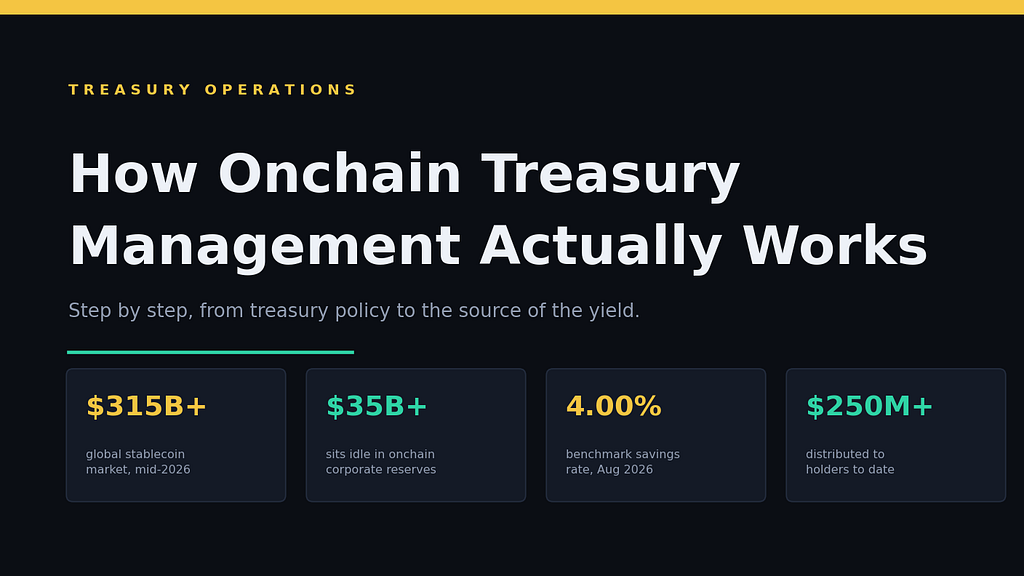
Six steps, one uncomfortable question, and the part almost every finance team skips.
How onchain treasury management actually works, step by step. A Sky Ecosystem treasury series explainer.
In the first quarter of 2026, companies, DAOs and fintechs were holding more than $35 billion in onchain stablecoin reserves.
Most of that balance did nothing.
Not underperformed. Nothing. A flat number in a wallet somebody checks on Fridays.
Here is the odd part. The same finance team that runs a careful maturity ladder for its offchain cash will let the onchain balance sit at zero for twelve months and call it conservative.
It is not conservative. It is unpriced.
Onchain treasury management is the work of turning that unpriced balance into a documented position: what you hold, why you hold it, where it can go, and how fast you can get it back.
The market has already moved. Roughly 60% of stablecoin payment volume now comes from B2B activity rather than trading, and 74% of finance leaders say stablecoins improve cash-flow efficiency.
Here is how the work actually gets done.
The six-step onchain treasury workflow. Steps 1 and 2 are governance, steps 3 to 5 are allocation, step 6 is the one auditors ask about.
Step 1: Write the Treasury Policy Before You Move a Single Dollar
Almost every crypto treasury management failure starts the same way. Someone moved the funds first and wrote the rules afterwards.
A working treasury policy fits on one page. It answers five things:
Mandate. Is this treasury protecting runway, funding operations, or both?Limits. Maximum share per issuer, per chain, per counterparty.Signers. Who can move funds, at what size, with how many approvals.Liquidity floor. The balance that never leaves instant access, whatever the rate is doing.Review cadence. Monthly is normal. Quarterly is the floor.
Write it before the first transaction. The policy is what turns a digital asset treasury from a personality into a process.
Step 2: Choose Your Dollars, Because Issuer Risk Is Not Diversified by Default
Holding four stablecoins is not diversification if you have never checked what sits behind them.
For every dollar in the treasury, answer three questions:
What backs it? Bank reserves, onchain collateral, or a hedged derivatives position. Those are three completely different risks wearing the same ticker shape.How do I redeem? Directly with the protocol, or through a market maker at whatever price the order book offers that morning.Who sets the terms? A company, or an onchain governance process with a public voting record.
USDS, the core stablecoin of Sky Ecosystem, is overcollateralized and backed by a diversified collateral base.
Protocol Collateral reached $12.32B at the close of Q2 2026, up 45.5% year over year.
Redemption runs through the Peg Stability Module, which has processed roughly $550M in USDC to USDS volume through its Uniswap integration.
A redemption path you can test is worth more than a rate you cannot exit.
Step 3: Price What “Idle” Actually Costs You
What an idle treasury actually costs. A $10M balance held flat versus supplied at a 4.00% Sky Savings Rate over twelve months. Illustrative only.
Most treasuries never run this calculation, which is exactly why it never gets fixed.
Take $10 million. Hold it flat for a year. Now supply the same balance into a yield-bearing stablecoin instead.
At the Sky Savings Rate, which sits at 4.00% APY as of August 2026, the gap is roughly $407,000 over the year. That is a senior hire. Or a runway extension. Or the entire audit budget.
The rate is accessed through sUSDS, the largest rate-bearing stablecoin by supply. Three properties make it usable for treasury work rather than trading:
It stays liquid. No lock-ups, no notice period, no exit fee.It accrues on its own. The token appreciates against USDS, so there is nothing to claim and nothing to compound manually.It is non-custodial. The treasury keeps control of its own funds the whole time.
The rate is variable and set by Sky Governance, not by borrowing demand on a lending market. Check it live before you model anything on it.
Step 4: Trace the Yield to Its Source (Most Teams Stop Asking Here)
Follow the money. Sky Protocol supplies USDS liquidity, the Sky Agent Network deploys it, returns become protocol revenue, and governance calibrates the Sky Savings Rate.Ask one question about any onchain yield: who is paying it, and out of what?
If the answer is a token emission, you are being paid in dilution. If the answer is a funding rate, you are quietly short volatility and you should know that. If the answer is protocol revenue, you can audit it.
For the Sky Savings Rate, the chain of custody is public:
Sky Protocol makes USDS liquidity available under governance-set risk parameters.The Sky Agent Network, an independent group of capital allocators, borrows that liquidity and deploys it across diversified strategies spanning collateralized lending, treasury bills and tokenized real-world assets.Those returns flow back as protocol revenue. Gross Protocol Revenue reached $107.35M in Q2 2026, the second straight quarter above $100M.Governance then calibrates the savings rate against that revenue base. In July 2026 it cut the Sky Spread to zero, narrowing the gap between the Base Rate and the savings rate.
Prime Agent Vaults closed Q2 2026 at $6.84B, with roughly $2.58B deployed across Janus Henderson, BlackRock, Anchorage, PayPal, Securitize and Galaxy. Grove, one of the agents, now backs a $500 million warehouse lending facility with Galaxy.
Scale is a risk control, not a vanity metric. sUSDS supply and Protocol Collateral, Q2 2025 versus Q2 2026.
Scale is not a vanity metric in treasury work. It is what lets you exit at size without moving the price.
sUSDS closed Q2 2026 at $5.52B, up 149% year over year. In Q1 alone it added more new capital than the next four yield-bearing stablecoins combined.
Step 5: Build the Liquidity Ladder Before You Chase the Rate
Build the liquidity ladder before you chase the rate. Three tiers: operating float, working reserve, strategic reserve.
Sort the treasury by when you need the money, not by which line shows the biggest number.
Three tiers cover almost every operating business:
Tier 1, operating float, 0 to 30 days. Plain payment dollars. No rate. This is the payroll tier and it should be boring.Tier 2, working reserve, 1 to 6 months. sUSDS at the Sky Savings Rate. Liquid, variable, no lock-up. This is where most of the balance belongs.Tier 3, strategic reserve, 6 months and beyond. Fixed-rate positions sized to a known maturity date.
Tier 3 is newer than most treasurers realise. The Fixed Yield product for sUSDS reached $55.94M in TVL at a 5.37% fixed rate in late July 2026, with a 26 November 2026 maturity.
Swapping a floating rate for a fixed one against a known date is a familiar trade in any treasury seat. It just settles faster here.
Step 6: Report It Like a Public Company
Roughly 80% of Sky Protocol Q2 2026 expenses went to sUSDS holders through the Sky Savings Rate.
Blockchain treasury operations have one genuine advantage over the offchain version. You can prove your numbers instead of asserting them.
Build the monthly pack around four lines:
Balance by issuer, chain and wallet, with block explorer links next to each one.Realised rate for the period, not the advertised rate.Counterparty and protocol exposure measured against your own policy limits.Any governance or parameter change that touched your positions during the month.
Sky Frontier Foundation publishes on the same rhythm. The Q2 2026 report showed $33.29M in Net Protocol Surplus, a fifth consecutive positive quarter, and $53.91M paid to sUSDS holders through the savings rate.
That single line was roughly 80% of the quarter’s protocol expenses. Cumulative distributions have now crossed $250M.
Read the expense line, not the marketing line. It tells you where a protocol’s priorities actually sit.
Three Mistakes That Show Up in Almost Every Onchain Treasury
Chasing the headline rate. A rate you cannot exit at size is a quote, not a return. Size your position against daily liquidity, not against the APY box.Treating “audited” as a synonym for “safe.” Ask when, by whom, and what has shipped since. Sky Ecosystem currently has an AI-assisted security review running with Sherlock across every module and associated contract.Skipping the drawdown test. During April’s roughly $292M Kelp DAO bridge exploit and the multi-billion-dollar collateral contraction that followed it, Sky Protocol operated without interruption and took no losses. Ask any protocol you use what its worst week looked like. If nobody can answer, that is the answer.
The Question Worth Arguing About
Most treasury debates get framed as risk versus return. That framing is lazy and it lets everyone off the hook.
The real question is simpler and much harder to dodge:
Can you explain, in one paragraph, where your yield comes from and who is on the other side of it?
If you can, the rate is a decision. If you cannot, the rate is a story someone told you.
So, honest answers in the comments: what percentage of your treasury is sitting flat right now, and what is genuinely stopping you from moving it? Policy? Signers? Or nobody has ever asked?
Sky Ecosystem is a global savings and capital allocation network managing billions in diversified assets, powering the Sky Savings Rate, accessed through sUSDS. Explore the network at skyeco.com. The Sky Savings Rate is a variable rate set by SKY token holder governance. This article is for informational purposes only and is not financial, legal or tax advice.
How Onchain Treasury Management Actually Works, Step by Step was originally published in Coinmonks on Medium, where people are continuing the conversation by highlighting and responding to this story.