
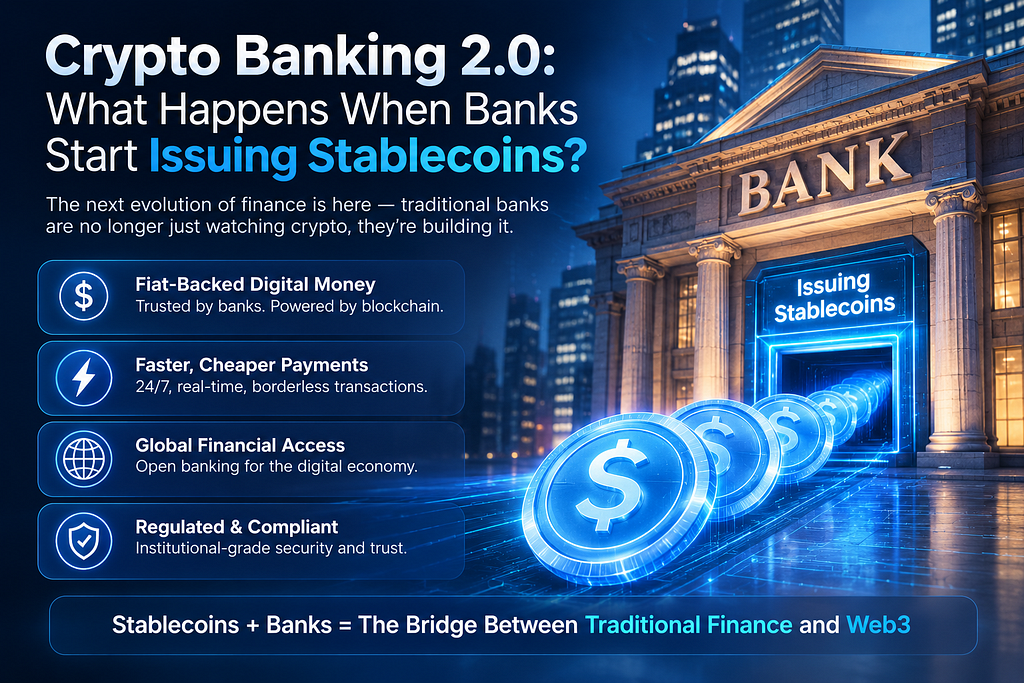
The line between traditional finance and crypto just got a lot thinner.
For years, banks watched stablecoins from the sidelines. Now they’re stepping onto the field and some are already preparing to issue their own.
This isn’t another hype cycle. It’s a quiet but significant shift in how money moves, settles, and earns yield. When regulated banks begin issuing stablecoins, the entire financial plumbing changes. Here’s what that future looks like, why it matters, and what it means for everyday users, institutions, and the broader crypto market.
Generative AI
Why Banks Are Entering the Stablecoin Game
Stablecoins have already proven their utility. They move value across borders in minutes instead of days, settle 24/7, and sit on transparent ledgers. Tether and USDC process hundreds of billions in volume monthly. That kind of efficiency is hard for banks to ignore especially when their own customers keep asking for faster, cheaper ways to move money.
Regulators have also shifted tone. In several major jurisdictions, frameworks for bank-issued digital dollars (or euro, yen, etc.) are taking shape. The message is clear: if stablecoins are going to be part of the financial system, better they come from institutions that already face capital requirements, AML rules, and consumer protection standards.
For banks, issuing a stablecoin isn’t just about keeping up. It’s about reclaiming territory. Right now, a large share of on-chain dollar activity lives outside the traditional banking system. A bank-issued stablecoin brings that activity back onto their balance sheet, under their compliance umbrella, and potentially into their product suite.
What Changes When Banks Issue the Coins
1. Trust and regulation get baked in Most current stablecoins rely on reserves held at banks or in short-term Treasuries, with varying levels of transparency. A bank-issued version can carry the full weight of the bank’s charter, deposit insurance frameworks (where applicable), and regulatory oversight. That doesn’t make them risk-free, but it does change the risk profile. Institutional treasurers and risk committees who currently hesitate may suddenly find the product acceptable.
2. Settlement rails get upgraded Banks already sit at the center of payment systems. Pair that with a programmable digital dollar and you get near-instant settlement between counterparties that currently wait for ACH or wire windows. Cross-border payments, which still rely on correspondent banking chains, become dramatically simpler when both ends of the transaction can hold the same bank-issued stablecoin.
3. Yield and product design evolve Some bank stablecoins may remain non-yielding (closer to digital cash). Others could offer interest, depending on regulatory treatment. Either way, banks can layer familiar products credit lines, treasury management tools, escrow services on top of the token. The stablecoin becomes infrastructure rather than the product itself.
4. Liquidity and market structure shift Today’s major stablecoins dominate on-chain liquidity. Bank-issued versions could fragment that market at first, then consolidate around the most trusted and widely accepted ones. Exchanges, DeFi protocols, and payment apps will need to decide which bank coins to support. Network effects will matter a lot.
The Practical Impact on Users and Businesses
For individuals, the most visible change may be in everyday payments and remittances. Imagine sending money abroad without the usual 3–7 day wait or the 5–10% fee haircut. Or holding a digital dollar that can move into a savings product, a payment app, or a trading platform without leaving the regulated banking perimeter.
For businesses, the upside is operational. Payroll, supplier payments, and intercompany transfers can settle in minutes. Working capital gets freed up because money spends less time trapped in transit. Treasury teams gain real-time visibility into balances that currently sit in opaque correspondent accounts.
Institutions already exploring tokenized deposits and on-chain settlement will find bank stablecoins a natural extension. The difference is that these tokens come with the bank’s name and regulatory status attached.
Risks and Open Questions
This transition won’t be frictionless. Several issues still need clarity:
Interoperability: Will different banks’ stablecoins talk to each other easily, or will we end up with siloed digital dollars?Reserve and redemption rules: How quickly can holders redeem for fiat, and under what stress scenarios?Competition with existing stablecoins: Will bank versions coexist with, or gradually displace, the current leaders?Monetary policy transmission: Central banks are watching closely. Widespread use of bank-issued digital money could change how policy rates flow through the system.
There’s also the question of innovation speed. Banks move carefully by design. Pure crypto-native stablecoin issuers have iterated faster. The challenge for banks will be delivering the reliability of traditional finance without losing the speed and programmability that made stablecoins useful in the first place.
Looking Ahead: Crypto Banking 2.0
We’re not talking about banks “adopting crypto” in the superficial sense of offering a trading app. This is deeper. It’s banks treating digital dollars as a core product and settlement layer.
In the best version of this future, users get faster, cheaper, more programmable money that still sits inside a regulated framework. Liquidity becomes more resilient. Compliance becomes clearer. And the boundary between “crypto” and “banking” starts to dissolve into something more practical: just better money rails.
That future is already being built in regulatory sandboxes, pilot programs, and boardroom discussions. The institutions that treat stablecoins as infrastructure rather than a side experiment will shape the next decade of payments and settlement.
Crypto Banking 2.0 isn’t about replacing banks. It’s about banks finally building the kind of digital money the market has been demanding for years only this time, with their own name on it.
Crypto Banking 2.0: What Happens When Banks Start Issuing Stablecoins? was originally published in Coinmonks on Medium, where people are continuing the conversation by highlighting and responding to this story.