
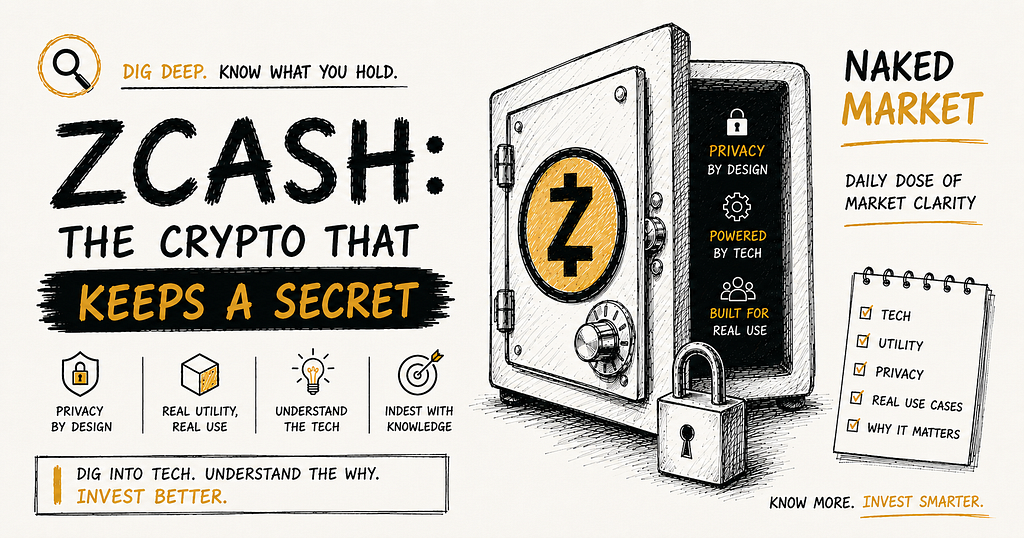
Zcash, the coin almost nobody knows, built to do the one thing Bitcoin cant.
Let me introduce you to a coin youve probably never really looked at. Not its price, its soul. Its called Zcash, and it can do one thing Bitcoin simply cannot. It can keep a secret.
You know Bitcoin. Everyone does. But heres what nobody mentions at the dinner table: Bitcoin keeps no secrets at all. Every payment you have ever made on it is painted on a glass wall the whole world can read, forever. Your salary. Your rent. The money you sent your brother. That donation youd rather keep quiet. All of it, legible from the street, to anyone who cares to look. Zcash was built to pull the curtains.
And that is what this new series is really about. Im calling it The Teardown. One coin at a time, well crack a single one open like the back of a watch, not to guess where its price is heading, but to see the actual machine inside. Because I dont want you holding anything just because a chart went up. I want you to be the person who, when a friend asks why you own it, doesnt shrug and mumble a number, but explains the idea, the tech, the reason the thing exists. Price is what you pay. Understanding is what you keep.
One honest word before we climb in
Friend to friend, quickly.
This issue goes deeper than usual. Were climbing inside actual cryptography today, the machinery, not just the headline. And Ive decided thats the whole point of Naked Market. As we grow, Im going to keep taking you further down than most newsletters dare, because Id rather teach you one genuinely hard thing and lose a few readers than keep you comfortable and teach you nothing you didnt already know.
So if a stretch of this feels difficult, good. Sit with it. That feeling is you learning something almost nobody around you understands. Reread the tricky bit. Or step back to the earlier issues where we poured the foundation, like how blockchain actually works and why a blockchain cant be secretly changed. Nothing here is beyond you. I promise to explain every hard idea the way a friend would over coffee, slowly.
Im not here to keep you nodding along at the same three things everyone repeats. Im here to grow with you. Take my hand. Were going somewhere most people never bother to go.
And one more thing, so its said plainly. This is not investment advice. I dont care if you never touch this coin. I fell down a rabbit hole of how this thing is actually built, it rewired how I think about money and privacy, and I just want to show you what I found. Okay. In we go.
Your “anonymous” wallet is a diary
Here is the thing most people get wrong about Bitcoin, and it took me years to really feel it. Bitcoin is not anonymous. It never was.
Every payment you have ever made on it sits on a public ledger, tied to an address, visible to the whole planet, permanently. Yes, the address is a string of letters and numbers, not your name. But an address is a pen-name that writes everything on a public wall. The moment anyone links that pen-name to you, one exchange with your ID, one shop that knows your face, one careless post, your entire history unspools. Every payment before. Every payment after.
And un-masking those pen-names is now an industry. Whole companies exist for one job: sit on top of these transparent chains and connect wallets to humans, mapping the flow of money like a detective’s wall of red string. Governments buy the service. So do scammers. Your “anonymous” wallet is a diary written in a code a professional can crack in an afternoon.
Which leaves a genuinely hard question, the one thats haunted this field since day one.
Can a ledger be verifiable by everyone AND private from everyone, at the same time?
For most of crypto’s life, the honest answer was: pick one. The way you prove a payment is honest, on Bitcoin, is by showing everyone the amounts and addresses so they can add it up themselves. Proof required exposure. To let the world check your maths, you had to show the world your maths. That trade-off felt like a law of nature.
It isnt.
The idea that matters more than money
Here is the single most important idea in this whole issue, and if you take only one thing away, take this. It will change how you see far more than money.
For your entire life, two things have been welded together that were never actually the same thing. Proving that something is true. And revealing why it is true.
Think about how you prove youre old enough to buy a drink. You hand over an ID card. But look at what just happened. To prove one tiny fact, over 18, yes, you exposed a pile of unrelated ones: your exact birthday, your full name, your address, your ID number, your photo. You wanted to prove a single bit and you disclosed a dozen. Proof and disclosure, bundled.
We do this everywhere. To prove you can afford the flat, you show your whole bank balance. To prove youre a citizen, you hand over the entire passport. To prove you have the funds, you reveal exactly how much you have. Every time, to prove one thing, you reveal ten.
What if you could snip them apart? Prove the one fact, really, truly, unfakeably, while revealing nothing else at all?
That is not a fantasy. Its a real branch of mathematics, about forty years old, with a name that sounds like a contradiction: the zero-knowledge proof. It lets you convince someone a statement is true while handing over zero knowledge beyond the fact of its truth. They walk away certain youre over 18, and knowing nothing else. Not your birthday. Nothing.
How is that even possible? Heres the intuition, no equations.
Imagine I claim I can tell red apples from green ones, but youre colour-blind and cant check. So we play. You hold one apple behind your back, show it, hide it again, and ask, did I swap it? I say yes or no. If I really can see the colours, Ill be right every single time. If Im bluffing, chance will eventually catch me. Play twenty rounds and get it right every time, and youre overwhelmingly convinced I can tell them apart, yet you never learned which apple was which, or how I did it. You got the proof. You got none of the knowledge.
Real zero-knowledge proofs do this with numbers instead of apples, in a single shot instead of twenty rounds. But thats the soul of it. Convince, without disclose. Now imagine wrapping your money in that.
Frosted glass
That is exactly what Zcash did, starting back in 2016.
Picture the glass house again, but now some walls are made of a strange, new frosted glass. From outside you cannot see who is in the room, or what they hold, or how much. But the glass glows a steady green, and that green means something precise: everything happening in here obeys every rule. No money was conjured from nothing. Nobody spent a coin they didnt own. Nobody spent the same coin twice. The books balance.
The world gets to verify the room is honest. The world does not get to see inside. Proof, unbundled from disclosure, poured into concrete.
That green glow has a real name, a zk-SNARK, which is a mouthful for “a tiny, quick-to-check proof that a hidden computation was done correctly.” Every private Zcash payment carries one. Now let me show you, gently, how the machine actually works, because this is the part I found genuinely beautiful.
How it is built, part one: two doors
Zcash gives you two kinds of address, and this is the first thing to hold onto.
One is transparent. It starts with a t, and it behaves exactly like Bitcoin, out in the open, readable by all. The glass wall.
The other is shielded. It starts with a z, and everything about it sits behind the frosted glass. Amounts, sender, receiver, all hidden.
You choose. You can hold your coins in the open, move them into the shielded pool, move them back out. Hold that thought, because the fact that its a choice turns out to be both Zcash’s cleverest feature and its biggest weakness. Well get there, honestly.
Part two: a coin becomes a sealed note
Inside the shielded pool, how do you even have a coin nobody can see?
Forget “accounts with balances.” In the shielded world your money exists as a note, think of it as a sealed envelope that says “this is worth 5 ZEC and belongs to whoever holds this secret key.” When a note is created, the network never sees inside it. Instead it publishes only a commitment, a cryptographic fingerprint of the sealed envelope. From the fingerprint you cannot rebuild whats inside, but the fingerprint is unique to that exact note.
Every commitment ever made gets added to one giant, ever-growing tree, a structure that lets anyone later prove “yes, this exact sealed note is in here” without flipping through every envelope. The tree only grows. Notes go in. Nothing is ever crossed out.
Which raises the problem that, when I finally understood how Zcash solves it, actually made me put my coffee down.
Part three: the trick that made me put my coffee down
Heres the puzzle. In Bitcoin, when you spend a coin, the network marks it spent so you cant spend it again. It can do that because it can see the coin. In Zcash, the coin is sealed. Nobody, not even the network, knows which note youre spending. So how on earth do you stop someone spending the same invisible coin twice?
If you cant see the coin, you cant mark it spent. And if you cant mark it spent, whats to stop me copying my 5-ZEC envelope a thousand times?
Zcash’s answer is one of the most elegant tricks Ive seen in any system, anywhere.
When you spend a note, you dont reveal the note. You reveal a single number derived from it, call it a serial number, with two magical properties. First, it can only be computed by the secret owner of that note, using their private key. Second, each note produces exactly one possible serial number, and that number tells you nothing about which note it came from. Its a fingerprint that points to no face.
The network keeps a list of every serial number it has ever seen. When your payment arrives, it does one dumb, simple check. Is this serial number already on the list?
If no, the coin has never been spent. Accept it, and add the serial to the list. If yes, someone already spent this exact coin. Reject.
Thats it. Double-spending is stopped completely, and the network never learns which coin was spent, who owns it, or what it was worth. It only ever learns “this unique-but-faceless serial number is now used up.”
Read that twice if you need to, because it is genuinely one of the cleverest ideas in modern computing. You prove a coin is being spent for the first time, without ever revealing the coin. (Cryptographers call this serial number a nullifier. Now you know why it matters.)
Part four: the green light
So how does the network trust any of this if it cant see anything? This is where the green glow does its work.
Every shielded spend carries a zk-SNARK, a compact proof that quietly guarantees, all at once and all in zero knowledge: that the note youre spending genuinely exists in that great tree (its a real coin, not one you invented); that the serial number you revealed was correctly derived from it (no cheating the double-spend check); that you actually own it (you hold the secret key); and that your inputs and outputs balance to the cent (youre not quietly printing money).
Four crucial truths, proven together, with none of the underlying facts shown. And the beautiful part: the proof is tiny, and checking it is lightning fast. The network verifies it in milliseconds without redoing your computation. One small green light that can only glow if everything behind the glass is honest.
Sit with what just happened. We have a public ledger, anyone can download it, anyone can verify every payment is valid, no trusted keeper needed. And at the same time, every payment on it can be completely private. The two things everyone swore you had to choose between, living together. That is the whole miracle of Zcash, and it took some of the best cryptographers alive to build it.
But, and this is where the story turns human and a little dark, there was a catch. A big one.
The ceremony, and the toxic waste
To make its early proofs work, Zcash needed a set of public “starter numbers,” the master parameters the whole proof system is built on. And there was a terrifying quirk in how they had to be born.
To generate those public numbers, someone first had to generate a matching secret number. Once the public parameters existed, that secret was meant to be destroyed forever, because anyone who kept a copy could do something catastrophic: forge fake proofs. They could counterfeit Zcash out of thin air, make coins from nothing, and the green light would glow valid, and no one could ever tell.
Cryptographers gave this secret a wonderfully honest name. They call it toxic waste.
So in October 2016, before Zcash launched, six people scattered across the planet held what can only be called a ritual. Each one, on their own machine, generated a piece of the parameters and their own shard of toxic waste, then destroyed the toxic waste. The whole thing had one saving grace built in: only one of the six had to be honest. As long as a single participant truly destroyed their secret, the master key could never be reassembled, and the system was safe, even if the other five were crooks.
And the lengths these people went to are the best part. Terrified that a virus or a spy might snatch the toxic waste off a machine before it was destroyed, they got creative. They used computers with the networking hardware physically ripped out, so nothing could phone home. One participant ran the ceremony and then physically destroyed the computer afterward. Another drew part of his randomness from the radioactive decay of a tiny sample, literal physics as a source of un-hackable chance. Radiolab made a whole episode on it. It sounds like a spy film. It was real, and it was guarding a piece of math.
Now, full honesty, because you deserve it. That ceremony is a real asterisk on Zcash’s history. If somehow all six had secretly kept their toxic waste and conspired, they could have counterfeited coins invisibly. (Even in that nightmare they could not have broken anyone’s privacy, the worst case was fake money, not spying. Still, its a real thing to sit with.) For years sceptics pointed at the ceremony and said, how can I trust a system that had to be born in a room full of people I just have to hope were honest?
Fair. And the engineers clearly agreed, because they spent the next six years trying to kill the ceremony entirely.
And then they killed it
In 2022, they did.
A cryptographer on the team named Sean Bowe cracked a long-standing problem and built a new proof system, poetically named Halo, that needs no starter secret at all. No master parameters born from toxic waste. No ceremony. Nobody you have to trust destroyed anything, because there was never a dangerous secret to destroy in the first place. The proofs, in a sense, stand on their own.
With that upgrade (the new shielded system is called Orchard), the original sin was gone. The frosted glass no longer leans on anyone’s promise. It works from the math alone.
This is the part I love about watching a real technology grow up. It began with a fragile, human, slightly terrifying ritual, and then, brick by brick, replaced the fragility with proof.
The twist nobody outside the field connects
And now the thing that made me sit back.
The zero-knowledge machinery Zcash spent a decade forging in the name of privacy turned out to be the thing that would let the entire crypto industry scale.
Heres the link. That same “prove a whole pile of computation happened correctly, in one tiny quick-to-check proof” trick, the thing that lets Zcash hide a payment while proving its valid, is exactly what you need to squeeze thousands of transactions into a single proof and check them cheaply. Drop the privacy angle, keep the compression, and you get whats called a zk-rollup, the leading way Ethereum is being scaled to the world right now. The names racing to do it, zkSync, StarkNet, Scroll, Polygon, are all standing on foundations Zcash and its academic circle laid.
And it reaches further, right back to something we touched last time. Remember cities like Buenos Aires handing millions of residents an ID where you can prove youre over 18 without revealing your birthday? Same family of math. The bouncer trick, running a city.
So heres the real punchline about Zcash, and its a very Naked Market kind of punchline. Its most important product was never the coin. It was the math. Zcash was a ten-year, live-fire research lab that taught the whole world how to prove things without showing them, and that idea is now quietly wiring itself into payments, scaling, identity, and eventually, I think, almost everything.
Now let me turn it over and show you the scratches
A piece that only sells you the shine isnt worth your trust. So, the hard parts.
First, the uncomfortable one everyone asks. Isnt private money just for criminals?
It deserves a real answer, not a dodge. Cash, plain paper cash, is private. Hand someone a note and no record is created, no company logs it, no one sees it. We have lived with private money for all of human history and civilisation did fine. The strange thing, the historically abnormal thing, is not privacy. Its the brand-new idea that every payment you ever make should be permanently recorded and readable by strangers. Transparency-by-default is the weird mutation here, not privacy. Yes, criminals use cash. They also use cars, phones, and the internet, and we didnt ban those. A right isnt void because a villain also enjoys it.
And Zcash has a genuinely clever answer to the part of this that is legitimate. Say you want privacy from the whole world but you still need to prove your income to a tax office, or show your books to an auditor. Zcash builds in a viewing key, a read-only key you can hand to your accountant or the authorities that lets them see your shielded transactions, and only see, never spend. So you can keep your financial life sealed from the street while proving exactly what you must to the people with a real right to check. Privacy, with a door you control. Thats a far more grown-up answer than “hide everything from everyone.”
Second scratch. For most of Zcash’s life, hardly anyone used the private part. Because privacy was optional, a z-address you had to choose, most ZEC just sat in transparent, Bitcoin-like addresses. And privacy has a strange group property: a shielded pool is only as private as it is crowded. If youre one of five people in the frosted room, hiding there isnt worth much. For years, that thin crowd was Zcash’s quiet failure. Its improving fast, by late 2025 roughly a quarter to a third of all ZEC was finally sitting shielded, a record, but the world took a long time to walk into the room.
Third. Regulation. Privacy coins live under a permanent legal cloud. Some exchanges in some countries have delisted them to stay onside with anti-money-laundering rules, in 2025 a couple of big platforms pulled ZEC for users in certain regions. Thats a real, ongoing risk that isnt going away, and pretending otherwise would be lying to you.
Fourth. Nothing here is magic, its engineering, and engineering has bugs. A serious flaw was found in the newer shielded system in 2026 and had to be patched. Normal for hard software, but a reminder that “mathematically private” still runs on human-written code.
About the circus
I should mention the price, since its all anyone talked about. After years as a forgotten “dead coin” under forty dollars, ZEC caught fire in late 2025 and ran up many hundreds of percent, briefly overtaking its old rival Monero as the most valuable privacy coin, pulled along by a big-name investment vehicle, a Nasdaq-listed company that flipped its whole treasury into hoarding ZEC, and a chorus of loud voices predicting a thousand dollars, then ten thousand.
Heres my honest read, and its the only reason Im mentioning any of it. The price is the least interesting part of this whole story, and its the only part the crowd looks at. A lot of that move is reflexive noise, a treasury firm buys, the price rises, which lets it raise more to buy more. But under the noise sits one real signal worth hearing. After a decade, the world is suddenly remembering that financial privacy is not a criminal indulgence but a basic human need, and the people quietly moving their coins into that frosted room, in record numbers, are voting for it with more than words. That shift is real. The price target on some influencer’s screen is not the story. Forget it. Look at the machine.
The one thing to keep
Long after youve forgotten the words nullifier and SNARK, keep this.
Every day, someone asks you to hand over information. And almost every time, they dont actually need to see your information. They only need to check a fact about it. The bar doesnt need your birthday, only “over 18.” The landlord doesnt need your bank balance, only “can pay.” The website doesnt need your whole identity, only “is a real, unique human.” We hand over the entire envelope out of pure habit, because until very recently there was no other way.
Zero-knowledge is the other way. So Ive started running a little filter on every “give me your data” moment, and I want to give it to you. Call it Prove, Dont Show. Ask three things. Does this person need to see this, or only to check it? Could a plain yes-or-no replace the whole document? And if it leaked, who would get hurt, me or them? The more you ask, the more you notice how much of your life you disclose when all anyone needed was a proof.
Privacy, it turns out, was never really about hiding. It was about proving without showing. Once you see that, you cant unsee it.
Where this comes home
Which brings us to the thread this whole newsletter is really about.
For a long time Ive been making a case here that the world is slowly, unstoppably converging onto shared financial rails, one connected settlement layer under everything, which we have walked through in pieces like what “settlement layer” really means. I still believe it. But tonight I want you to sit with the shadow side of that dream, because it matters more than the dream.
If the whole planet ends up transacting on one shared, transparent ledger, we will have accidentally built the most complete surveillance grid in the history of our species. Every human being’s entire financial life, every wage, every purchase, every donation, every quiet act of dissent, readable forever by whoever holds power. Not one government’s citizens. Everyone’s. That is not freedom. Thats a glass house the size of the Earth.
The convergence is coming either way. The only real question, the one Zcash has been quietly asking for ten years in mathematics while the market laughed at its dead-coin price, is whether that shared world is made of clear glass or frosted glass. Whether “one earth, one set of rails” also has to mean “one all-seeing eye.” It doesnt. The math to have both, a world that can verify everything and see nothing, already exists. Somebody built it. It works.
The people who spent a decade on this werent hiding something. They were trying to carry one quiet, ancient human right across the bridge into the digital age, the right to a sealed envelope. The right to prove youre honest without being forced to strip.
We are about to decide, as a species and mostly without noticing, whether that right survives the century.
I know which side Im on. Now, at least, you know the choice is even there.
If you want to understand the machines quietly rewiring money, before the headlines catch up and without the hype, Naked Market goes this deep every week.Subscribe free →
Start here — the pinned welcome post
One Planet, 180 Currencies. Something’s Got To Give.
If this issue stretched you, read these next
How Blockchain Actually Works, From The Ground UpWhy A Blockchain Can’t Be Secretly ChangedCrypto Was Supposed To Escape The SystemThe Convergence: How Every Piece Connects
-More soon
Zcash: The Crypto That Keeps a Secret was originally published in Coinmonks on Medium, where people are continuing the conversation by highlighting and responding to this story.