
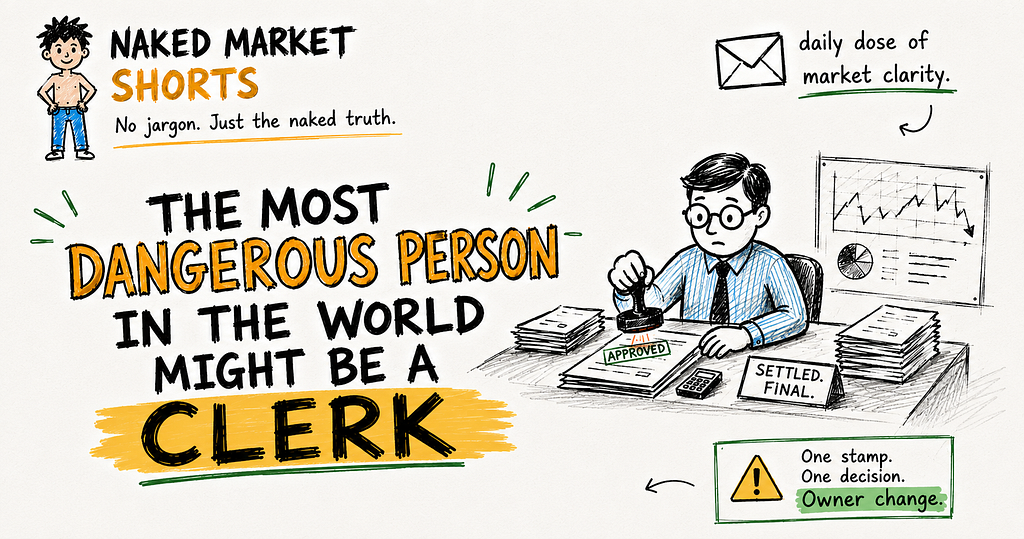
That power is finally changing hands, and not where anyone is looking.
Somewhere tonight, a family will lose a house theyve lived in for thirty years. Not to a fire. Not to a flood. To a line in a book.
Someone with access to the right record will change one entry, a name, a plot number, and land that belonged to three generations now belongs to a stranger. No broken window. No theft you can point to. Just ink.
This isn’t rare. In Honduras, officials once quietly rewrote the government’s land database and handed themselves beachfront property. Across huge stretches of the world, families farm the same soil their whole lives and still cant prove a single inch of it is theirs. One clerk, one bribe, one “sorry, your file was lost,” and the ground under a life is gone.
Heres the part that should stop you cold. The same is true of almost everything you think you own.
Everything you own is a line in someone’s book
Your house isn’t yours because you live in it. Its yours because a record somewhere says so. Your money isnt really in your pocket, its a number in your bank’s book, and the bank promises the number is real. Even your name, your birthday, the plain fact that you legally exist, its all an entry in some official register.
Strip life down to the wiring and you keep hitting the same thing underneath all of it. A ledger. A list. Who owns what. Who owes what. Who is who.
Civilization doesnt actually run on money, or gold, or armies. It runs on ledgers. And heres the truth weve lived with so long we stopped seeing it.
Someone has always kept the book. And whoever keeps the book holds the power.
We have only ever swapped scribes
Go back five thousand years. The oldest human writing anyone has ever dug up isnt poetry or prayer. Its accounting. Clay tablets from the first cities, scratched with who owed how much grain. Before we wrote down a single story about ourselves, we wrote down the ledger.
And from that day, whoever held it ruled. The temple scribe decided what you owed the gods. The king’s men decided what you owed the crown. If the scribe made a mark against your name, you were in debt, and there was no arguing with the book.
Not much has really changed. Weve just kept swapping scribes.
Today the book is kept by banks, and land offices, and government databases. Nicer buildings. Same deal. You are rich because a bank’s computer says so. You own your home because a registry’s file says so. You exist because a database says so. Every time, youre trusting a keeper, some stranger, some system, to hold the truth about your life and not lose it, not sell it, not change it.
Most of the time, they dont. But youve seen what happens when they do. A currency printed until your savings turn to wallpaper. A land record that “disappears.” An account frozen by someone who never has to explain themselves to you. Every one of those is the same ancient wound. The keeper had power over you, and you had none over the keeper.
The quiet earthquake nobody explained to you
Now. For the first time in five thousand years, that is changing. And almost nobody is telling the story straight, because they keep burying it under words designed to make your eyes glaze. Crypto. Tokens. Coins. Moon. Forget all of it.
Heres the whole idea, in a picture a child could follow.
Imagine a village where everyone owns a bit of land. Instead of one big book locked in the chief’s hut, every single family keeps their own identical copy of the record. Someone sells a field, and everyone updates their copy at the same moment. Now picture one man sneaking home to rewrite his copy so it says he owns his neighbor’s land too. He marches to the market waving it. And every other family opens their copy, a hundred books that all say hes lying. His fake doesnt stand a chance.
Thats it. Thats a blockchain. Not a coin. A book that everyone holds a copy of, so no single person can quietly change it, because to rewrite the truth you’d have to rewrite everyone’s copy at once, and you cant.
I keep circling this idea in this newsletter, that blockchain is best understood as plumbing and rails, not a casino (The New Rails is the long version). But heres the plainest way I can put it. For the first time, we have a record with no keeper. A ledger that sits in no one’s drawer. No one to bribe, because theres no single clerk. No one to trust, because you dont have to. You can just check it yourself.
Read that twice. The oldest lever of power on earth, keeping the book, just stopped needing a keeper.
So where does a change this big show up first?
Not where youd expect. And this is the part almost everyone gets wrong.
Everyone stares at the top. Will there be one world currency, whats the Fed doing, is the dollar finished. And everyone stares at the bottom. Is my coin up, is it down, should I buy. Up there, and down here. Thats where all the noise lives, and all the fireworks.
But your ledgers, the ones that actually run your daily life, arent up there or down here. Theyre not at the world bank and theyre not in a coin on your phone. The deed to your home, the record of your birth, the title to your land, those sit in a filing cabinet, in a building, in your city.
The city is where the book has always physically lived. Which makes the city the one place the keeper’s grip is quietly being pried loose, right now, one unglamorous upgrade at a time. Not by revolution. By clerks quietly changing which kind of book they use.
Let me show you it happening, in real places, to real people. Because once you see it, you cant unsee it.
Your name
Start with who you are.
In Buenos Aires, more than three and a half million people now carry their own identity, their birth record, their proof they exist, in a wallet on their phone. Not a copy the city lets them peek at. The real thing, in their hands, that they control.
And the city built it so cleverly it barely made the news. Normally, to prove youre old enough, or married, or a citizen, you hand over everything, your whole ID, all your data, to whoever asks. Buenos Aires uses a quiet trick that lets you prove just the one fact that matters, yes, over eighteen; yes, a resident, without handing over the rest. Picture a bouncer who can confirm youre old enough without ever learning your name or your address. You prove it. He learns nothing else. The keeper who used to hold your whole identity, and could lose it or leak it, is simply cut out of the middle.
Your home
Remember that family, losing a house to a line of ink? This is the fix.
The country of Georgia, the one by the Black Sea, moved its land titles into a keeper-less record and cut the time to sell a property from days to minutes, and made “sorry, your file was lost” close to impossible. India is doing it at a scale thats hard to even picture. By late 2025, hundreds of millions of government records were anchored into a book no clerk can quietly rewrite. City after city, the same move, taking the ledger out of the drawer.
And once a record gets that solid, something wild becomes possible. In Dubai, ownership got so trustworthy that you can now slice a single apartment into thousands of tiny shares and trade them like nothing. One flat, split into pieces, and a slice of it sold out in under two minutes, to strangers on the far side of the planet who never met, never signed a paper, never had to trust a keeper. They just trusted the book that no one can fake. (That slicing-up of the world’s assets has a name and a staggering scale, I mapped it in Tokenization: The 16 Trillion Dollar Shift.)
Your money
A tiny Swiss town called Zug, smaller than a lot of city neighborhoods, let people start paying taxes in digital money years ago, and told businesses plainly, in writing, how the new records would be treated. It didnt promise no rules. It promised a book you could rely on.
And that alone pulled in builders from all over the world. Because the thing everyone is really starving for isnt hype, and it isnt some coin going up. Its a record they can finally trust without trusting a person. (One entire country, Estonia, put nearly its whole government onto this kind of backbone, I broke that down here. A city is that same move, shrunk to a size that can happen almost anywhere on earth.)
Now the part the sales-people leave out
You deserve the whole truth, not a pitch. So here it is.
Taking the book away from the old keeper is not the same as setting you free. Sometimes the old keeper just gets swapped for a new one, with a friendlier logo, and your money in his pocket.
A few years back, the mayor of Miami launched a city coin and dangled a dream. Buy in, and maybe one day the city gets so rich off it that it stops taxing you. People bought. It soared. Then it fell more than ninety-nine percent and quietly died. It never recorded anything. It never proved anything. It never protected a single home or name. It did exactly one thing, go up, then down, and take real money from real people on the way. That wasnt a book with no keeper. That was a new keeper, in a hoodie, running the oldest trick there is.
Theres a grander version too. Off the coast of Honduras, investors built a private city that runs less like a town and more like an app you live inside. Its own rules, its own courts, pay in Bitcoin, register a company in an hour. Same technology as Buenos Aires. Opposite spirit entirely. One hands the book to the people. The other hands it to a company. The country called the whole thing unconstitutional; the project sued for a sum near a third of the nation’s yearly income. Watch closely and you learn the real lesson. Sometimes “innovation” isnt taking the keeper away at all. Its just becoming the keeper.
The one question to keep for life
So heres the single thing to carry out of all this. The question that will keep you clear for decades, long after youve forgotten every name in this piece.
Whenever anyone, a city, a company, a founder, a government, tells you theyre putting something “on the blockchain,” dont ask whether its exciting. Ask one thing.
Did the keeper actually disappear, or did the keeper just change costume?
Three quick ways to tell. Can you check it yourself, without asking anyone’s permission? A book with no keeper is open to all. A new keeper keeps the key. Does it still protect you if the price of everything crashes to zero? A real record, your home, your name, doesnt care about any price. A new keeper’s coin lives and dies on it. And if it all falls apart, who gets hurt, you, or them? If youre the one who can lose everything while someone else collects, youve just met the new keeper.
No keeper, and youre freer than any generation before you. New keeper, and its the same old chain with a shinier link. That one question cuts through all of it.
Where this is all going
Zoom out, and heres the destination.
Every city that takes its book out of the drawer is doing it in roughly the same way, to the same standards, on records built to talk to each other. Which means, slowly and quietly, the books are starting to connect. Picture a world where your name, your home, your money live in records that no single power, no clerk, no bank, no government, anywhere, can secretly change or seize.
Thats the real thing this newsletter keeps pointing at. Not one currency for the planet, handed down from on high by treaty. Something deeper than that. One earth where proving what is yours finally doesnt depend on trusting whoever happens to be holding the pen. The rails for it are being laid right now, and not from the top, and not from the bottom, but from the middle. From your city.
So stop watching the coin prices. They are the fireworks, not the fire.
Watch your city instead. The morning it moves your deeds, your ID, your records onto a book that no one can quietly rewrite, that is the morning a leash you never knew was around your neck goes slack. It wont make the news. It never does. But it will change, forever, the answer to the oldest question a human being can ask.
When I say this is mine, and this is who I am, who do I have to trust to make it true?
For five thousand years, the answer was: someone else.
For the first time, the answer can be: no one. Just the book. And a copy of it, at last, in your own hands.
If you want to understand where finance is heading before it becomes obvious, Naked Market is where these dots get connected every week.Subscribe free →
Start here — the pinned welcome post
One Planet, 180 Currencies. Something’s Got To Give.
Keep reading, in this thread
The New Rails: Blockchain As InfrastructureHow Estonia Put A Whole Country On-ChainTokenization: The $16 Trillion ShiftThe Convergence: How Every Piece Connects
-More soon
The Most Dangerous Person in the World Might Be a Clerk was originally published in Coinmonks on Medium, where people are continuing the conversation by highlighting and responding to this story.