
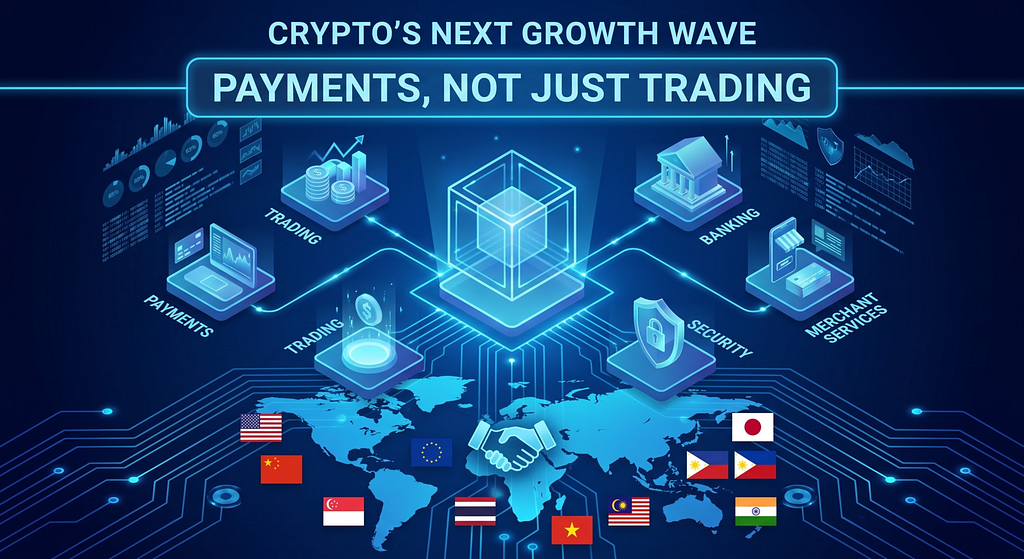
As digital assets move closer to everyday commerce, the biggest opportunity may be hiding outside the exchange.
For most of crypto’s history, trading has been the center of attention.
Users bought Bitcoin.
They traded altcoins.
Exchanges competed for volume.
New tokens created new market cycles.
But the industry is slowly approaching a different question:
What happens when people stop treating crypto primarily as an investment and start using it as money?
That shift could fundamentally change the Web3 market.
Crypto Has a Usage Problem
Crypto has millions of users.
But a large part of activity is still connected to speculation.
People enter the ecosystem because they expect prices to rise.
That creates liquidity and attention, but it does not necessarily create everyday utility.
A technology becomes much more powerful when people use it even when they are not trying to make money from it.
This is where payments become important.
Payments Could Bring a Different Type of User
A trader opens an exchange because they want to trade.
A business may use digital assets because it needs to move money.
These are very different motivations.
A company operating internationally may care about:
Settlement speedCross-border paymentsTransaction costsCurrency conversionLiquidityOperational efficiency
For these businesses, digital assets are not necessarily an investment.
They are a tool.
And that distinction matters.
The Most Important Crypto Users May Not Call Themselves Crypto Users
Imagine a customer paying an online merchant.
The customer sees a familiar payment interface.
The merchant receives the value they need.
The transaction settles through blockchain technology in the background.
Neither side necessarily needs to understand:
Which blockchain is being usedHow wallets workWhat a smart contract does
The blockchain simply becomes part of the infrastructure.
This may be the point where Web3 finally becomes mainstream.
Not when everyone understands blockchain.
But when nobody needs to.
Businesses Have Different Priorities
For retail traders, market prices are critical.
For businesses, other factors can matter more:
Reliability.
Settlement.
Compliance.
Integration.
Security.
Scalability.
This creates an entirely different product opportunity.
Instead of building another platform primarily designed around trading, companies can build digital asset services around real business workflows.
The Exchange Could Become Part of a Larger Financial Ecosystem
This does not mean trading will disappear.
Far from it.
Trading remains an important component of digital asset markets.
But future platforms may connect trading with other financial activities.
Users could potentially:
Trade assetsTransfer valueMake paymentsManage portfoliosAccess financial services
The exchange becomes one component of a broader financial platform.
This Creates an Opportunity for Regional Businesses
Cross-border payments are particularly interesting in emerging digital economies.
Businesses operating across Southeast Asia, the Middle East, and other fast-growing regions often deal with multiple currencies and financial systems.
A digital asset platform designed around these specific markets could potentially solve problems that a global, generic platform does not prioritize.
This is where localization becomes important again.
The technology can be global.
The product experience does not have to be.
The Next Competition May Be About Integration
The future of digital finance will not be determined only by who has the best trading interface.
It may be determined by who integrates digital assets into existing business workflows most effectively.
That means platforms will need to connect with:
Payment systemsFinancial applicationsBusiness softwareLiquidity providersBlockchain networks
The goal is simple:
Make digital assets useful without making them complicated.
Why This Matters for Web3 Businesses
The opportunity is much larger than creating another crypto trading platform.
Businesses can build products around:
Digital paymentsMerchant servicesCross-border settlementDigital asset managementFinancial platforms
The underlying technology may be similar.
The business model can be completely different.
That is why the next phase of Web3 may produce companies that look less like traditional crypto startups and more like financial technology companies.
Final Thoughts
Crypto’s first major use case was speculation.
Its next major use case could be utility.
Trading brought people into the ecosystem.
Payments could make digital assets part of everyday economic activity.
And that would represent a much bigger transformation.
Because the ultimate success of Web3 will not be measured by how many people own crypto.
It will be measured by how many businesses and individuals use digital assets without even thinking about the technology behind them.
The future of crypto may not be about trading more.
It may be about making value move better.
About SoonTech
At SoonTech, we help businesses build customizable Web3 and digital asset platforms designed around different markets, business models, and customer needs.
#SoonTech #Web3 #Crypto #DigitalPayments #Blockchain #DigitalAssets #FinTech #CryptoExchange
Crypto’s Next Growth Wave May Come From Payments, Not Trading was originally published in Coinmonks on Medium, where people are continuing the conversation by highlighting and responding to this story.