
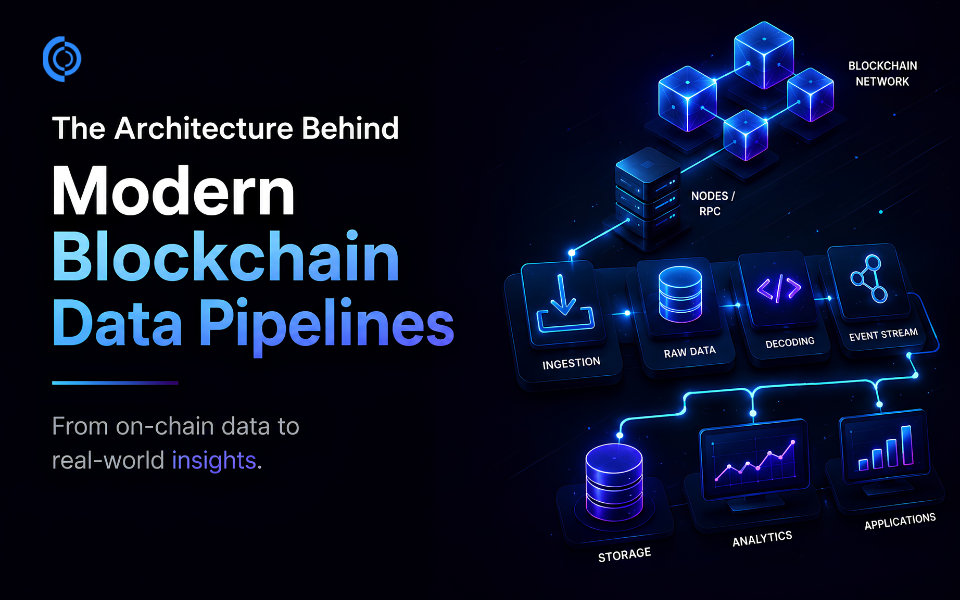
Architecture Behind Modern Blockchain Data Pipelines
A blockchain can record every block, transaction, contract interaction, and state change with cryptographic guarantees. But that does not mean the data is immediately usable by an application.
A blockchain explorer needs to retrieve transaction histories in milliseconds. A DeFi analytics platform needs to aggregate swaps, liquidity, and lending activity across millions of records. A wallet needs to identify token transfers associated with an address. A monitoring system may need to detect an on-chain event seconds after it occurs.
None of these workloads can be handled efficiently by repeatedly asking a blockchain node for raw information.
The reason is simple: blockchains are designed primarily for decentralized execution and consensus, not for application-friendly data querying.
This is where a blockchain data pipeline fits into the architecture.
A modern blockchain data pipeline transforms raw on-chain activity into structured, searchable, and application-ready data:
Blockchain Network → Nodes/RPC → Extraction → Decoding → Streaming → Indexing → Storage → APIs → Applications & Analytics
Each layer solves a different problem. The ingestion layer captures blockchain activity. Decoders turn encoded events into meaningful records. Streaming systems distribute those records to downstream processors. Indexers organize them around query patterns. Databases and data warehouses store the resulting datasets, while APIs expose them to applications.
The challenge is that blockchain pipelines must also deal with reorganizations, finality, RPC failures, duplicate processing, protocol changes, historical backfills, and continuously increasing data volumes.
Understanding these layers is therefore essential for designing blockchain infrastructure that works beyond a prototype.
1. Why Blockchain Data Needs a Dedicated Pipeline
A blockchain already contains the information an application needs, so the first instinct might be to query the chain directly.
For example, an application could ask a node for a block, retrieve its transactions, inspect the receipts, find relevant logs, and process them whenever a user opens a page.
That approach can work for a small application.
It becomes inefficient when thousands of users make similar requests.
Consider a wallet application displaying token transfers. To answer:
“Show the latest ERC-20 transfers involving this address.”
The system may need to search historical blocks, identify relevant transaction receipts, inspect logs, decode events, and filter the results by address.
Doing this repeatedly at request time wastes both RPC capacity and computational resources.
The blockchain’s native data model also does not necessarily match the application’s data model.
At the protocol level, a pipeline may deal with:
BlocksTransactionsTransaction receiptsEvent logsContract callsExecution tracesState changes
At the application level, developers want:
Token transfersDEX swapsNFT salesWallet balancesLending positionsStaking activityProtocol metrics
The job of the data pipeline is to bridge these two representations.
A useful way to think about it is:
Blockchain-native data → interpreted data → application-specific data
Modern blockchain data architectures often preserve raw records while creating decoded and higher-level datasets from them. Ethereum’s own data-and-analytics documentation, for example, describes raw on-chain data around blocks, transactions, logs, and traces, with decoded and further abstracted datasets built on top.
That layered model is important because it separates the immutable source from the transformations built on top of it.
Once the need for a pipeline is established, the next layer is the source itself: blockchain nodes.
2. Blockchain Nodes and RPC: The Data Source Layer
Blockchain nodes maintain and expose blockchain data. Applications generally communicate with nodes through an RPC interface.
On Ethereum, JSON-RPC provides standardized methods for interacting with blockchain clients. These methods cover state queries, historical blockchain records, transactions, blocks, receipts, and logs.
For example, a pipeline can request a block using a method such as:
eth_getBlockByNumber
It can retrieve a transaction using:
eth_getTransactionByHash
and obtain the execution receipt using:
eth_getTransactionReceipt
For event-oriented ingestion, it can query logs using:
eth_getLogs
A simplified request looks like:
{
“jsonrpc”: “2.0”,
“method”: “eth_getBlockByNumber”,
“params”: [“0x1b4”, true],
“id”: 1
}
The important architectural point is that the data pipeline should not depend on a single request succeeding forever.
RPC endpoints can experience:
Rate limitsNetwork timeoutsTemporary outagesProvider-specific restrictionsSynchronization delaysLarge historical query limitations
A production ingestion service therefore commonly includes retry logic, request throttling, provider failover, and checkpoint management.
Some systems operate their own nodes to gain greater control over data access. Others use managed RPC infrastructure. Multi-provider architectures can also route requests between multiple endpoints.
The node provides access to the data, but the pipeline still needs to decide what data to retrieve and how to retrieve it efficiently.
That responsibility belongs to the ingestion layer.
3. Block and Transaction Extraction: Building the Ingestion Layer
The ingestion layer continuously moves data from the blockchain into the pipeline.
A basic block ingestion loop looks like this:
Read last processed block
↓
Request next block
↓
Validate block metadata
↓
Persist raw block
↓
Extract transactions/receipts/logs
↓
Advance checkpoint
The checkpoint is critical.
Suppose a pipeline has successfully processed block 20,000,000 and then crashes while processing block 20,000,001. When the service restarts, it can resume from the last confirmed checkpoint rather than rebuilding the entire dataset.
A robust checkpoint may include:
chain_id
block_number
block_hash
parent_hash
processing_status
timestamp
Storing the block hash along with the block number is particularly useful because block height alone does not establish which chain segment was processed.
Historical Backfill
Historical ingestion processes existing blocks.
A new blockchain analytics platform may need to ingest millions of blocks before it can serve historical queries.
The architecture for backfill is usually optimized for throughput:
Block Range
↓
Partitioned Workers
↓
RPC Requests
↓
Raw Data Storage
Instead of processing one block at a time, workers can process independent ranges, subject to provider limits and ordering requirements.
Real-Time Ingestion
Real-time ingestion focuses on the newest blocks.
A simplified flow is:
New Block
↓
Block Fetcher
↓
Receipt / Log Extraction
↓
Event Stream
↓
Processors
Historical backfill and real-time ingestion are often separate workloads because their optimization goals differ.
Backfill prioritizes throughput.
Real-time ingestion prioritizes latency and continuity.
A production architecture needs both.
4. Event and Log Decoding: Turning Encoded Data Into Meaning
Raw blockchain logs are not automatically application-friendly.
Smart contracts emit events containing structured information, but the information is encoded according to the contract’s event definition.
Consider the standard ERC-20 transfer event:
event Transfer(
address indexed from,
address indexed to,
uint256 value
);
The event describes three important pieces of information:
SenderReceiverAmount
Ethereum documentation describes events as signals emitted by smart contracts, with event history becoming searchable through indexed data.
A pipeline must identify the event and decode its parameters.
The conceptual flow is:
Raw Log
↓
Event Signature
↓
Contract ABI
↓
Parameter Decoding
↓
Normalized Event
For an ERC-20 transfer, the resulting record could look like:
{
“token”: “0xToken…”,
“from”: “0xAlice…”,
“to”: “0xBob…”,
“amount”: “1500000000000000000”,
“block_number”: 21000000,
“transaction_hash”: “0x…”
}
The pipeline has now transformed protocol-level information into a record an application can understand.
The same process becomes more complex for protocols such as decentralized exchanges and lending platforms.
A DEX swap might require interpreting:
Token inToken outAmount inAmount outPoolTraderFees
A lending protocol may require:
AssetBorrowerAmountInterest informationCollateralPosition state
This is why serious blockchain data systems often maintain ABI registries, contract metadata, decoder libraries, and protocol-specific transformation logic.
Decoding creates meaning.
Indexing makes that meaning searchable.
5. Blockchain Indexing: Making On-Chain Data Queryable
An indexer transforms processed blockchain records into structures optimized for downstream queries.
Suppose the raw dataset contains millions of event logs.
A wallet application does not want to scan all those logs every time it needs a user’s transfer history.
Instead, the pipeline can create a transfer dataset indexed around fields such as:
wallet_address
token_address
block_number
timestamp
transaction_hash
Now a query such as:
SELECT *
FROM token_transfers
WHERE from_address = ‘0x…’
OR to_address = ‘0x…’
ORDER BY block_number DESC;
can operate against a purpose-built dataset.
The indexer therefore acts as a translation layer between blockchain structure and application query patterns.
A Practical Data Model
A simplified relational model might contain:
blocks
— — -
block_number
block_hash
parent_hash
timestamp
transactions
— — — — — —
tx_hash
block_number
from_address
to_address
value
gas_used
status
logs
— —
tx_hash
block_number
log_index
contract_address
topic0
topic1
topic2
topic3
data
token_transfers
— — — — — — — –
tx_hash
log_index
token_address
from_address
to_address
amount
block_number
timestamp
The logs table preserves a relatively raw representation.
The token_transfers table is a decoded abstraction.
This distinction is valuable because not every future query can be predicted during initial pipeline development.
If raw logs remain available, new transformations can be built later without re-fetching the blockchain.
Indexes Should Follow Query Patterns
A common mistake is to create indexes based only on what the blockchain provides.
Instead, indexing should be driven by how applications query the data.
A wallet platform may prioritize:
address + timestamp
A DEX analytics platform may prioritize:
pool + token + timestamp
A block explorer may prioritize:
transaction_hash
block_number
address
The indexing strategy should therefore be derived from the application’s access patterns.
6. Streaming and Event-Driven Processing
Once data is extracted and decoded, it needs to move between pipeline components.
A tightly coupled architecture might look like:
RPC → Decoder → Database
This is simple but creates dependencies between components.
A more flexible architecture introduces an event stream:
RPC
↓
Ingestion
↓
Message Queue / Event Stream
↓
├── Decoder
├── Indexer
├── Analytics Processor
└── Monitoring Service
The ingestion service publishes an event after successfully capturing blockchain data.
Multiple consumers can then process the same event for different purposes.
For example:
Consumer 1: updates operational database
Consumer 2: calculates analytics metrics
Consumer 3: triggers alerts
Consumer 4: writes data to a warehouse
This architecture also provides buffering.
If the database becomes temporarily unavailable, ingestion does not necessarily need to stop immediately. Events can remain in the queue until downstream processing recovers.
The message layer therefore acts as a form of decoupling between ingestion and processing.
It also introduces new operational concerns:
Consumer lagMessage duplicationOrderingPartitioningRetry handlingDead-letter queues
This is where blockchain data engineering starts to resemble large-scale distributed data engineering, while still having blockchain-specific correctness requirements.
7. Real-Time vs Batch Blockchain Processing
Not every dataset needs to be processed with the same latency.
Real-Time Processing
A real-time pipeline may look like:
New Block
↓
Ingestion
↓
Decode
↓
Stream
↓
Process
↓
Operational DB
↓
API
This is suitable for:
Trading applicationsWallet notificationsLiquidation monitoringFraud detectionOn-chain alertsLive dashboards
The main metric is often end-to-end latency.
If a block appears at time T and the application displays the relevant event at T + 2 seconds, the pipeline latency is approximately two seconds.
Batch Processing
Batch architecture looks different:
Raw Historical Data
↓
Distributed Processing
↓
Aggregations
↓
Data Warehouse
↓
Analytics
This is useful for:
Historical reportingWallet cohort analysisProtocol researchCross-chain analyticsLarge-scale aggregations
Hybrid Architecture
Modern systems often combine both.
The streaming path provides recent data quickly, while batch jobs periodically recompute historical datasets.
For example:
┌──→ Real-Time DB → API
│
Blockchain → Stream
│
└──→ Data Lake → Batch Processing → Warehouse
This gives applications low-latency access while preserving a separate analytical pipeline for large-scale computation.
8. Storage Architecture: Choosing the Right Database
A blockchain pipeline should not assume that one database will solve every workload.
Operational Database
A relational database such as PostgreSQL can be useful for structured application queries.
Typical data might include:
wallets
transactions
token_transfers
contracts
balances
It is especially suitable for applications that require transactional consistency and relational queries.
Analytical Database
Analytical systems are optimized differently.
A workload such as:
Calculate daily DEX volume across 500 million swap records.
is very different from:
Retrieve the latest 20 transactions for wallet X.
The first requires large-scale aggregation.
The second requires low-latency lookup.
A production architecture may therefore use an analytical database or warehouse for historical workloads while maintaining an operational database for application-facing queries.
Data Lake / Object Storage
Raw data can also be written to object storage.
For example:
raw/
chain=ethereum/
date=2026–08–10/
blocks/
receipts/
logs/
This provides a durable source for future reprocessing.
Suppose a decoder bug caused incorrect token amounts to be written for the previous six months.
Without raw data, the pipeline may need to retrieve and process those blockchain records again.
With a raw data layer, the corrected transformation can run against the existing source.
This creates a powerful architectural separation:
Raw data is preserved.
Transformation logic can change.
Derived datasets can be rebuilt.
9. Handling Reorganizations and Finality
Blockchain data pipelines have a problem that many conventional pipelines do not: the data they just observed may not remain canonical.
A node can report a block that is later replaced during a chain reorganization.
Ethereum’s JSON-RPC specification, for example, distinguishes block states such as latest, safe, and finalized, reflecting different levels of confidence in chain state.
Logs can also show when they were removed due to a restructuring.
This means a production pipeline needs a concept of data confidence.
A useful model is:
Observed
↓
Confirmed
↓
Finalized
The exact semantics depend on the blockchain.
Reorg Handling
Suppose the pipeline has processed:
Block 100
Block 101
Block 102
Then the chain reorganizes and block 102 is replaced.
The pipeline must identify the changed branch and invalidate affected derived records.
A block table that stores both:
block_number
block_hash
parent_hash
makes this possible.
The system can compare the incoming block’s parent_hash with the previously stored canonical block.
If they do not match, the pipeline has evidence that its current chain segment needs reconciliation.
This is one reason blockchain data systems should not treat block height as a sufficient identifier.
Block number tells you where the block sits. Block hash tells you which block it is.
10. Idempotency, Recovery, and Exactly-Once Illusions
Distributed systems fail.
A worker may successfully write a database record and then crash before acknowledging a queue message.
When it restarts, it may receive the same message again.
This creates a duplicate-processing scenario.
For example:
Message received
↓
Database write succeeds
↓
Worker crashes
↓
Message delivered again
↓
Database write attempted again
The solution is usually not to assume perfect exactly-once execution.
Instead, design processing to be idempotent.
A token transfer might use a natural uniqueness key such as:
chain_id + transaction_hash + log_index
If the same event is processed twice, the second operation can be recognized as a duplicate rather than creating another transfer.
This principle should apply throughout the pipeline:
Retries are expected. Duplicate delivery is expected. Reprocessing is expected.
The architecture should remain correct under those conditions.
11. Observability: Knowing When the Pipeline Is Broken
If the observability of a blockchain data pipeline is weak, it may collapse silently. Imagine the ingestion service continues running but has stopped processing new blocks. The application may still respond to API requests, but the data becomes increasingly stale. Monitoring should therefore cover the entire pipeline.
Important metrics include:
Ingestion Metrics
Current block heightLast processed blockBlocks behind chain headRPC error rateRequest latency
Processing Metrics
Events processed per secondFailed decoding operationsQueue depthConsumer lagRetry count
Storage Metrics
Database write latencyQuery latencyStorage growthFailed writesConnection utilization
Data Quality Metrics
Block continuityDuplicate event countMissing block rangesTransaction count mismatchesReconciliation failures
A particularly useful metric is:
Pipeline lag = Current chain height − Last successfully processed height
If the chain is at block 20,000,000 while the pipeline has processed only 19,999,500, the system is 500 blocks behind.
This metric immediately turns an invisible problem into an operational signal.
12. A Complete Production Architecture
Putting all the layers together produces a much more realistic architecture:
The important feature is not any individual technology.
It is the separation of responsibilities.
The ingestion layer should not need to understand every application query.
The decoder should not need to manage API requests.
The API should not need to understand how blockchain logs are encoded.
The analytics system should not depend on users querying raw node data.
Each layer receives a well-defined responsibility and passes structured information to the next.
13. Practical Example: Tracking an ERC-20 Transfer End to End
Consider a wallet application that wants to display the latest ERC-20 transfers.
A new block is first observed by the ingestion service.
Step 1: Retrieve the Block
The service requests the block and relevant transactions through the RPC interface.
Step 2: Retrieve Receipts
For transactions that require event analysis, the pipeline retrieves transaction receipts.
A receipt contains execution information and generated logs.
Step 3: Identify Transfer Events
The decoder examines logs and identifies events corresponding to the token’s transfer event.
Step 4: Decode Parameters
The event definition is used to interpret:
from
to
value
Step 5: Normalize
The pipeline creates a consistent internal representation:
chain_id
block_number
block_hash
transaction_hash
log_index
token_address
from_address
to_address
amount
timestamp
Step 6: Publish
The normalized event enters the processing stream.
Step 7: Index
The indexer writes the record into a transfer dataset with appropriate indexes.
Step 8: Serve
An API receives:
GET /wallet/0x…/transfers
and queries the indexed dataset.
Step 9: Display
The wallet application renders the transfer history.
To the user, this appears to be a simple database query.
In reality, the result has passed through multiple infrastructure layers.
That is the fundamental role of a blockchain data pipeline.
14. Design Principles for Modern Blockchain Data Infrastructure
Several principles consistently appear in well-designed systems.
Separate Ingestion and Processing
This allows each component to scale independently and prevents downstream failures from immediately stopping blockchain ingestion.
Preserve Raw Data
Raw blockchain records provide a recovery and reprocessing layer when decoding or transformation logic changes.
Make Processing Idempotent
Assume messages can be delivered more than once.
Model Finality Explicitly
Do not treat every newly observed block as permanently canonical.
Index for Queries
Design indexes around application access patterns rather than simply reproducing blockchain structures.
Support Backfills
New contracts, protocols, analytics requirements, and decoder versions will eventually require historical reprocessing.
Design for Chain Differences
A multi-chain pipeline should share common abstractions while retaining chain-specific adapters where necessary.
Make Observability a First-Class Component
If operators cannot see ingestion lag, processing failures, or data-quality problems, the pipeline is difficult to operate reliably.
Conclusion
Modern blockchain data infrastructure is essentially a distributed data system built around a blockchain’s unique properties.
The blockchain provides the source of truth, but raw on-chain records are rarely the final format that applications need.
A complete pipeline must:
Extract data from nodes and RPC endpoints.
Decode smart-contract events and transactions.
Normalize different blockchain structures into useful records.
Stream information between independent processing components.
Index data around real application queries.
Store raw, operational, and analytical datasets in appropriate systems.
Expose processed information through APIs and application-facing services.
And throughout the entire process, it must account for reorganizations, finality, retries, duplicate events, infrastructure failures, protocol changes, and historical reprocessing.
The architecture can therefore be summarized as:
Blockchain → Nodes/RPC → Ingestion → Raw Data → Decoding → Event Stream → Indexing/Processing → Storage → APIs → Applications
The most important insight is that blockchain data engineering is not simply about extracting blocks faster.
It is about creating a reliable path from distributed on-chain activity to trustworthy application-level information.
As blockchain applications become increasingly real-time, multi-chain, and data-intensive, the pipeline behind the application becomes just as important as the smart contracts running on the network.
The blockchain may contain the data.
The data pipeline determines how effectively that data can be understood, queried, and used.
The Architecture Behind Modern Blockchain Data Pipelines was originally published in Coinmonks on Medium, where people are continuing the conversation by highlighting and responding to this story.