
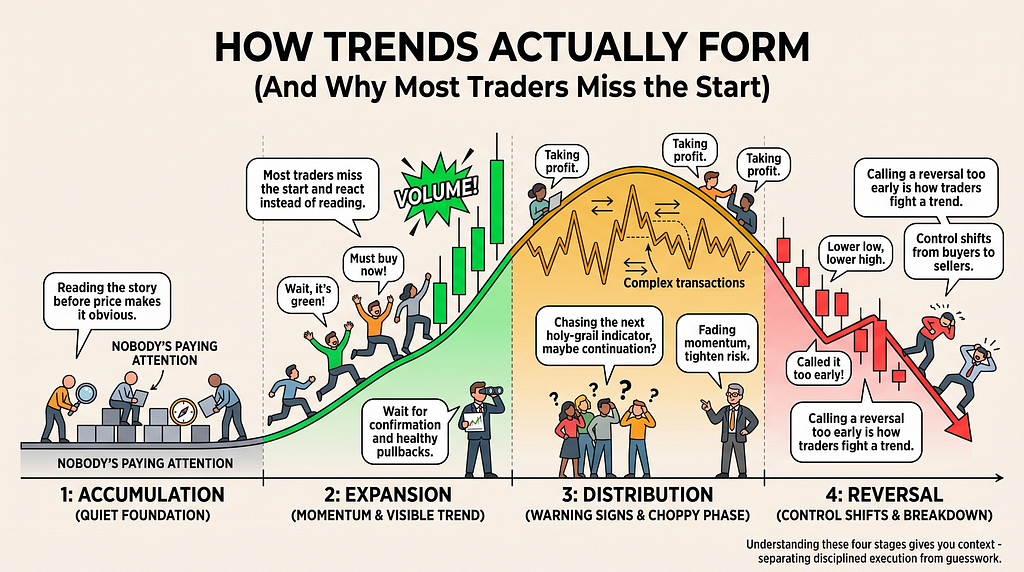
Every strong trend tells a story before price makes it obvious.
Most traders only notice a trend once it’s already running — once the candles are green, volume is loud, and everyone’s talking about it. By then, they’re reacting instead of reading. But trends don’t appear out of nowhere. They move through four repeating stages, and learning to identify them can help you avoid chasing moves, improve your timing, and understand what the market is actually communicating.
Stage 1: Accumulation
This is where a new trend quietly builds its foundation.
After a decline or a stretch of uncertainty, price stabilizes into a narrow range. Volatility drops, selling pressure fades, and patient buyers start building positions while nobody’s paying attention.
Sentiment here is usually neutral, sometimes outright pessimistic. Most traders lose interest because price “isn’t going anywhere.” That disinterest is exactly why this phase matters — it’s laying the groundwork for the next real move.
Stage 2: Expansion
Once demand overtakes supply, price breaks out of the range and momentum takes over.
This is the stage everyone recognizes: higher highs, higher lows, rising volume, strong directional candles. It’s also where trend-following strategies do their best work — and where most beginners get hurt, because they chase the move after it’s already extended.
Experienced traders don’t buy the first breakout candle. They wait for confirmation, look for healthy pullbacks, and size their risk properly before entering. Expansion rewards patience just as much as accumulation does.
Stage 3: Distribution
No trend runs forever, and this stage is where that starts to show.
As price reaches higher levels, early participants begin taking profit while new buyers keep entering, convinced the move still has room. Price action gets choppier, volatility rises, and momentum starts fading even as the trend technically continues.
False breakouts become common here. Many traders read them as continuation signals; experienced traders read them as warning signs and tighten up their risk instead.
Stage 4: Reversal
Eventually sellers take control and the existing trend structure breaks down.
In an uptrend, that means the first lower high followed by a lower low. In a downtrend, it’s the mirror image — a higher low followed by a higher high. Reversals rarely happen on a single candle. They build gradually as pressure shifts from one side to the other, which is exactly why confirmation matters more here than anywhere else in the cycle. Calling a reversal too early is how traders end up fighting a trend that hasn’t actually turned.
AI Generated
Key takeaways
Every trend begins with accumulation, not excitement.Expansion is where momentum becomes visible — and where patience still pays off.Distribution is a warning that the trend may be losing strength, not a green light to keep adding.Reversal confirms that control has shifted from buyers to sellers, or vice versa — but only once structure actually breaks.
Understanding these four stages won’t help you predict every move. What it gives you is context — a way to read where price sits within the bigger picture instead of reacting to every candle in isolation. Markets are always cycling through this pattern, at different speeds and different scales. Recognizing which stage you’re in is what separates disciplined execution from guesswork.
The Four Stages Every Market Trend Moves Through was originally published in Coinmonks on Medium, where people are continuing the conversation by highlighting and responding to this story.