
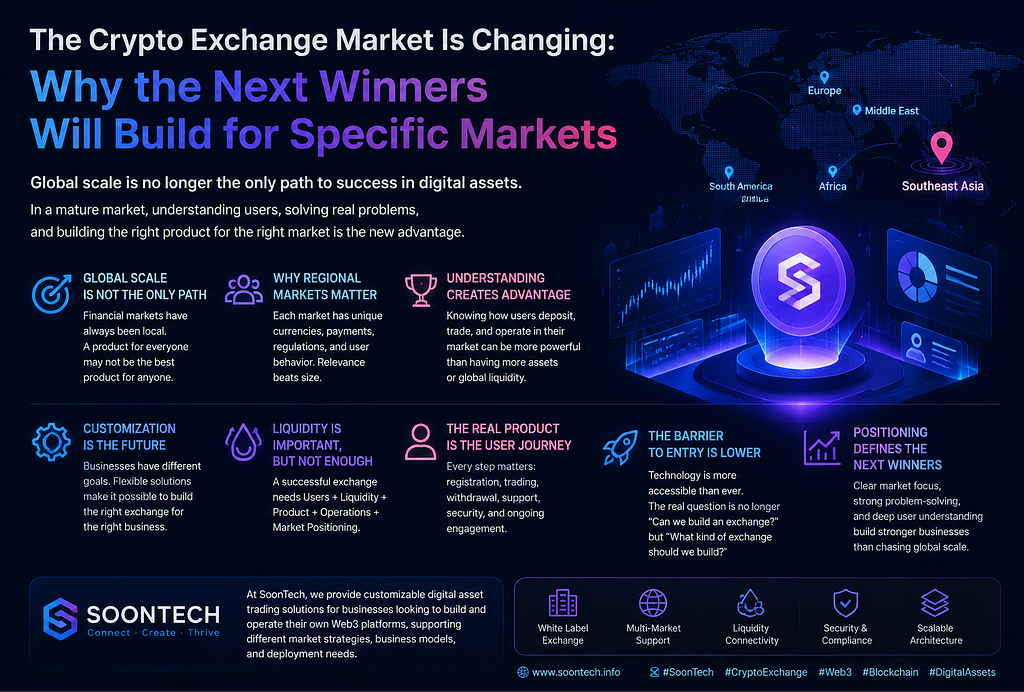
Global scale is no longer the only path to success in digital assets.
For years, the crypto exchange industry followed a simple formula:
More users. More assets. More trading volume. More markets.
The strategy made sense.
Crypto was expanding rapidly, and exchanges competed to become global platforms.
But the market is becoming more mature.
Today, users have more choices than ever. Businesses can access increasingly sophisticated exchange technology. Liquidity can be connected across multiple venues. And entering the market no longer requires building every component from scratch.
This creates a new question:
If technology and liquidity are becoming more accessible, where will the next competitive advantage come from?
The answer may be specialization.
The Global Exchange Model Is Not the Only Model
When people think about a successful crypto exchange, they often imagine a platform serving users across dozens of countries.
But financial markets have always been highly local.
Users have different:
CurrenciesPayment methodsRegulationsTrading preferencesFinancial habitsRisk expectations
A product designed for everyone may not necessarily be the best product for anyone.
This creates an opportunity for regional and specialized exchanges.
Why Regional Markets Matter
Consider Southeast Asia.
The region is not a single financial market.
Malaysia is different from Singapore.
Indonesia is different from Thailand.
Vietnam is different from the Philippines.
Each market has its own financial environment and user behavior.
A platform that understands these differences can potentially create a much stronger user experience than a generic global product.
This does not mean competing with global exchanges on size.
It means competing on relevance.
The Future May Belong to Platforms That Understand Their Users Better
Imagine two exchanges.
Exchange A serves users across 100 countries.
Exchange B focuses heavily on one regional market.
Exchange A may have more assets and greater global liquidity.
But Exchange B may understand:
How local users deposit fundsWhich payment methods they preferWhat products they actually useWhat regulatory requirements applyHow local businesses operate
In a mature market, that knowledge can become a powerful competitive advantage.
Customization Is Becoming More Important
The traditional exchange model often assumes that every business needs the same product.
But businesses entering Web3 have different goals.
A fintech company may want to integrate digital assets into an existing financial ecosystem.
A regional business may want to serve local customers.
A Web3 project may need a dedicated trading environment.
An enterprise may prioritize compliance, scalability, and operational control.
The technology underneath may be similar.
The business model is not.
That is why customizable exchange solutions are becoming increasingly relevant.
Liquidity Alone Cannot Build a Business
Liquidity is critical.
Without sufficient liquidity, users experience:
Wider spreadsHigher slippagePoor execution
But liquidity is only one part of the equation.
A successful exchange also needs:
Users + Liquidity + Product + Operations + Market Positioning
Remove any one of these, and the business becomes harder to sustain.
The next generation of exchange operators will need to think beyond technology.
The Real Product Is the Entire User Journey
A user does not experience an exchange through its matching engine.
They experience:
RegistrationVerificationDepositTradingWithdrawalCustomer supportSecurityOngoing engagement
Every step affects whether that user stays.
This is why user experience is becoming one of the most important competitive factors in crypto.
The best platform is not necessarily the one with the most features.
It may be the one that creates the fewest unnecessary problems.
The Cost of Building Is Changing the Market
Another important shift is the decreasing technical barrier to launching digital asset platforms.
Businesses can increasingly access solutions for:
Trading systemsLiquidity connectivityWallet integrationAdministrationRisk managementMulti-chain support
This means the question is no longer simply:
“Can we build an exchange?”
It becomes:
“What kind of exchange should we build?”
That is a much more strategic question.
The Next Generation Will Be Defined by Positioning
A new exchange does not necessarily need to compete with the largest global platforms.
It needs to answer three questions:
Who are we serving?
What problem are we solving?
Why should users choose us?
The clearer these answers are, the easier it becomes to build the right product.
A focused exchange with a clear market position may have a stronger foundation than a platform trying to replicate every feature of the world’s largest exchanges.
From “Build an Exchange” to “Build a Business”
This distinction is critical.
Technology allows a company to launch a platform.
But technology does not automatically create:
LiquidityCustomersBrand recognitionRevenueRegulatory readiness
Those require business strategy.
The exchange itself is only the beginning.
Final Thoughts
The crypto exchange market is entering a different stage.
The early competition was about speed and scale.
The next stage may be about relevance and specialization.
The winners will not necessarily be the companies with the largest number of trading pairs.
They may be the companies that understand a particular market better than anyone else.
Because in a world where technology becomes increasingly accessible, knowing exactly who you are building for may become the most valuable advantage of all.
About SoonTech
At SoonTech, we provide customizable digital asset trading solutions for businesses looking to build and operate their own Web3 platforms, supporting different market strategies, business models, and deployment needs.
#SoonTech #CryptoExchange #WhiteLabelExchange #Web3 #Blockchain #DigitalAssets #FinTech #CryptoTrading
Everyone Wants to Build the Next Binance. That May Be the Wrong Strategy. was originally published in Coinmonks on Medium, where people are continuing the conversation by highlighting and responding to this story.