
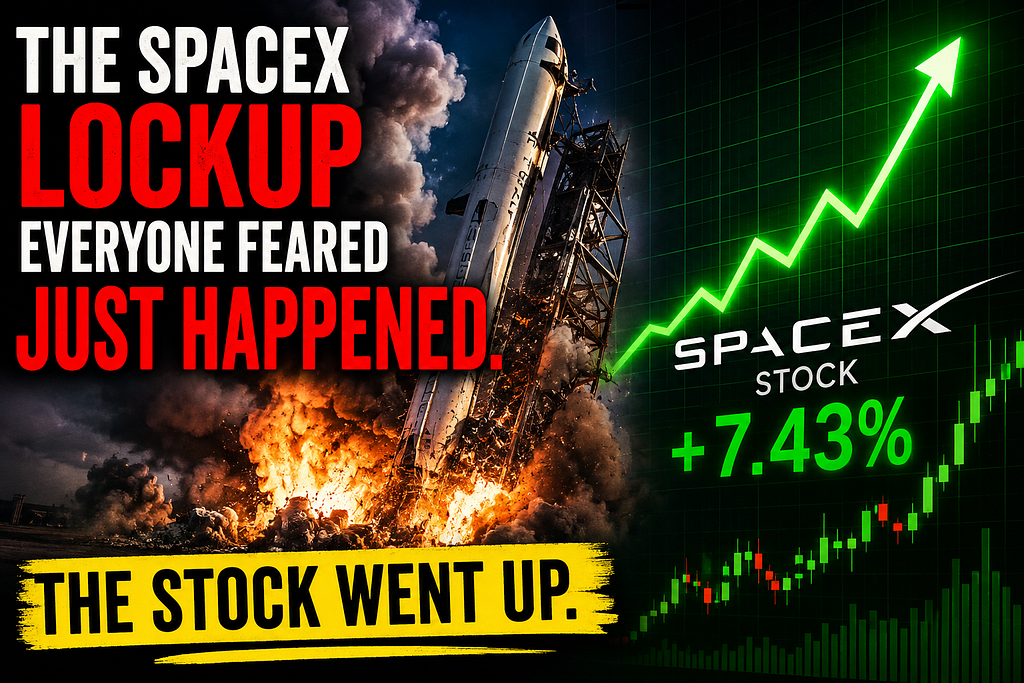
911 million shares hit the market on Thursday. Here’s why the crash didn’t come — and why that’s a more complicated lesson than it looks.
For three weeks, one date dominated every conversation about SpaceX stock: August 6.
That was the day the first tranche of insider shares came unlocked. Roughly 911.5 million of them — about 43% more stock than the entire 638.9 million-share float SpaceX sold in its June IPO. In dollar terms, somewhere around $116 billion of newly sellable shares landing on a market that had already pushed SPCX below its offering price.
The setup looked ugly. Analysts called it one of the largest lockup expirations in recent market history. Jim Cramer told viewers to wait. Short sellers built a position that S3 Partners estimated could run as high as 36% of the tradable float. Two days earlier, SpaceX’s first-ever earnings report had sent the stock down more than 10%.
Thursday arrived. SPCX opened at $105.11 — a fresh all-time low.
Then it went up all day and closed at $114.92, a gain of 6.14%.
And on Friday it kept going, trading around $129 by midday, up roughly 12% more.
If you’re new to investing and watched this unfold, you probably learned a lesson this week. I want to spend the rest of this article making sure it’s the right one, because there’s a very tempting wrong one sitting right next to it.
First, what actually happened
Quick recap of the week, in order:
Tuesday, August 4 — first earnings as a public company. The results were, on their face, good. Revenue came in at $7.81 billion against the $6.93 billion analysts expected — up 92% from $4.1 billion a year earlier. The loss per share was 9 cents versus an expected 26 cents. Net loss narrowed to $541 million from $1 billion.
The stock fell about 8% in extended trading anyway, because capital expenditure jumped sharply. This is worth pausing on: SpaceX beat on revenue, beat on losses, grew 92%, and got sold off. Investors weren’t reacting to the quarter. They were reacting to how much cash the company is committing to AI infrastructure and Starship.
Thursday, August 6 — the unlock. The 911.5 million shares became eligible for sale, lifting the freely tradable portion of the company from about 4.9% of shares outstanding to roughly 11.8%. Volume hit 252.4 million shares, more than double the three-month average of 121 million.
And the stock rose 6.14%.
Four reasons the crash didn’t come
1. “Eligible to sell” is not “selling”
This is the single biggest misunderstanding, and it’s the one that trips up almost every beginner watching their first lockup.
A lockup expiration doesn’t push shares into the market. It removes a legal restriction. Every one of those 911.5 million shares belongs to someone — an early employee, a venture fund, an executive — and each of those people gets to decide independently whether today is the day.
Plenty of them won’t sell. Some believe in the company. Some don’t want the tax bill. Some are institutions with mandates to hold. Some looked at a stock down 40-plus percent from its high and concluded this was a poor moment to exit.
We won’t actually know how much insider selling occurred for weeks, when Form 4 filings and quarterly disclosures arrive. Everything said about it before then is inference.
2. The market had already priced it
SPCX fell from $225.64 in mid-June to $105.11 on Thursday morning. A big chunk of that decline was investors positioning for exactly this event.
That’s the part people miss. The decline into the event was the event. Markets are forward-looking; a date circled on every calendar in the country three weeks in advance is not a surprise. By the time August 6 arrived, anyone who wanted to be out ahead of it was already out.
The generalizable version: scheduled, well-publicized events are usually reflected in the price before they happen. The times markets truly break are the times nobody saw it coming. A lockup expiration is the opposite of that.
3. A crowded short trade needed an exit
With short interest possibly running as high as 36% of the tradable float, an enormous number of traders were positioned for a drop.
Crowded trades have a mechanical problem: when the expected catastrophe doesn’t materialize, everyone reaches for the door simultaneously. Closing a short position means buying the stock. So the very thing shorts were betting against — a calm unlock — forced them into buying pressure that pushed the price up.
Some meaningful share of Thursday’s 6% and Friday’s continued move is probably that, not a fresh wave of conviction about Starlink.
4. There was other news
On the same day, Reuters reported that SpaceX and Tesla will initially invest $16.8 billion to build Terafab, the chip fabrication project in Texas. Real capital, committed to the vertical integration story bulls have been arguing.
Stocks respond to more than one input at a time. Attributing all of Thursday and Friday to lockup dynamics would be tidy and probably wrong.
Now the wrong lesson — please don’t learn this one
The tempting takeaway is: lockup expirations are overhyped, the fear was noise, buy the dip.
Be careful. Three problems with that.
The unlock isn’t finished. It’s barely started. August 6 released the first tranche of a staggered schedule, not the whole thing. Roughly 319 million additional shares could free up as soon as August 12. After that, tranches of about 7% of restricted shares release at intervals through late October. A much larger wave — around 28% of restricted shares — follows the Q3 earnings report. The full 180-day lockup expires December 8.
And then the big one: Elon Musk’s roughly 6.4 billion shares unlock on June 12, 2027. That single block dwarfs everything happening this year.
Thursday tested whether the market could absorb one tranche at a beaten-down price with shorts crowded on the other side. It did not test the whole schedule.
One data point isn’t a pattern. Lockup expirations sometimes pass quietly. They also sometimes produce sustained pressure that shows up over the following weeks rather than on the day itself. Insider selling can be gradual and deliberate specifically to avoid moving the price — which means the effect is spread out and invisible on any single chart.
Judging the outcome by Thursday’s close is like judging a book by the first page. The actual answer arrives over the next two months.
A 6% day and a 12% day are not vindication. SPCX at $129 is still below its $135 IPO price and roughly 43% below its June high. A stock can bounce hard and still be in a downtrend. Sharp rallies inside declines are extremely common — common enough that traders have a dismissive name for them.
The lesson actually worth taking
Here’s what I think this week genuinely teaches, and it applies far beyond one stock.
Consensus fear is usually already in the price. When everyone agrees something bad is coming on a specific date, positioning adjusts in advance, and the event itself frequently underwhelms. This is why trading around scheduled catalysts is so much harder than it looks: you’re not betting on what happens, you’re betting on what happens versus what’s already assumed.
Supply and demand both matter, and only one was in the headlines. Every article about August 6 focused on the supply side — 911 million shares, $116 billion, triple the float. Almost none asked the other half of the question: who might want to buy at $105? As it turned out, quite a lot of people, including shorts who had no choice.
Fundamentals and price move on different clocks. SpaceX grew revenue 92% and cut its loss nearly in half, and the stock dropped. Two days later, with no new operating information, it rose 6%. If you’re trying to trade the gap between those, understand that you’re doing something professionals lose money on regularly.
If you’re holding or watching this stock
Not advice about what to do — just a frame.
The supply calendar between now and December is public information. You can look up the tranche dates and know exactly when float expands. That’s genuinely unusual; most risks aren’t scheduled. Whatever you decide, decide it with the calendar in front of you rather than reacting to each date as it arrives.
If you were planning to buy after the unlock “resolved,” recognize that it hasn’t resolved — one tranche cleared, with several more and a far larger 2027 event still ahead. Waiting for full resolution means waiting a very long time.
And if this week made you feel like you missed something: you didn’t. A 6% day and a 12% day on a stock that’s down 43% from its high is volatility, not a signal. There will be more of both.
The company reported 92% revenue growth and is spending heavily to build something enormous. Whether that’s worth $1.7 trillion is the actual question, and nothing that happened Thursday answered it.
Prices and figures are as of midday Friday, August 7, 2026, and markets were still open at the time of writing — check current quotes before acting on anything here. This article is general information, not investment advice, and I’m not a financial advisor. Financial data comes from SpaceX’s SEC filings and public market reporting. Never invest money you can’t afford to lose.
The SpaceX Lockup Everyone Feared Just Happened. The Stock Went Up. was originally published in Coinmonks on Medium, where people are continuing the conversation by highlighting and responding to this story.