
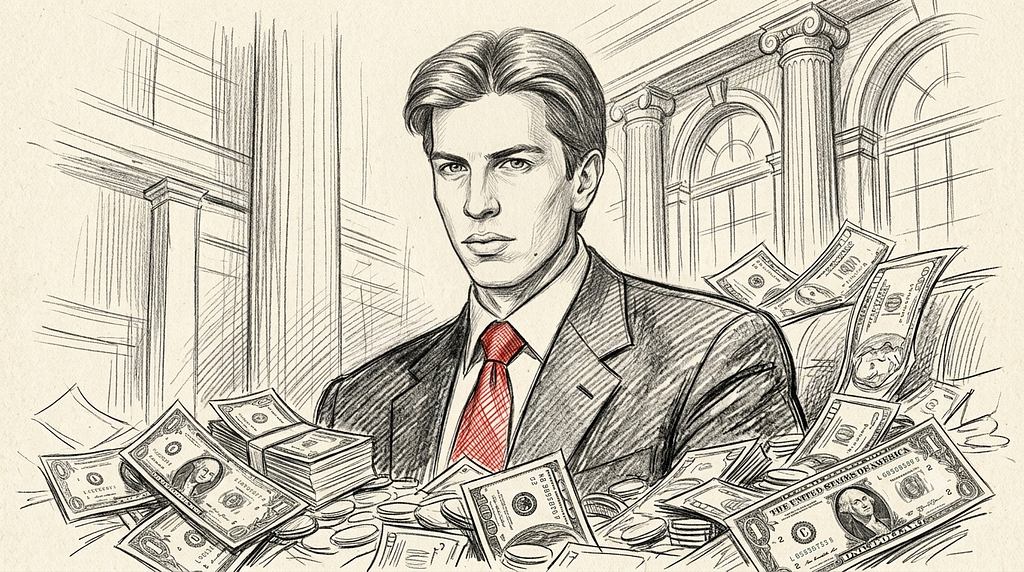
In July 2026, the eyes of the global financial world turned to one young man. At 24, Leopold Aschenbrenner was running $45 billion and had just posted a staggering 439% return for the first half of the year. In just six trading days, two-thirds of that fund’s value evaporated, his prime brokers hit him with margin calls, and his entire public equity portfolio ended up in the hands of Citadel. Was he a genius, or just a trader who happened to catch a wave?
College at 15: The Monster Built by “Effective Altruism”
Born in Germany, Aschenbrenner entered Columbia University at 15 and graduated valedictorian at 19, the textbook prodigy. His worldview is rooted in Effective Altruism (EA), a movement started by Oxford philosophers that names “uncontrolled AI” as the single greatest extinction risk facing humanity, and argues that high earners should funnel their money toward saving it.
Fired From OpenAI: The Security Memo and the Board Coup Fallout
Aschenbrenner worked on OpenAI’s “Superalignment” team. He fell out of favor with leadership after sharing an internal memo with the board arguing the company’s security was too weak to withstand nation-state hackers, and he was one of a small handful of employees who didn’t sign the petition to reinstate Sam Altman during the CEO’s ouster. He was fired in April 2024 over an alleged information leak, a charge he disputes.
“Situational Awareness” and an Unusual Investor List
Two months after being fired, he published a 165-page essay, “Situational Awareness,” predicting AGI would arrive by 2027. At the same time, he launched a hedge fund of the same name, and its early backer list turned heads. Alongside Silicon Valley heavyweights like Stripe’s Collison brothers, Nat Friedman, and Daniel Gross, Jane Street, the quant trading firm known for high-frequency execution, signed on as an LP. It is exceedingly rare for Jane Street to put its own money into an outside fund, and on Wall Street that fact alone was read as a signal: this guy is the real deal.
From $225 Million to $45 Billion in Under Two Years
The fund launched in late 2024 with roughly $225 million and grew to a peak of $45 billion in under two years, nearly a 200x increase. His edge was that while everyone else was chasing Nvidia chips, he looked at energy and infrastructure:
Power and nuclear: Vistra, Talen EnergyCooling: VertivMemory chips: SK Hynix, Micron, SanDiskBitcoin miners repurposed: buying miners that already had power grid access and cooling in place (Core Scientific, IREN) and converting them into AI hosting infrastructure
The Man Who Said “Not Blowing Up Is Priority One”
Here’s the interesting part: it’s not that he didn’t understand risk. Asked in one interview how he managed it, he said, “Obviously, not blowing up is task №1 and 2.” Yet in practice he was running leverage of three to four times his equity. The gap between what he said and what he did is the most ironic detail in this whole story.
How Cold Wall Street Really Is: “The Moment Word Gets Out, You’re Done”
This is where the real Wall Street story starts. On July 24, as losses mounted, Aschenbrenner sent investors a letter leveling with them about the situation. The problem came next. There’s a saying in finance: the moment you tell your investors you’re in trouble, word always leaks. Sure enough, once that letter’s contents hit the market, rival hedge funds showed no sympathy at all. If anything, they moved in the way people describe as smelling blood in the water. His holdings were already public via 13F filings, so competitors knew exactly what he owned and how much. Knowing that, they shorted those same names first, betting he would eventually be forced to sell. There is no sympathy and no professional courtesy on this side of the business. Someone else’s weakness is simply your opportunity.
Algorithms Can Read Your Desperation in Milliseconds
An even colder story comes from the actual mechanics of the selling. As Aschenbrenner’s team dumped sell orders into the open market to raise cash for margin calls, Wall Street’s high-frequency trading algorithms didn’t miss it. When VPIN, the toxic order-flow metric quant desks use, crossed its threshold on SK Hynix and certain infrastructure names, essentially every automated market maker in the market arrived at the same conclusion within milliseconds: there’s a large, trapped seller here. It wasn’t humans who read his desperation and marked prices down further, it was machines, on a millisecond clock. On Wall Street, a risk-management failure gets punished instantly, by data, not by feeling.
The Last Scramble Before Citadel
Once he couldn’t hold on in public markets any longer, he tried private channels too. According to Bloomberg, just before the margin calls hit, he approached Sequoia Capital and Greenoaks about selling private holdings, specifically $3.5 billion of his Anthropic stake. That deal never closed. In the end, under pressure from his three prime brokers, Goldman Sachs, JPMorgan, and Bank of America, he handed over his entire public equity book (roughly $16 billion) to Ken Griffin’s Citadel in one block, at around a 10% discount to market. People familiar with the deal say it was less a negotiation than a notification.
Citadel Bought It Cheap and Was Smiling By the Next Day
The cruelest twist in this whole story is what happened next. Some of the very names he handed over in tears, IREN among them, jumped sharply the day after Citadel took the block. What was a forced, survival-driven sale for one side turned into a discount buying opportunity for the other. Market watchers read the forced liquidation itself as marking a short-term bottom. One person’s bankruptcy becomes another person’s profit. That’s simply how Wall Street runs.
“Every Blowup Like This Follows the Exact Same Script”
On Wall Street, this episode gets placed right alongside LTCM in 1998 and the Archegos Capital collapse in 2021. Some outlets went so far as to call it “Archegos 2.0.” All three follow the identical script: get drunk on paper gains, refuse to trim the position when the correction comes, and lose all control the moment a margin clerk takes over the account. Aschenbrenner’s AI infrastructure thesis wasn’t necessarily wrong. What took him down wasn’t the idea, it was the leverage. On Wall Street, being right about the idea and surviving long enough to prove it are two completely different problems.
Did Citadel Hunt This Young Genius?
In the immediate aftermath, what spread fastest on X wasn’t a lesson about risk management, it was a suspicion. On July 27, a macro strategist at Citadel Securities, another arm of Ken Griffin’s empire, published a note calling for a surprise rate hike at the upcoming FOMC meeting. Two days later, on July 29, the market sold off hard on that forecast, and Aschenbrenner’s fund got margin-called. One day after that, on July 30, Ken Griffin’s Citadel acquired his entire stock portfolio. Line up those three dates and one picture emerges: the party that spread the fear and the party that scooped up the wreckage at a discount were the same firm.
Citadel CEO Ken Griffin
There are counterarguments, of course. Citadel Securities and Citadel the hedge fund are separate legal entities. Inside the Fed, three officials actually did dissent in favor of a hike, the first hawkish dissent of that kind since September 2016, meaning the fear wasn’t manufactured out of thin air. No one has disclosed the exact price Citadel paid, and some analysts argue the chip index’s rally the next day had nothing to do with the block trade at all, it was driven by Microsoft’s earnings report instead.
So whether this was really a game Citadel rigged is something nobody can actually prove. But that’s exactly the point. The fact that this suspicion caught on so fast, with so many people, so easily, says something on its own. Because on Wall Street, this kind of scenario is structurally possible. A major market maker leaks a forecast, that forecast manufactures fear, the fear breaks a leveraged player who’s already weak, and that broken player’s assets get picked up at a discount by someone inside the same ecosystem. Nobody in that chain has to break a single law. No one has to pull a trigger. A weak animal simply fell out of the herd, and the law of the jungle did the rest.
So the truest answer to “did Citadel hunt Aschenbrenner” is this: no one can prove who hunted him. But the fact that no one can prove it is itself evidence of how this jungle is built. Nobody has to break the rules for the weak to fall, and the strong get to pick up the pieces completely within the rules. Before “be careful with leverage,” the real takeaway for individual investors here is this: figure out, honestly, where you rank in this jungle’s food chain.
Did Wall Street Hunt Down the 24-Year-Old Who Ran a $45 Billion Fund? was originally published in Coinmonks on Medium, where people are continuing the conversation by highlighting and responding to this story.