
A $25 billion regulated market, a brand-new CFTC rulebook, and the infrastructure layer that one Nasdaq-listed treasury is built on.
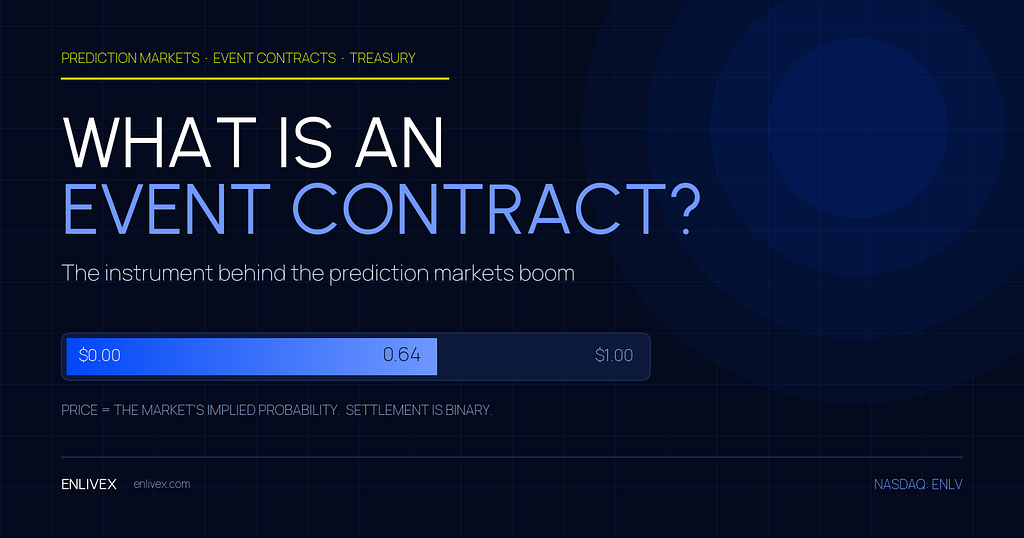
An event contract settles at $1.00 or $0.00. The price in between is the market’s implied probability.
A bar in New York ran a customer promotion tied to an NBA playoff outcome. If the wrong team advanced, the free drinks were going to cost more than the night brought in.
So the owner hedged. Not with an insurer. With an event contract.
According to Hedgeweek, that is a real case, and it is not isolated. Specialist insurers have started using the same instrument to offset performance-linked payouts they could not hedge anywhere else.
Sit with that for a second. A bar owner and an institutional underwriter reached for the same financial product.
That is what a genuinely new instrument looks like in its early years.
The CFTC described the category more plainly in its 2008 concept release: prediction markets function as information aggregation vehicles.
Eighteen years later, that dry piece of regulatory language describes a market that institutions are building desks around.
So what is an event contract, actually?
What Is an Event Contract? The One-Line Definition
An event contract is a derivative that pays a fixed amount if a specified event occurs, and nothing if it does not.
That is the entire instrument. The mechanics are almost aggressively simple:
Each contract settles at either $1.00 or $0.00Before settlement it trades somewhere between $0.01 and $0.99That trading price is the market’s implied probabilityA contract at $0.64 means participants collectively price a 64% chanceSettlement is binary. There is no partial outcome and no gradient
The venues where these trade are called prediction markets. They are not new. According to CFTC filings, the Commission first designated a prediction market as a contract market in 2004.
What is new is the scale.
One contract, two possible settlements, and a price that moves in between. A contract at $0.64 implies a 64% chance.
Why 2026 Became the Year Event Contracts Went Institutional
The numbers moved faster than the vocabulary did.
According to the Federal Register, total trading volume across CFTC-registered prediction markets exceeded $25 billion in 2025According to the Congressional Research Service, Kalshi traded $39.7 billion in the twelve months to February 2026, and Polymarket $36.2 billionAccording to the CFTC, applications for designated contract market registration more than doubled over the past year, largely from firms focused on operating prediction marketsAccording to MetaMask, Polymarket set a single-day trading volume record of $425 million on 28 February 2026According to CNBC, Bernstein analyst Gautam Chhugani expects the category to reach $1 trillion by 2030
Then the rulebook arrived.
On 10 June 2026, the CFTC published a proposed rule titled “Prediction Markets; Public Interest Determinations.”
It establishes a three-step test for whether a given event contract may be listed for trading. The comment period closed on 27 July 2026.
Regulatory clarity is what institutional capital waits for. It is arriving now.
Volume across CFTC-registered prediction markets passed $25 billion in 2025. Bernstein expects $1 trillion by 2030.
Event Contracts vs. Traditional Forecasting: Why a Price Beats a Poll
Most corporate forecasting is not really forecasting. It is a target with a spreadsheet wrapped around it. Analysts publish estimates with no capital at risk and no cost to being wrong.
An event contract inverts that.
A poll captures stated intent. Respondents pay nothing to be inaccurate.A survey captures sentiment at one moment, then goes stale.An expert panel captures reputation, and reputations update slowly.An event contract captures priced conviction. Every participant has capital exposed.
Price discovery here is continuous. The number moves the instant new information lands, because somebody is willing to trade on it.
That is why newsrooms now cite these markets and why forecasting desks watch them.
It is also why the composition of the market matters.
According to CNBC, Bernstein expects sports contracts, which make up more than 60% of volume today, to fall to roughly half that share by 2030 as economic, business and policy contracts take over. The instrument is the same. The use case is changing underneath it.
The Question Nobody Asks First: Who Decides the Outcome?
This is the part that determines whether the whole category holds together.
An event contract is only as sound as its resolution. Get that wrong and the instrument is worthless, however deep the liquidity.
Centralised venues resolve against official data feeds. Decentralized forecasting infrastructure has to solve it differently, and Rain protocol offers one of the clearest worked examples.
According to the Rain whitepaper, resolution runs through Delphi, an AI oracle built on a consensus architecture:
Five independent Explorer Agents research the outcome separatelyOne Extractor Agent weighs their findingsAt least three of the five must agree before an answer is confirmedA 15-minute dispute window allows challengesContested outcomes escalate to human arbitration
Automated where it can be. Human where it must be. That is a design choice, not a shortcut.
Resolution is the hard part. Rain protocol’s Delphi oracle uses five agents, a three-of-five consensus, and a human backstop.
Infrastructure, Not a Single Venue
Here is the distinction most coverage misses.
Kalshi and Polymarket are venues. Rain protocol is infrastructure, the layer other people build venues on top of.
According to the Rain whitepaper and protocol documentation:
It runs on Arbitrum, Ethereum’s leading Layer 2 networkMarket creation is permissionless, through SDKs and APIsIt supports public markets and private, invite-only markets2.5% of protocol trading volume is used to buy back and permanently burn RAINThe token contracts have been audited by Hacken
That 2.5% buyback-and-burn is the mechanism worth understanding. As protocol usage rises, supply reduces. Value is linked to network activity rather than to sentiment alone.
Where This Fits in the Digital Asset Treasury Story
Digital asset treasuries, usually shortened to DATs, are listed companies that hold digital assets as a core balance sheet strategy rather than as a side allocation.
According to CoinGecko’s DATCo report, roughly 142 such companies were being tracked by late 2025, with combined holdings valued above $130 billion. The overwhelming majority hold the same three assets.
That concentration is the interesting part:
Most DAT companies hold Bitcoin, Ethereum or SolanaThose reserves are passive. They sit on the balance sheet and track a priceA treasury anchored in prediction markets infrastructure behaves differently, because the underlying asset is linked to fee-generating protocol activityThe question shifts from “how far did the price move” to “how much did the network get used”
That is a different thing to underwrite, and a different thing to explain to a board.
How a Nasdaq-Listed Company Holds Exposure to This Layer
Which brings us to the part that surprises people.
Enlivex (Nasdaq: ENLV) is a quality longevity company powered by a prediction markets treasury. It anchors its reserves in Rain rather than in cash or Bitcoin.
Per Enlivex disclosures:
As of 18 July 2026, the Company held 79,550,593,122 RAIN tokensTotal treasury value was approximately $1.1 billionNet asset value per ordinary share was $66.16On 24 June 2026, Enlivex announced that RAIN had been listed on Gate, which the Company noted ranks second globally by 24-hour spot trading volumeOn 28 July 2026, Enlivex announced a $400,000,000 private placement with a single institutional investor, priced at a premium to the prior close, with the investor electing to fund in RAIN tokens
Read that last point again. An institutional investor elected to pay a 40.8% premium, in RAIN, for exposure through a listed equity.
Mark-to-market treasury metrics are published on the Enlivex market data dashboard.
The distinction is structural. This is treasury exposure connected to the usage of an infrastructure protocol, not a passive holding waiting on price.
The Convergence: One Ticker, Two Engines
The treasury is one engine. It does not run alone.
Allocetra™, the clinical program, is the biological floor. It is a macrophage reprogramming therapy targeting age-related knee osteoarthritis.
Per Enlivex:
Phase II data showed a 72% reduction in pain and a 109% improvement in functionMore than 250 patients have been treated to dateThe target indication sits within a $314 billion longevity marketOn 13 July 2026 the FDA granted RMAT designation for Allocetra™ in age-related knee osteoarthritis
Two independent mechanisms. One listed structure. Healthspan meshed with wealthspan. The full structure is set out here.
Allocetra™ is the biological floor. The Rain treasury is the forecasting engine. Both sit under one Nasdaq listing.
What to Watch From Here
Whether the CFTC final rule widens or narrows the listable contract categoriesWhether institutional volume rotates from sports outcomes toward economic and business contracts, as Bernstein expectsWhether decentralized infrastructure captures builder demand that centralised venues cannot serveWhether more listed companies adopt treasury assets linked to protocol usage rather than passive reserves. Enlivex investor resources track this structure in public.
The Punchline
An event contract is the simplest derivative ever devised. One dollar or nothing.
What is complicated is everything that had to be built around it. Resolution systems. Regulatory frameworks. Liquidity. And now corporate balance sheets.
The instrument is trivial. The infrastructure is the actual asset.
Your turn. If you could list one event contract on any question in the world, what would it be, and who would you trust to resolve it? Leave it in the comments.
Enlivex Ltd. (Nasdaq: ENLV) is a quality longevity company powered by a prediction markets treasury. This article is for information purposes and is not investment advice. Forward-looking statements are subject to risks and uncertainties described in the Company’s SEC filings.
What Is an Event Contract? The Instrument Behind the Prediction Markets Boom was originally published in Coinmonks on Medium, where people are continuing the conversation by highlighting and responding to this story.