
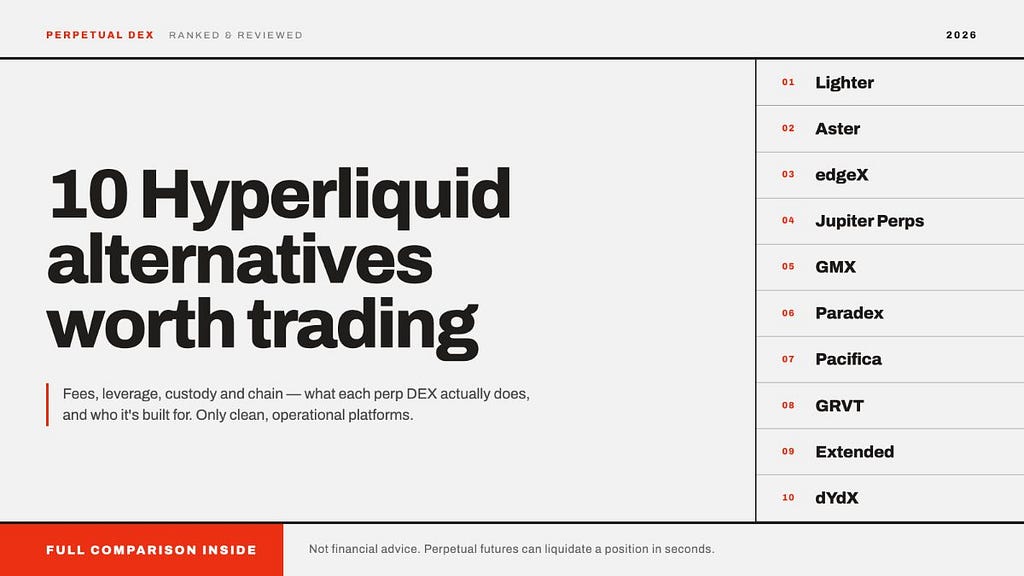
A practical guide to the best decentralized perpetual exchanges: what each one does, how its fees work, and who it’s actually built for. Only clean, operational platforms made the list.
Disclosure: This article contains affiliate links. If you sign up to a platform through one of them, We may earn a commission at no extra cost to you. It doesn’t change our rankings. Every platform here was chosen on features and merit, not on who pays us. Nothing here is financial advice.
Hyperliquid is the dominant perpetual DEX, and for good reason: deep liquidity, a purpose-built Layer 1, and a real order book. But dominant doesn’t mean right for everyone. If you want lower fees, extreme leverage, on-chain privacy, tokenized-stock perps, or a Solana-native venue, a different platform will serve you better.
Here’s the problem with most “Hyperliquid alternatives” lists: half of them still point you to platforms that were hacked or quietly shut down. This guide only includes perp DEXs that are clean and operational, with no active exploits, no wind-downs, and no frozen withdrawals.
Below you’ll find each platform’s core features, its fee structure, its leverage, and the type of trader it fits. Let’s start with how to actually judge a perpetual DEX, because once you understand the levers, the right pick becomes obvious.
Not financial advice. Perpetual futures are leveraged products that can liquidate your position in seconds. Trade like you know that.
How to choose a perp DEX (what actually matters)
Five things separate a good perpetual DEX from a bad one. Weigh them in this order:
Fee model – Order-book venues charge maker/taker fees per fill. Pool-based venues charge you to open and close a position, plus an ongoing borrow fee. A scalper and a swing trader care about very different parts of that.Order-book vs pool – Order books (Hyperliquid, Lighter, Aster, dYdX, edgeX) give tight spreads and advanced order types. Pools (GMX, Jupiter, Gains) let you trade against shared liquidity and let passive depositors earn yield.Leverage and margin – Max leverage is a headline; what matters is whether margin is cross or isolated, and how liquidations are handled.Custody and privacy – All of these are self-custodial, but only a few (Paradex, GRVT) keep your positions encrypted so bots can’t hunt your liquidation level.Chain and collateral – The chain decides your gas costs, bridging steps, and which wallet you use. Collateral flexibility decides how much capital you tie up.
Keep those five in mind as you read. Now the platforms.
Features & fees comparison
A few things the table alone won’t tell you:
Cheapest to trade: on paper, Lighter and Paradex win at 0% retail, with Aster’s 0% maker close behind. But factor in volume tiers and HYPE-staking discounts, and Hyperliquid’s effective cost drops below its 0.045% headline. Its deep liquidity also means less slippage — a real cost the fee column never shows.Deepest liquidity: Hyperliquid, by a mile. Roughly $180B in 30-day volume and $7B+ open interest dwarf everyone else. Jupiter Perps is the exception inside Solana.Highest leverage: GMX/Jupiter (~100x), and Aster (1001x). Remember: leverage is a risk multiplier, not a feature to chase.Best for passive income: GMX, whose pool pays LPs real trading fees instead of emissions.Fee model matters: order-book venues charge per-fill maker/taker; pool venues charge you to open and close. A scalper flipping in and out pays open/close twice on a pool venue — often worse than a low maker fee on an order book.
10 Hyperliquid Alternatives
1. Lighter: the strongest all-round challenger
If you replace Hyperliquid with one platform, make it Lighter. It’s a fully verifiable zero-knowledge perp DEX on its own Ethereum rollup, where every order match, funding payment, and liquidation is proven with a zk-SNARK and posted to Ethereum before it counts. That’s a stronger correctness guarantee than any competitor offers.
Key features
Genuine central-limit order book with a professional-grade API and WebSocket feedsZero-knowledge verification of every trade, funding payment, and liquidationMaker rebates for high-volume and programmatic tradersReal-world-asset and pre-launch markets alongside crypto perps
Fees & leverage
Trading fees: 0% maker and 0% taker for retail; differentiated tiers for heavy high-frequency flowMax leverage: up to 50x on majors, lower on altcoinsChain: zkLighter, a ZK-rollup settling to EthereumToken: LIT, launched December 2025 with a large share of supply airdropped to early users
Best for: algo traders and anyone fee-sensitive who wants cryptographic guarantees. The catch: liquidity is deep but not Hyperliquid-deep, and the token unlock schedule is an overhang.
2. Aster / AsterDEX: the biggest challenger
Aster is the loudest Hyperliquid rival, offering the widest feature set of any challenger. It’s CZ-affiliated, backed by YZi Labs, and built for traders who find Hyperliquid too tame.
Key features
Multi-chain, bridge-free trading across BNB Chain, Arbitrum, Ethereum, and SolanaHidden / dark-pool limit orders that shield your intentions from MEV botsTokenized US-stock and gold perpetuals alongside cryptoNo-KYC access and a simple “1001x” one-click mode
Fees & leverage
Trading fees: 0% maker and 0.04% taker on USDT-margined perps; as low as 0.005% taker on USD1-margined perpsMax leverage: up to 1001x on BTC (around 250x on ETH, 75x on major alts)Chain: BNB Chain (primary) plus multi-chain supportToken: ASTER, launched September 2025
Best for: exotic assets, stock perps, and traders who want maximum leverage and reach. The catch: two of them. Treat 1001x as marketing rather than a setting you’d actually use, because at that ratio a fractional move against you is a full liquidation. And take Aster’s headline volume with a pinch of salt: DefiLlama briefly delisted its perp data in late 2025 over near-1:1 correlation with Binance before relisting it under review. Its fee revenue is real; the reported volume has been questioned.
3. edgeX: a low-fee order book with real revenue
edgeX is a hybrid order book (off-chain matching, on-chain settlement) incubated by Amber Group with a Circle Ventures investment, so USDC is the primary collateral. It’s one of the more serious low-fee venues around.
Key features
Order book spanning crypto perps, tokenized equities, and prediction marketsMaker-rebate fee model that rewards passive liquiditySelf-custodial deposits from Ethereum, BNB Chain, and ArbitrumHigh-throughput matching engine aimed at active traders
Fees & leverage
Trading fees: maker rebates with low taker fees on a retail-friendly scheduleMax leverage: up to 100x on BTCChain: StarkEx today, migrating to its own EDGE ChainToken: EDGE, launched in 2026
Best for: traders who want a low-fee order book with tokenized-equity and event markets. The catch: it’s an EVM-only venue. The “70+ chains” you’ll see quoted elsewhere refers to deposit access, not where you can trade. The EDGE token also stumbled badly soon after its 2026 launch, so weigh the platform on its trading product rather than its token.
4. Jupiter Perps: Solana’s revenue leader
Jupiter Perps is the perp arm of Solana’s default aggregator, and the ecosystem’s most proven pool-based venue. You trade against the JLP liquidity pool, and passive depositors earn a share of the fees.
Key features
Pool-based model with deep, oracle-priced liquidity on blue-chip assetsJLP token lets passive users earn trading fees as yieldNear-instant execution on Solana with negligible gasTight integration with the wider Jupiter aggregator and swap ecosystem
Fees & leverage
Trading fees: roughly 0.06% to open or close a position, plus an hourly borrow fee on the size you useMax leverage: up to 100x on SOL, ETH, and wBTCChain: SolanaToken: JUP (governance); JLP is the liquidity-pool token
Best for: Solana traders who want the ecosystem’s most established, highest-revenue perp venue. The catch: a narrower asset menu than the big order books, and the pool model cuts both ways. The JLP pool has been shrinking as large depositors rotate out, and its value moves inversely to trader P&L, so LP returns are far from guaranteed.
5. GMX: the real-yield original
GMX pioneered the shared-pool perp model and still runs it honestly: a fixed share of fees goes to liquidity providers. Live since 2021, it’s one of the most battle-tested venues in DeFi.
Key features
Isolated GM liquidity pools so risk is compartmentalized per marketOracle-based pricing with zero price impact on supported pairsReal-yield distribution: a set percentage of fees paid to stakers and LPsDeployed on multiple chains with a widening market list
Fees & leverage
Trading fees: roughly 0.05–0.07% to open or close, depending on whether your trade balances open interest, plus borrow fees; no maker rebatesMax leverage: up to 100x on majors, lower on alts depending on pool liquidityChain: Arbitrum and Avalanche, plus newer deploymentsToken: GMX, with a real-yield staking model
Best for: liquidity providers who want fee-based yield instead of emissions. The catch: pool pricing gives worse execution on large or exotic orders than a deep order book. One note on trust: the pick here is GMX V2. The older V1 was exploited in 2025 (most funds were returned and V1 was paused), while V2’s record has stayed clean.
6. Paradex: privacy by default
Paradex is a privacy-first appchain on Starknet. Your positions, entry prices, and liquidation levels stay encrypted, which keeps you off the radar of the liquidation-hunting bots that stalk transparent order books.
Key features
Encrypted positions and liquidation levels by defaultPerpetual options in addition to standard perps, which few rivals offerZero-fee retail trading on an appchain built for derivativesSelf-custodial throughout
Fees & leverage
Trading fees: zero-fee retail tradingMax leverage: around 50xChain: Starknet appchainToken: DIME
Best for: traders who don’t want their positions readable on-chain. The catch: thinner liquidity than the top order-book venues, plus a bumpy reliability record. A January 2026 maintenance bug briefly drove prices to zero and triggered mass liquidations, forcing Paradex’s first-ever chain rollback and refunds to affected users. They were made whole, but it’s a mark against the ops track record.
7. Pacifica: the Solana volume leader
Pacifica is the Solana perp DEX that has grown fastest, built for low-latency, low-cost trading on Solana. It’s currently pre-token, which is the draw for a lot of its users.
Key features
Order book optimized for Solana’s speed and near-zero gasOpen points program and pre-launch farming ahead of a likely airdropClean, fast trading interface aimed at active users
Fees & leverage
Trading fees: low, incentive-driven scheduleMax leverage: around 50xChain: SolanaToken: none yet (points/airdrop farming live)
Best for: Solana traders chasing an airdrop and low costs. The catch: newer and less proven than the established venues.
8. GRVT: the privacy-first hybrid
GRVT (pronounced “gravity”) blends a centralized-exchange experience with self-custody and zero-knowledge privacy on the ZKsync stack. It’s a strong option for traders leaving a CEX who want a familiar interface without giving up their keys.
Key features
CEX-grade interface and UX with full self-custodyZero-knowledge privacy across perps and optionsA licensed, compliance-forward structurePerpetual options alongside standard perps
Fees & leverage
Trading fees: low maker/taker scheduleMax leverage: around 50xChain: ZKsync (Validium)Token: GRVT ecosystem token
Best for: traders who want a CEX feel without giving up custody. The catch: a smaller ecosystem than the majors.
9. Extended: Starknet’s TradFi-flavored contender
Extended is a Starknet perp DEX built by an ex-Revolut team. Its edge is breadth of markets, blending crypto with traditional assets.
Key features
50+ markets spanning crypto and TradFi (gold, oil, indices)Order-book trading with EVM wallet support and no bridgingA clean, professional interface aimed at cross-asset traders
Fees & leverage
Trading fees: low order-book feesMax leverage: up to 100xChain: StarknetToken: Extended ecosystem token
Best for: traders who want crypto and TradFi perps in one venue. The catch: smaller and less liquid than the leaders.
10. dYdX: the decentralization purist
dYdX invented on-chain perps. It has since lost most of its market share to newer venues, but it remains the benchmark for decentralization: its own Cosmos chain, secured by 60+ independent validators, means no single company can freeze your funds.
Key features
Fully decentralized order book on an independent app-chain60+ validators securing the networkAdvanced order types and a mature, well-documented APIA new DEX (Arcus) launched to broaden its reach
Fees & leverage
Trading fees: 0.02% maker / 0.05% taker at the base tier, dropping to 0% maker / 0.02% taker for high-volume desksMax leverage: up to 20xChain: dYdX Chain (Cosmos SDK)Token: DYDX (governance and staking)
Best for: decentralization and self-custody maximalists. The catch: far less liquidity than the current leaders.
More clean perp DEXs worth a look
No need to stop at ten. These are smaller but legitimate, currently-operational venues, each with a clear niche:
Apex Omni (ApeX Protocol): a ZK-powered omnichain order-book DEX with cross-margin support and a clean track record. A solid mid-size choice for order-book traders who want cross-chain reach.Gains Network (gTrade): one of DeFi’s original real-yield perp platforms, live since 2021 on Arbitrum, Polygon, and Base. Its synthetic model lists crypto, forex, and commodities with very high leverage on some pairs, and charges an opening/closing fee plus a rollover fee rather than maker/taker.Avantis: a Base-native leveraged-trading protocol (crypto, FX, commodities) backed by Coinbase Ventures, using a pool model with opening fees and spreads. A clean pick if you live on Base.Bluefin: the leading order-book perp DEX on Sui, worth a look if you want fast, low-cost trading in the Sui ecosystem.
None of these rivals the top tier on liquidity, but all are running cleanly and each owns a specific corner of the market.
Why look at Hyperliquid alternatives at all?
Because being the biggest venue and being the right venue for you are two different things. Hyperliquid’s lead is real, but it comes with baggage:
A single-chain deposit flowA fee schedule built for size, not small accountsA house style that favors professional order-book traders
Trade exotic assets, want extreme leverage, live on Solana, or need your positions kept private?
Another platform might fit you better, cost you less, or drop an airdrop the incumbent never will.
What follows is a ranked look at the nine best Hyperliquid alternatives in 2026 — every one a serious perpetual DEX (perp DEX) in its own right.
Whether you’re weighing Hyperliquid vs dYdX, sizing up Aster, or hunting for the cheapest decentralized perpetual exchange, the right pick comes down to how you trade.
No hype. No “Hyperliquid killer” nonsense. Just the trade-offs.
Not financial advice. Perpetual futures are leveraged products that can wipe out your position in seconds. Trade like you know that.
So which one should you actually use?
Strip out the noise and it’s a short decision tree:
Want the best all-round alternative? Lighter, for zero retail fees and ZK verification.Want maximum leverage and exotic markets (with eyes open)? Aster.Want a low-fee order book with tokenized equities? edgeX.Trade on Solana and want a proven venue? Jupiter Perps. Chasing an airdrop instead? Pacifica.Want fee-based yield, not trading? GMX or Gains Network.Need privacy? Paradex or GRVT.Value pure decentralization? dYdX.Want gold, oil, or index perps on-chain? Extended.
Most “alternatives” only win on a specific need Hyperliquid doesn’t serve. So don’t switch because a token is being farmed or an influencer got paid to shill. Switch because a platform genuinely does the one thing you care about better. And whatever you pick, check that it’s clean and running before you deposit a cent.
Frequently asked questions
What is the best Hyperliquid alternative in 2026?
Lighter is the strongest all-round alternative: zero retail fees and a zero-knowledge order book. Aster and edgeX are the next tier for leverage and low fees, while Jupiter Perps is the go-to on Solana.
Which perp DEX has the lowest fees?
Lighter and Paradex offer 0% retail trading, and Aster charges 0% maker fees. Remember that “zero fee” still isn’t free: funding rates, spreads, and (on pool venues) borrow fees always apply.
How do perp DEX fees actually work?
Order-book venues charge maker/taker fees per fill, usually on your full position size rather than your margin. Pool-based venues (GMX, Jupiter, Gains) instead charge a fee to open and close a position, plus an ongoing borrow fee for the leverage you use.
Which Hyperliquid alternative has the highest leverage?
Aster, at up to 1001x on BTC. Treat that as marketing rather than a usable setting, since a tiny move liquidates positions at that ratio.
Which perp DEX is best for privacy?
Paradex and GRVT both keep positions encrypted, so your entry and liquidation levels aren’t visible to other traders or liquidation bots.
Are these perp DEXs safe to use?
Every perp DEX carries smart-contract, liquidity, and leverage risk. Every platform on this list is currently clean and operational, but that can change, so stick to established venues, start small, and never trade with money you can’t afford to lose.
This article is for educational purposes only and is not financial advice. Perpetual futures carry substantial risk of loss. Do your own research and never trade with funds you can’t afford to lose.
10 Hyperliquid Alternatives Worth Trading in 2026 (Ranked and Reviewed) was originally published in Coinmonks on Medium, where people are continuing the conversation by highlighting and responding to this story.