
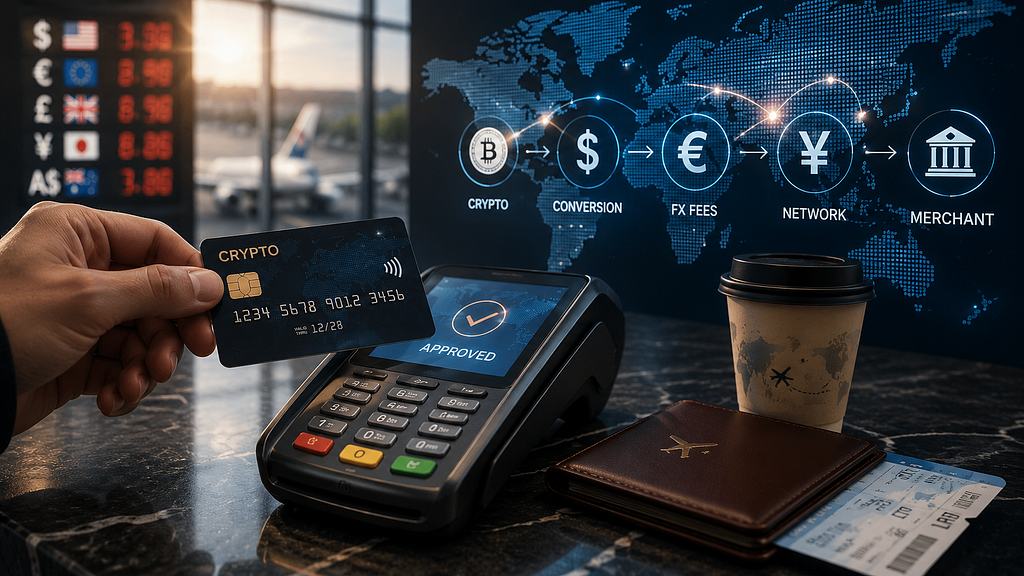
The card may work almost anywhere. The real cost appears in the exchange rate, the settlement process and what happens after the payment.
Paying with crypto abroad can feel remarkably ordinary.
You tap a card at a restaurant, confirm the amount and receive the same approval message you would expect from a bank. The merchant does not need a wallet, does not choose a blockchain and may never know that the payment began with Bitcoin, Ether or a stablecoin.
That familiarity is the product.
Most crypto cards do not ask merchants to accept digital assets directly. Somewhere between the user’s balance and the card terminal, the crypto is sold, converted or used to fund a fiat settlement. Visa or Mastercard then carries the payment through the same infrastructure used by conventional debit and credit cards.
Crypto cards have largely solved the acceptance problem. They have not removed conversion. They have moved it behind an interface that looks like an ordinary card.
“Crypto Card” Can Mean Four Different Products
The label is used so broadly that two cards with nearly identical marketing can behave very differently.
Some products require users to sell their crypto before spending. A customer converts an asset, loads a prepaid balance in euros or pounds, and later spends ordinary fiat through the card.
Crypto.com’s European prepaid card follows this model. When a user tops up the card with crypto, the app shows a rate for a short confirmation window. Once the transaction is complete, the card balance is held in fiat. The crypto conversion happened before the purchase.
Other cards sell crypto at the moment of payment.
Coinbase Card, for example, can automatically convert the selected digital asset into the card’s settlement currency when a user pays or withdraws cash. The checkout still looks instant, but the transaction includes an asset sale behind the scenes. Coinbase does not charge a separate card transaction fee in the United States, though it says a spread may be included in the conversion price.
Stablecoin-linked cards form a third category. They allow users to spend from a USDC, USDT or similar balance, often without manually selling it first. Stablecoins reduce the volatility associated with spending Bitcoin or Ether, but they do not make the rest of the payment chain disappear. The issuer may still convert the stablecoin into fiat before settlement, while the card network may separately convert the merchant’s currency into the card’s billing currency.
A fourth category is often mixed into the same conversation even though it works differently: crypto reward or crypto-backed credit cards. These may offer Bitcoin cashback or use digital assets as collateral, but the purchase itself is financed through credit rather than an immediate sale from the user’s wallet.
A card with a Bitcoin logo is not necessarily a card that spends Bitcoin.
One Purchase Can Trigger More Than One Exchange
Consider a traveler who holds USDT, uses a card denominated in euros and pays for a hotel in Japanese yen.
The customer sees one payment. The provider may process several financial steps.
First, the card authorizes the purchase in yen. The requested amount may be higher than the final bill, especially for hotels, car rentals, restaurants and fuel stations, where merchants often place temporary holds.
Next, the provider converts enough USDT to cover the payment. Depending on the card, this stage may include a quoted spread, an explicit conversion fee or both.
The card network then converts the yen purchase into euros. The issuer may add its own foreign-exchange charge on top of the Visa or Mastercard rate.
Finally, the merchant receives yen through its normal acquiring bank. It does not receive USDT and does not settle directly with the traveler’s wallet.
The card may therefore involve two currency exchanges:
USDT into the card’s euro balance.Japanese yen into euros for card settlement.
A third conversion can appear if the terminal offers to charge the user in euros instead of yen.
That is where a simple payment can become unexpectedly expensive.
“No Transaction Fee” Does Not Mean Free
Crypto card pricing is difficult to compare because providers place costs in different parts of the transaction.
One card may advertise zero purchase fees but include a spread in every crypto sale. Another may display a clear crypto conversion fee but use a competitive foreign-exchange rate. A prepaid product may charge nothing at checkout while collecting a fee when the user loads the card.
The full cost can include:
a spread when crypto is sold;a crypto conversion fee;the card network’s foreign-exchange rate;an issuer’s foreign transaction fee;a card top-up fee;an ATM fee;a merchant or ATM currency-conversion markup;tax and recordkeeping costs.
Regional differences make comparisons harder.
Bybit’s European card, for instance, lists a 0.9% crypto conversion fee and a 0.5% charge above the Mastercard exchange rate when the purchase is made in a currency other than the card currency. Conditions differ in Australia, Brazil, Argentina and other supported markets.
Crypto.com’s European prepaid card charges 1% when users top it up with a debit or credit card. Foreign transaction fees depend on the card tier: the basic tier has separate charges for some non-euro purchases, while higher tiers may not apply the same provider fee.
These examples are not permanent price comparisons. Card terms change, sometimes quickly, and the same brand may operate through different issuers in different jurisdictions.
The useful question is not whether the card has a “transaction fee.”
It is how much of the user’s original crypto balance is consumed by a completed purchase after every conversion and charge.
The Terminal May Offer to Convert the Payment Again
Dynamic Currency Conversion, usually shortened to DCC, is familiar to anyone who has used a card abroad.
A terminal or ATM detects the apparent home currency of the card and offers to complete the transaction in that currency instead of the local one. A European traveler in Japan might see a choice between paying in yen and paying in euros.
The euro amount may look reassuring because it is immediately understandable. The exchange rate is usually set by the merchant’s payment provider or ATM operator rather than the card issuer.
Visa says DCC commonly adds around 3–5% through a less favorable exchange rate. The service is supposed to disclose the original amount, the converted amount, the rate and any markup, but the information is often presented during a rushed checkout.
For a crypto card, DCC can sit on top of an earlier crypto conversion.
The card provider may already have sold USDT into euros. The terminal then applies its own euro conversion to a purchase originally priced in yen. The user has paid for two different forms of convenience without necessarily realizing it.
Choosing the merchant’s local currency normally leaves the foreign-exchange calculation to the card network and issuer. That does not guarantee the lowest possible cost, but it avoids accepting a separate conversion proposed by the terminal.
A Dollar Stablecoin Is Still a Foreign Currency for Many Users
Stablecoin cards are often marketed as an escape from volatility.
That claim is partly fair. A well-functioning dollar stablecoin is designed to remain close to one U.S. dollar, making it less volatile than Bitcoin or Ether for everyday spending.
But stability depends on the currency used as the reference.
For an American whose income, expenses and taxes are all calculated in dollars, USDC may behave much like a digital dollar balance. For someone living in the eurozone or the United Kingdom, it is still a dollar-denominated asset.
A European user who buys USDC with euros and later spends it through a euro card remains exposed to changes in EUR/USD. The stablecoin can maintain its dollar value while becoming more or less valuable in euros.
There are other risks as well:
temporary loss of the stablecoin’s peg;issuer and reserve risk;network or smart-contract problems;address freezes;restrictions on redemption;the cost of converting into local currency.
Stablecoins reduce one layer of volatility. They do not turn every foreign purchase into a domestic one.
Authorization Is Not the Same as Final Settlement
The approval shown at checkout is only the beginning of the card transaction.
A hotel may reserve several hundred euros for incidentals. A car rental company may place a security deposit. A fuel station may authorize a fixed amount before it knows the final cost.
When a normal bank card is used, the excess hold is later released. With a crypto-funded card, the provider may already have sold digital assets to cover that authorization.
Coinbase explains that when an excess authorization is released, the returned fiat amount may be used to repurchase the selected crypto at the current market price. If the asset moved between the original authorization and the release, the customer may receive a different quantity than was initially sold.
Suppose 0.003 BTC is sold to cover a rental-car deposit. A week later, part of the deposit is released. The provider uses the returned dollars to buy Bitcoin again, but the market price has changed. The customer might receive 0.0027 BTC or 0.0033 BTC.
The fiat refund may be correct. The crypto position has still changed.
A refund also does not erase the first transaction. It creates another transaction at another time and, potentially, at another price.
That difference is easy to overlook because the card interface uses familiar banking language: pending, completed, reversed and refunded. Behind those labels, asset sales may already have taken place.
Spending Can Create a Tax Record
A crypto card may make digital assets feel like money, but tax authorities do not necessarily treat them that way.
In the United States, digital assets are generally treated as property. Using crypto to pay for a product or service is a disposal. The user may need to calculate a capital gain or loss based on the difference between the asset’s cost basis and its value when spent.
A person who bought Bitcoin at $40,000 and later uses it when Bitcoin trades at $70,000 may create a taxable gain, even if the purchase was only a restaurant bill.
Stablecoins often produce much smaller gains or losses, but they are not automatically outside the reporting framework. Minor movements around the peg, fees and changes against the user’s reporting currency may still matter.
The United Kingdom also generally treats spending crypto as a disposal for capital-gains purposes. In 2026, the government began discussing whether some stablecoin payments or small transactions should receive simpler treatment, but that discussion had not yet produced a universal exemption.
The administrative burden can be disproportionate to the purchase.
A traveler might make dozens of small card payments in a week. If each one includes a crypto disposal, the card statement becomes a transaction ledger that may need cost-basis data, timestamps, fees and exchange rates.
That is a very different experience from checking a bank statement after a holiday.
Self-Custody Changes Who Holds the Funds, Not How the Merchant Gets Paid
Newer products are trying to reduce dependence on centralized exchanges.
A self-custodial card can allow funds to remain in the user’s own wallet until a purchase is made. MetaMask Card is one example: supported assets remain connected to a self-custody wallet, then convert when the card is used.
This changes custody risk. The user does not need to leave a large balance on an exchange account solely to fund future purchases.
It does not eliminate the rest of the payment system.
The user still needs:
a supported token and network;permission for the card mechanism to access funds;a regulated card issuer;identity verification;a conversion provider;access to Visa or Mastercard;compliance with regional restrictions.
Self-custody can reduce one form of counterparty exposure. It does not turn a card payment into a direct wallet-to-merchant transfer.
The card remains an off-ramp connected to a conventional payment network.
Visa and Mastercard Are Expanding Because the Model Works
Stablecoin cards are still small relative to the global card market, but their growth has been fast.
Visa reported that stablecoin-linked cards processed about $5.2 billion in 2025, up 319% from the previous year. That represented roughly 0.04% of Visa’s total payment volume — enough to show demand, but far from replacing ordinary card funding.
By June 2026, Visa said more than 160 stablecoin-linked card programs had launched or were in development.
Mastercard has also expanded stablecoin settlement options for issuers and other payment participants. This may allow parts of the payment chain to operate during weekends and outside conventional banking hours.
The distinction between consumer funding and network settlement matters.
A user may hold USDC. An issuer may settle with a card network using another supported stablecoin. The merchant may still receive euros or pesos through its acquiring bank. All three sides can use different forms of money within one transaction.
This is why crypto cards are attractive to payment networks. They do not require millions of merchants to replace their terminals or accounting systems. The networks can add digital-asset funding while preserving the existing acceptance layer.
The card turns crypto into something merchants already understand.
What to Check Before Taking a Crypto Card Abroad
The logo on the front of the card tells only part of the story.
Before relying on one during a trip, a user should know:
whether the card sells crypto in advance or at checkout;which asset is spent first;the card’s billing currency;the crypto conversion fee or spread;the foreign-exchange fee;ATM limits and charges;how temporary authorizations are handled;whether refunds return fiat or repurchase crypto;which countries and merchant categories are restricted;whether spending creates reportable tax events.
Cashback should be considered only after those costs are understood.
A card offering 2% rewards may still be expensive if a purchase includes a 0.9% crypto conversion fee, a foreign-exchange charge and an unfavorable DCC rate. A card with no rewards may be cheaper if it draws from a fiat balance and applies a competitive network rate.
The best card is not always the one with the highest advertised reward. It is the one whose conversion chain matches how the user actually holds and spends money.
The Convenience Is Real
Crypto cards solve a practical problem.
They let people use digital assets in places that have no interest in running blockchain infrastructure. They can help travelers access a stablecoin balance, allow remote workers to spend international income and give self-custody users a familiar route into everyday commerce.
The experience can be easier than selling crypto manually, withdrawing to a bank and waiting for the funds before a trip.
But the simple checkout should not be confused with a simple financial transaction.
Behind one tap may sit an asset sale, a network exchange rate, an issuer markup, a temporary authorization, a later repurchase and a tax record.
The merchant sees an ordinary card.
The user still needs to understand what was converted, when it was converted and how much disappeared between the wallet balance and the final receipt.
Crypto Cards Make Spending Abroad Easy — Until the Conversion Starts was originally published in Coinmonks on Medium, where people are continuing the conversation by highlighting and responding to this story.