
The failure mode that will break agentic trading isn’t hallucination : it’s correlation
Every agent-safety framework on the market today :warrant-based, policy-gated, human-in-the-loop enforces the same primitive: one agent, one call, one static bound. Did this agent exceed its notional cap? Was this tool call authorized? Is the output schema valid?
None of them ask the question that actually breaks a market: what happens when five independently-compliant agents converge on the same side of a thin book at the same moment?
This is not a theoretical gap. It is the structural mechanism behind every major automated-flow market failure from the 1987 portfolio-insurance cascade through the 2010 Flash Crash to the 2015 ETF dislocation. The common thread was never a single participant misbehaving: it was many participants, each acting within their individual mandates, producing an aggregate flow that overwhelmed available liquidity.
Replace “portfolio insurance rebalancers” with “agentic trading systems running momentum-following tool calls” and the mechanism is identical, except now the decision loop is faster and the human circuit-breaker is further away.
The agent-safety ecosystem has spent two years building increasingly sophisticated per-call enforcement. The actual risk surface is orthogonal to everything they’ve built.
What per-agent enforcement misses
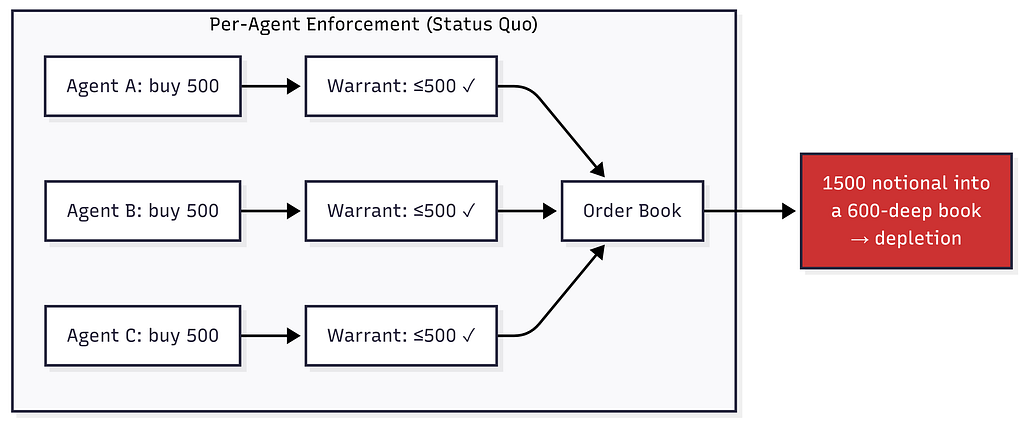
Consider three agents on the same desk, each governed by its own warrant (signed constraint envelope specifying notional limits, delta bounds, authorized tool surface: Agentic Warrant). Agent A is permitted to hedge up to 500 notional. So is Agent B. So is Agent C.
Each agent independently observes the same market signal: say, a momentum pattern in the last N ticks and submits a buy order within its individual limit. Each call is individually compliant. The warrant checks pass. The guardrails hold.
The book doesn’t.
The problem isn’t that any agent did anything wrong. The problem is that per-agent enforcement has no visibility into aggregate flow. Each warrant evaluates in isolation. The total effect is invisible until the book breaks.
The missing primitive: correlation-conditioned aggregate envelopes
The fix is not more sophisticated per-agent rules. It’s a second enforcement layer that operates on realized aggregate behavior across agents, and contracts the trading envelope for every agent in a correlated cluster as conditions deteriorate; even when no single agent has violated anything.
This requires three components that don’t exist in any current agent-safety stack:
1. A realized correlation detector operating on order flow, not declared labels.
Agents self-report strategy labels. A momentum agent might tag itself “momentum.” An arbitrage agent might tag itself “arb.” But under a trending market, the arb agent’s hedging flow can correlate perfectly with the momentum agent’s directional flow; their labels diverge while their realized behavior converges.
The detector must therefore ignore labels entirely and compute correlation from signed order-flow vectors over a trailing window. Cosine similarity of flow direction, not return correlation, not label matching.
2. A depth-conditioned envelope function.
A static aggregate cap (say, “total desk notional ≤ 2000”) is better than nothing but still misses the interaction between flow and available liquidity. The same 1500 notional is benign into a 10,000-deep book and catastrophic into a 600-deep book.
The envelope must be a function of current book depth, realized correlation, and a time-decay term with explicit directional relationships:
Envelope Function:
The envelope scales proportionally with book depth (more liquidity → more room) and inversely with the product of realized correlation and time-decay (higher correlation × more recent spike → tighter bound). In pseudocode:
Correlation Penalty:
Available Depth Calculation:
When correlation_penalty is near zero : either because agents aren’t correlated or the last spike has decayed, the envelope approaches the full depth-scaled limit. When both correlation and recency are high, the penalty term approaches 1 and the envelope contracts toward zero. The contraction applies to every agent in the correlated cluster, not just the one making the current call. Agent A’s fill changes Agent B’s available envelope, even though Agent B hasn’t done anything yet.
3. Structured refusal with time-based recovery.
When an agent’s requested notional exceeds its current envelope, the system refuses the call with a structured reason: which correlation cluster triggered the contraction, what depth and correlation values produced the bound, and when the envelope is expected to recover. This is not a circuit breaker (binary on/off). The envelope is continuous, and it recovers over time through a decay function as flow subsides and depth replenishes.
This recovery property is load-bearing. Without it, a single correlated spike permanently penalizes all agents in the cluster: which is overcorrective and produces its own pathology (agents that can never re-enter the market after a volatility event). With it, the system distinguishes between a transient correlated shock and a sustained crowded trade.
The full enforcement architecture
The aggregate governor composes with not replaces per-agent enforcement.
A call must clear both layers independently. Either can refuse; the refusal is attributed to the specific layer that triggered it.
This architecture runs at the desk or gateway layer, a single point through which a firm’s agents route before reaching any venue. It does not attempt to enforce across fragmented liquidity pools (CEXs, DEXs, OTC desks) with independent state; cross-venue state synchronization latency makes a global real-time governor impractical today, though a delayed reconciliation layer that flags cross-venue correlation after the fact is a natural extension.
Every decision : accept or refuse, from either layer is appended to a hash-chained audit log. The chain is independently verifiable offline: given the log, anyone can recompute the hash chain and confirm no entries were altered or omitted. This is the same primitive used in the agent-warrant project, applied to the aggregate layer.
Proof: governed vs. ungoverned under a convergent-agent shock
This isn’t a whitepaper argument. The correlation-governor repo runs a deterministic adversarial scenario : five synthetic agents, each running an independently-seeded momentum-following rule with a shared underlying signal component, against a deliberately thin order book. Same agents, same scenario, governed vs. ungoverned:
The governed run’s first refusal occurs before peak impact is realized : the governor is pre-emptive for the seeded scenario, not merely damage-limiting after the fact.
The envelope’s recovery behavior under a sustained quiet window, confirmed by instrumented diagnostics:
Correlation does not reset to zero during the quiet window. The envelope recovers while correlation is still elevated because the decay term : not the correlation signal itself , drives recovery. This is a real time-decay mechanism, not a scenario artifact.
A known limitation, stated plainly
Once decay_term reaches zero, the envelope fully recovers regardless of how elevated the standing correlation remains. An adversary who can time calls to land just as the decay window clears gets a clean slate. This is a defensible design choice : permanent penalization for a one-time correlated spike creates its own failure mode ; but it means the governor bounds transient correlated shocks, not patient, slow-burn crowding. The adversarial eval suite in the repo includes a recovery-exploitation test case for this exact scenario.
Where this sits
The agent-safety stack for financial markets currently looks like:
The bottom two layers are where the actual systemic risk lives in agentic trading infrastructure and where the tooling gap is widest.
Try it
The correlation-governor repo is MIT-licensed, template-enabled, and CI-proven. Clone it, run the adversarial scenario, read the audit log. The governed-vs-ungoverned delta reproduces deterministically from a fresh clone.
If you’re building agent infrastructure for a venue, a desk, or a prime broker: the question isn’t whether your agents will correlate ; it’s whether your guardrails will notice before the book does.
Vishnu Govind is a Systems Architect focused on institutional digital assets and tokenized finance. He builds open-source tooling for agent safety, mechanism design, and risk infrastructure. Find him on GitHub or LinkedIn.
Your Agent Guardrails Check the Wrong Thing was originally published in Coinmonks on Medium, where people are continuing the conversation by highlighting and responding to this story.