
A plain-English look at two very different ways to earn yield on your stablecoins, and one quick test to see which actually fits your life.
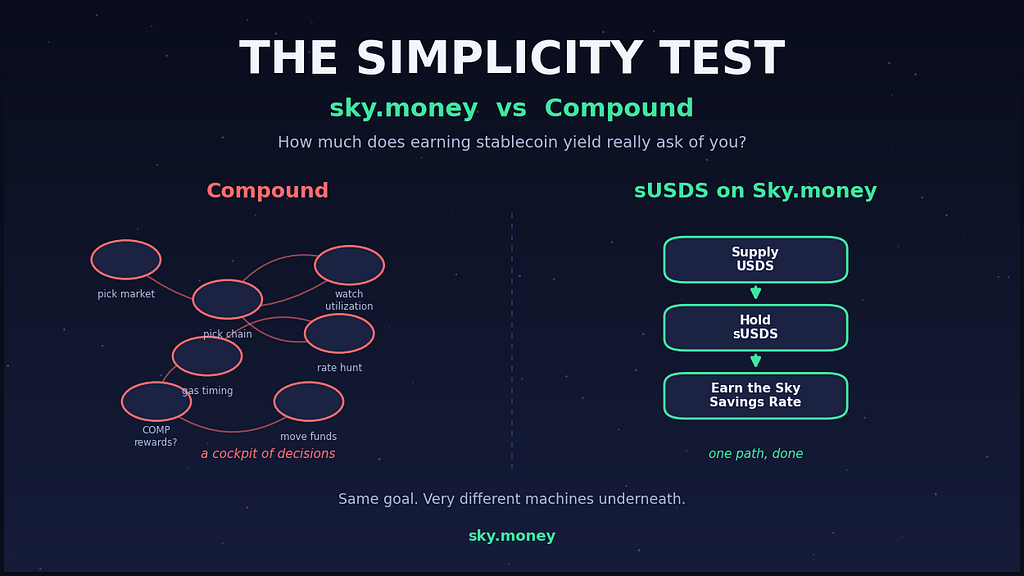
The Simplicity Test, in one image. Same goal, two very different machines.
You open a new tab. Then another. Then five more. One shows a lending market. One shows gas fees.
One shows a utilization chart you are quietly pretending to understand. You just wanted your dollars to earn something. Somehow you have become a part time risk analyst.
That is the hidden cost of modern crypto yield. Not the fees. The decisions. So let us run a simple test.
Two popular ways to earn stablecoin yield, Compound and sUSDS on Sky.money, judged on one thing most guides skip.
How much does each one actually ask of you? This is not about which name is louder. It is about which one lets you get on with your day.
And in 2026, with yield bearing stablecoins finally going mainstream, that question is no longer niche. It is the question.
Two Ways to Put Your Stablecoins to Work
Both options chase the same goal. Turn idle dollars into working dollars. Under the hood, they are built very differently.
Compound is a lending market. You supply a stablecoin, borrowers take it, they pay interest, and you get a slice.sUSDS is a savings token. You supply USDS, receive sUSDS, and it earns the Sky Savings Rate.
One asks you to manage a position. The other asks you to hold a token. That small gap turns out to be the whole story, so let us walk through both.
Think of it as the difference between driving a manual and flicking on cruise control. Both get you down the road. Only one lets you look at the view.
How Compound Works, and What It Quietly Asks of You
How Compound pays you. Your rate rises and falls with borrower demand.
Compound is one of DeFi’s originals. It has been live since 2018, it is battle tested, and it is genuinely well built. People sometimes call it the reliable workhorse of onchain lending, and that is fair.
Here is the model in one breath. You supply USDC to a market. Borrowers post collateral and borrow against it.
The interest they pay funds your yield. The catch is where that rate comes from. It is set by utilization, which is just a fancy word for how much of the pool is being borrowed at any moment.
When lots of people borrow, your yield climbs. When borrowing dries up, it drops. The number can move every few seconds.
So the real question is what Compound puts on your plate:
You pick a market and a chain, across Ethereum, Base, Arbitrum, and more.You watch utilization, because it quietly drives your rate.You time gas on every supply and every withdrawal.You keep half an eye out for a better rate somewhere else.You track COMP rewards, which have shrunk to a rounding error in 2026.
None of that is a knock. For hands on users who enjoy the dashboard, Compound is a great tool. But make no mistake.
It is a tool that expects you to show up, and to keep showing up. Skip a week and the rate you signed up for may be a distant memory. That is not a bug in Compound. It is simply what a live money market does.
How sUSDS and the Sky Savings Rate Actually Work
How sUSDS pays you. Supply once, then let the Sky Savings Rate do the work.
Now flip to the other side of the test. sUSDS is the flagship yield generating stablecoin of Sky Protocol. It is also the largest one in the world. That is not a slogan.
sUSDS is the biggest yield bearing stablecoin by supply, which tells you a lot of people have already voted with their dollars.
USDS supply has grown almost 97 percent over the past year, so this is not a quiet corner of DeFi. It is one of the busiest streets on the block.
The flow is short enough to say out loud:
You supply USDS and receive sUSDS.Your sUSDS earns the Sky Savings Rate automatically.It grows in value against USDS while you simply hold it.
No lockups. No fees. Instant liquidity. You can leave whenever you want, without asking permission or waiting for a window to open.
Do not hold USDS yet? You can swap USDC to USDS at a one to one rate with zero fees, then supply. That is the on ramp, and it is deliberately boring.
One honest note. The rate is variable and set by Sky governance, not by Sky.money, and it is not guaranteed.
Rates move on both sides of this comparison. The real difference is who is doing the steering. With sUSDS, it is not you.
The Simplicity Test: Just Count the Decisions
The whole test in one glance. One is a cockpit. The other is a light switch.
Here is the entire test. Count the things each option asks you to know, choose, and watch. Compound hands you a list:
Which market and which chain.What utilization is doing to your rate today.When to move funds for something better.Gas timing on every single action.
sUSDS hands you a shorter one:
Supply USDS, hold sUSDS.
That really is close to the whole difference. One is a cockpit full of switches. The other is a light switch. And simplicity is not the same as basic.
It is about removing the small decisions that quietly drain your attention, and often your returns, without you ever noticing.
Every extra choice is another chance to get the timing wrong. Fewer choices, fewer ways to trip.
Most people do not lose returns to a dramatic hack. They lose them to friction, forgotten positions, and rates that drifted while they were busy living.
Where the Yield Actually Comes From
Numbers you can verify onchain, not a marketing slide.
This is where simple and sustainable finally meet, and it matters more than any headline number. Compound’s yield comes from one thing.
Borrower demand in a single market. Rich when demand runs hot, thin when it cools. It is real, but it is narrow.
The Sky Savings Rate is funded by real revenue that Sky Protocol earns across diversified, governance approved sources. Not from one pool.
Not from printing a token to lure new money in. Better still, the scale is public and easy to check for yourself:
Sky Protocol is running at roughly 429 million dollars in annualized gross revenue.It booked more than 107 million dollars in a single quarter, its second straight quarter above 100 million.sUSDS holders have collected over 250 million dollars in yield since launch.USDS is backed by about 13.66 billion dollars in collateral against a supply near 10 billion.
Sit with that last one for a second. The collateral is worth more than every USDS in circulation. That is the opposite of a house of cards. There is a serious team behind those guardrails too.
The Sky Frontier Foundation are among the most systematic risk experts in the space, and measuring risk is the entire job.
History backs it up. The infrastructure behind Sky has been building for about ten years and has never been exploited.
USDS itself is the upgraded successor to DAI, one of the longest running dollars in all of DeFi. It also lands at the right moment.
Real world asset tokenization recently crossed 20 billion dollars onchain, and sUSDS sits as the largest issuer inside Ethereum’s real world asset ecosystem.
Traditional capital is walking onchain looking for predictable, diversified yield, and it keeps finding the same door.
So, Which One Passes the Test?
Both are real. Both are non custodial. Neither is risk free, and rates on both move with the market, so do your own homework before you commit a dollar.
Compound wins if you want a hands on money market and you actually enjoy managing a position. That is a valid choice, and plenty of skilled people make it happily.
sUSDS wins the Simplicity Test, cleanly. Supply USDS, hold sUSDS, earn the Sky Savings Rate, and keep your liquidity the entire time.
Independent yield trackers regularly list sUSDS held simply as one of the best risk adjusted options for people who do not want a second job.
Want certainty over a set window instead of a moving rate? You can even lock a rate to a future date with Fixed Yield.
Prefer to spread across curated strategies? Sky Vaults cover that too. The best yield is rarely the biggest number flashing on a screen.
More often, it is the quiet one you never have to babysit. If your dollars were meant to work, let them. You have better things to do than refresh a dashboard.
Be honest with me. How many browser tabs are open right now while you manage your crypto yield? Drop the number in the comments. I genuinely want to see who wins.
Compound vs Sky.money: The Simplicity Test for Stablecoin Yield was originally published in Coinmonks on Medium, where people are continuing the conversation by highlighting and responding to this story.