
Balancing AI Capabilities With Human Thought
Once, each reply grew out of curiosity, never from instruction.
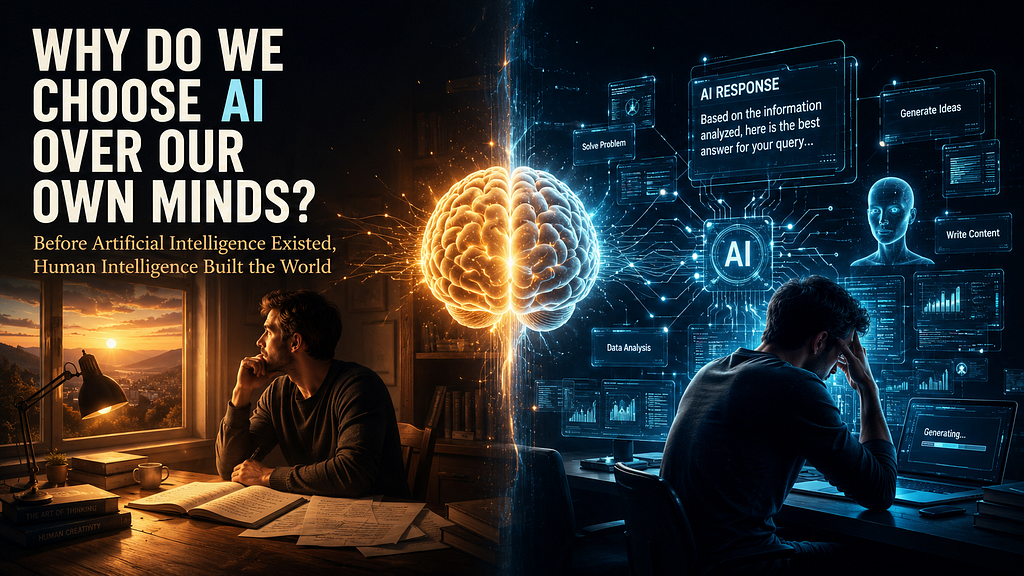
Back then, thinking came from within. Breakthroughs happened in silence. Words shaped worlds. Ideas grew slowly. Machines stayed quiet. Creators trusted only themselves. Tools were hands, paper, and time. Some inventions changed everything without a single algorithm helping. Minds worked alone and still reached far.
Image Generated by ChatGPT
Curiosity lit the way forward. Stillness between thoughts often sparked what persistence could not. Deep thinking showed up when least expected, yet always stayed long enough to matter.
Now things appear far less familiar.
Something smart machines make keeps changing how things get done. When stuck, lots of folks now look there before anything else. Fast answers come out, writing notes, shortening long texts, making new ideas appear, studying numbers, and solving problems quickly. This tool ranks among the strongest ever built by hands like ours.
What matters isn’t if AI works.
It clearly is.
What really matters might be how slowly we’re swapping human thought for machine smarts.
The Draw of Quick Responses
Most people reach for whatever feels easiest. When something quicker shows up, it usually catches on fast.
Exactly what comes out of AI. It gives just that.
Minutes replace hours, thanks to faster ways of getting things done. Right away, students find answers without waiting. Repetitive tasks run on their own, freeing up time for workers. Ideas emerge rapidly inside companies, moving quicker than before.
There is no question about the advantages.
Yet comfort tends to carry unseen consequences.
Out of the silence between questions, understanding sometimes slips in quietly. That moment when solutions don’t come fast — that’s where minds stretch. Not by design, but by doing things wrong first. Muscle grows not while resting, just as thought sharpens mid-effort. Figuring things out beats being told every single time.
When muscles go unused, they lose strength; so it is that deep thought fades without regular effort.
Curiosity Came First, Then AI
Back then, studying meant doing real work.
Back then, folks would walk into libraries just to dig through books. Talking with specialists helped them see things differently now and again. Trial after trial shaped their approach, mistakes didn’t stop them, they fueled progress. Waiting days for answers made patience a habit. Not having instant results pushed people to figure stuff out on their own.
Inventors built revolutionary technologies without AI.
Back then, folks figured things out just fine no machines needed. A single mind could shift how we see everything. It happened before circuits got involved. Discovery moved at human speed, not digital. Thought by thought, they changed what was known.
Authors wrote masterpieces without AI.
Back then, big names built worldwide firms long before smart machines arrived.
Without AI around, they still found a way forward. Thinking for themselves turned out to be the real advantage.
Without quick replies, people dug further into their questions.
AI As A Tool Rather Than a Replacement
Just because something changes does not make it dangerous.
Funny thing, really, artificial intelligence has quietly become one of the standout breakthroughs lately. Because it handles huge loads of data, spots trends others miss, takes over boring jobs people dread, yet also helps guide choices far beyond what any person could manage solo.
When guided well, artificial intelligence boosts what people are able to do.
Thinking fades once folks hand their questions over without pause.
Most times, answers come too fast because people skip curiosity. A ready-made thought often feels easier than building one yourself. Stopping wonder short happens when certainty seems safer. New thinking fades if borrowed words take its place.
Smart tools work best when they lift people up instead of taking over. What matters is support, not substitution.
The Rising Worth of Thinking for Yourself
When machines grow smarter, human judgement matters just as much. Yet it’s our ability to question that stays irreplaceable. While systems compute faster, original thought holds its ground. Because logic follows code, insight comes from somewhere else entirely. Though automation spreads, the mind’s role shifts never fades.
It’s usually the ones poking at what everyone takes for granted who find paths nobody else sees.
Most folks who question things early catch trouble before it grows. A sharp mind spots danger long before others notice anything wrong.
Staying interested keeps some folks studying way past when most give up.
Most fresh thoughts do not arrive just by taking in facts. Instead, they grow when life moments meet what we see, feel, and picture inside our minds.
Sorting data is something AI handles well.
Meaning comes because people say so.
The Future Belongs to Both
One thing is clear: ditching humans for machines misses the point entirely. Instead of picking sides, maybe it’s smarter to let both work in turn. Each brings something the other lacks, after all. Why force a race when they could walk step by step? What matters grows best when neither leads alone.
Blending what each does well makes sense. One piece fits here, another there. Strength comes from mixing these parts. Each brings something the other lacks. Together they cover more ground. What one misses, the other catches. Balance shows up when both are used.
Out of everything moving fast today, AI handles tasks quickly while digging through vast amounts of information. On the opposite end, people bring fairness, emotional understanding, original ideas, moral choices, plus long-term insight. Even as machines do more, those human traits stick around as non-negotiable parts of how we operate.
When machines learn faster, schools shift, hospitals adapt, offices change, daily routines evolve fighting progress isn’t the real problem.
Curiosity tends to fade just when things start moving forward. Yet it lingers if we pay attention at odd moments. Progress speeds ahead, but wonder sticks around quietly sometimes hiding behind small questions no one asks twice.
Questions find answers through technology.
It takes a person to dream up something fresh.
From the start of time, real change always started when someone dared to wonder something no device would ever think to say. Not machines, but people sparked what mattered most.
Choosing AI Instead of Thinking for Ourselves? was originally published in Coinmonks on Medium, where people are continuing the conversation by highlighting and responding to this story.