
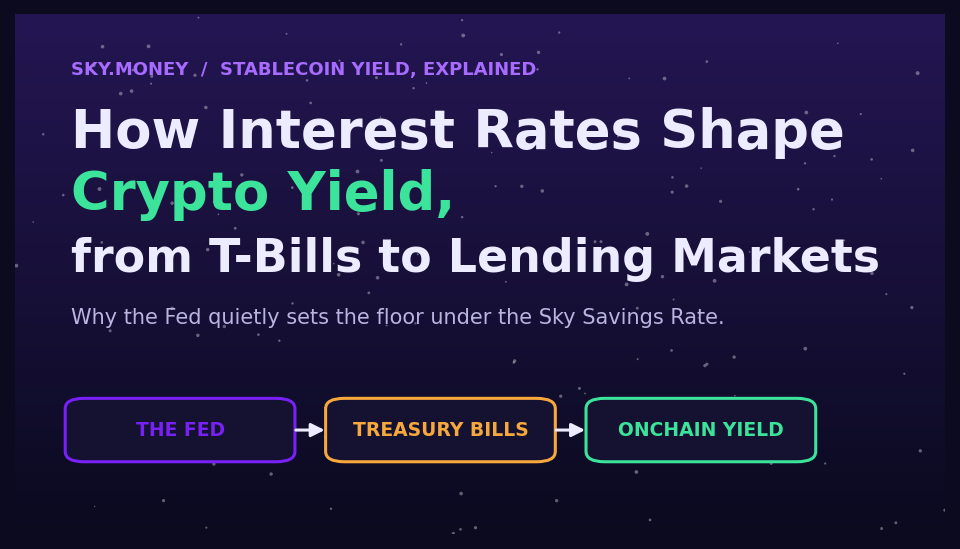
A plain-English guide to why the Fed quietly sets the floor under your stablecoin yield, and how the Sky Savings Rate turns that macro signal into real onchain returns.
Here is a question almost nobody asks before chasing a shiny APY.
When a crypto app offers you yield on your dollars, where does that number actually come from?
Follow the money far enough and you keep bumping into the same building. Not a DeFi protocol. Not a trading desk. The Federal Reserve.
Interest rates set in Washington ripple all the way down to the yield on your stablecoins. Most people never notice the wire. Once you do, you cannot unsee it.
Picture 10,000 dollars in stablecoins sitting idle in your wallet. One app offers you 5%. Another offers 8%.
A third offers 2%. Which one is real, and which one is about to collapse the moment the market blinks? You cannot answer that by staring at the numbers. You answer it by tracing the wire.
This is the story of that wire. How a single rate decision travels through Treasury bills, into lending markets, and finally lands on your screen as crypto yield.
And why understanding it is the difference between guessing at returns and actually knowing where yours come from.
The Fed Sets the Floor, Even Onchain
Start with one idea. Every dollar of yield competes with the safest dollar of yield in the world: a short-term US Treasury bill.
When the Fed raises rates, T-bills pay more. When it cuts, they pay less.
Right now the federal funds rate sits in a target range of 3.50% to 3.75%, held steady under new Chair Kevin Warsh, with the next decision due at the end of July.
That one number is the gravity behind nearly every yield in finance, crypto included.
Here is why. If safe government debt pays around 4%, no rational saver parks dollars somewhere riskier for less.
So onchain yields have to clear that bar, or capital simply walks. Researchers have measured the link directly.
A 2026 study on Fed-to-DeFi pass-through found that Fed moves and onchain stablecoin rates travel together with only a short lag.
The takeaway is simple:
The Fed sets the risk-free floor.Crypto yield gets built on top of that floor.Ignore the floor, and no APY really makes sense.
The Three Engines Behind Every Crypto Yield
Same APY on the banner. Three very different machines underneath.
Peel back any stablecoin yield and you find one of three engines humming underneath.
Treasury bills. The dollars sit in short-term government debt and earn what the government pays. Steady, boring, tied straight to the Fed.Lending demand. Your dollars get lent to borrowers, often traders using leverage. The rate rises and falls with how badly people want to borrow.The basis trade. A more advanced strategy that earns from the gap between spot and futures prices. Powerful, but sensitive to market mood.
Same word on the banner. Very different machines underneath.
The first tracks macro. The second tracks crypto sentiment. The third tracks both.
Knowing which engine powers your yield tells you exactly what will make it rise, fall, or disappear.
The APY is the headline. The engine is the real story.
Why Treasury Bills Are the Heartbeat of Stablecoin Yield
Crypto yield rides just above the Fed’s risk-free floor.
Of the three, T-bill yield is the one you can trust to behave.
Tokenized Treasuries have quietly become one of the biggest stories in crypto.
Onchain real-world assets grew from roughly 6 billion dollars to more than 31 billion between early 2025 and May 2026, and short-term Treasuries are the single largest slice.
Boston Consulting Group thinks the wider tokenized-asset market could reach 16 trillion dollars by 2030.
Stablecoins backed by these bills now pay yields that track the 3-month Treasury closely, sitting in a tight band while the Fed holds.
The mechanism is refreshingly honest. Real government debt, real interest, passed through to you.
There is even a feedback loop worth savoring. Money flowing into dollar-backed stablecoins has grown large enough to nudge Treasury yields themselves.
One market study found that a large wave of inflows into dollar stablecoins can shave a couple of basis points off the 3-month Treasury yield within days.
Crypto is no longer only downstream of the Fed. It is quietly starting to talk back.
One more twist shaped this whole design. The US GENIUS Act, signed in 2025, stops stablecoin issuers from paying interest directly to holders.
Yield routed through savings mechanisms and DeFi is unaffected. That single rule is a big reason the smartest yield now flows through savings tokens rather than the issuer’s own wallet.
This is the kind of yield that survives a boring year. It does not need a bull market. It does not need a subsidy. It just needs the government to keep paying interest, which it reliably does.
When Lending Markets Run Hot, and When They Go Cold
Lending yield is real, but moody. It swings with market appetite for leverage.
Lending yield is a different animal. It is thrilling when crypto is hot and forgettable when it is not.
Here is the pattern. When traders want leverage, they borrow stablecoins, and that borrowing demand pushes lending rates up. When the mood cools, demand dries up and rates fall fast.
You can watch it happen in real time. On one major lending market, the USDC supply rate slid from around 4.5% to roughly 2% between late 2025 and early 2026 as speculative borrowing faded. Nobody changed a rate by decree. Demand simply left the room.
Lending yield is real yield. But it is moody. It rewards you when the market is greedy and shrugs when it turns fearful.
For dollars you actually want to depend on, that swing matters more than the headline number.
Where the Sky Savings Rate Fits In
Diversified, non-custodial, and built for risk-adjusted yield.
So where does that leave someone who just wants their stablecoins to work without babysitting a dashboard?
This is exactly the gap the Sky Savings Rate is built for.
When you supply USDS through Sky.money and receive sUSDS, you tap into the Sky Savings Rate, a rate set through Sky Protocol governance.
Instead of betting on a single engine, sUSDS sits on a diversified base.
Its yield draws on revenue produced across the Sky Agent Network and a broad mix of collateral, not one moody market.
The mechanics are clean, and they fit the new rules perfectly. You hold sUSDS, and its redemption value rises over time as the Sky Savings Rate accrues. Nobody wires you interest.
Your token simply becomes worth more USDS, and you can unwind back to USDS whenever you like.
A few things make it stand out:
Diversified collateral. USDS is backed by a broad basket, allocated from real revenue that Sky Agents produce, not freshly printed tokens.Built for risk-adjusted yield. sUSDS is designed to deliver strong returns for the risk taken, not the loudest number on a banner.Real scale. sUSDS is the world’s largest yield-generating stablecoin, with billions in supply, inside a USDS system backed by over 14 billion dollars in collateral.No friction. Convert USDC to USDS one-to-one with zero fees, supply with instant liquidity, and stay fully non-custodial the whole time.
There is a quieter credibility point too. The infrastructure behind Sky has been built over roughly ten years and has never been exploited.
The Sky Frontier Foundation, which anchors the ecosystem’s approach to risk, is among the most respected groups anywhere at measuring and quantifying it. You can dig into what backs USDS before you supply a dollar.
Good yield is not the biggest number. It is the number that is still there, and still safe, next year.
Reading the Macro Signal in 2026
So what do you actually do with all of this?
Watch the Fed, but do not fear it.
If rates stay high, Treasury-linked yield stays healthy. Good news for savers.If the Fed cuts, safe yields drift lower everywhere, and a diversified, governance-set rate becomes even more valuable.If crypto heats up, lending yield can spike, but remember it can fall just as fast.
The point is not to predict the next rate decision. It is to understand that your crypto yield was never floating free. It was always tethered to the most important interest rate in the world.
How rates ripple into crypto is now core knowledge for any onchain saver.
Sky’s larger ambition is to make that legible. To build a shared language of capital, so a dollar can be measured the same way no matter the vehicle, the jurisdiction, or the currency.
For now, the move is smaller and simpler. Know where your yield comes from. Pick an engine you understand.
And if you want dollars that keep working through every part of the rate cycle, explore Sky Vaults, Fixed Yield, and the Sky Savings Rate on Sky.money. That is exactly what sUSDS was designed to do.
Your stablecoins were never built to sit still.
How Interest Rates Shape Crypto Yield: From Treasury Bills to Lending Markets was originally published in Coinmonks on Medium, where people are continuing the conversation by highlighting and responding to this story.