
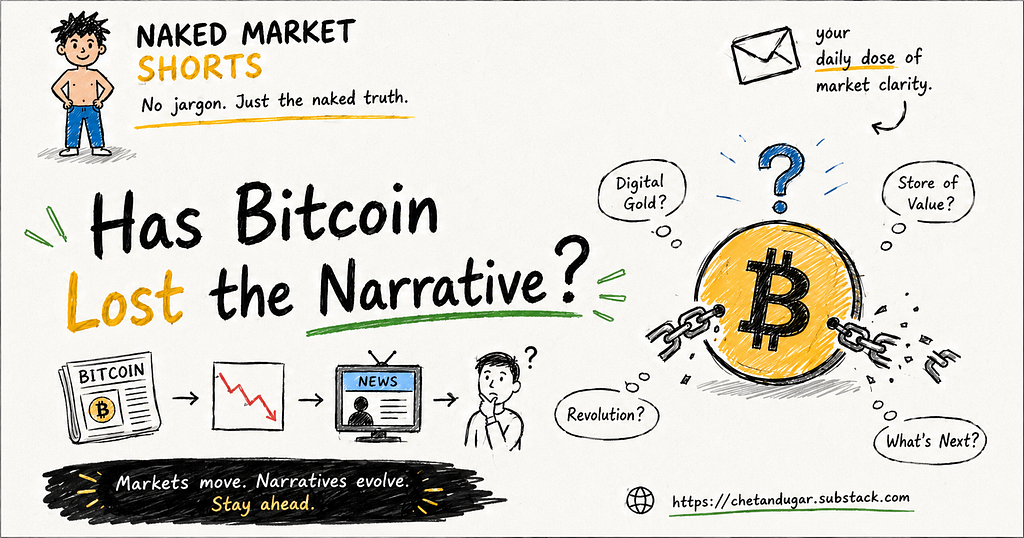
It’s down more than 50% from the top. Gold is eating its lunch. Stablecoins quietly stole its original job. But the story everyone’s arguing about is the wrong one.
Naked Market breaks down macro finance, blockchain infrastructure, AI systems, and automated trading to help you understand the future of global finance before the mainstream catches up.
Picture a screen glowing in the dark. Doesnt matter where a phone in Lagos, a laptop in Jakarta, a bedroom in Manila. Same numbers everywhere.
Bitcoin, July 2026: around $60,000.
A year ago it was near $109,000. Last October it touched $126,000 and half the internet was shouting that six figures was the new floor that it could only go up from here.
Its not the floor anymore. It hasnt been for months.
And heres the strange part. The price falling isnt even the interesting bit. Prices fall. Prices rise. Thats literally the one thing prices do.
The interesting bit is that Bitcoin is quietly losing something worth far more than dollars.
Its losing the narrative.
First — what does “losing the narrative” even mean?
Let me back up, because this word gets thrown around constantly and almost nobody stops to define it.
Every asset on earth is really two things at once. Theres the thing itself — the coin, the share, the bar of metal. And theres the story people tell about the thing. The story is what makes you hold it through a bad week, buy more when its down, or try to explain it to your uncle at a family dinner.
Gold’s story: “it has held its value for 5,000 years.” The dollar’s story: “the whole planet accepts it.” A hot tech stock’s story: “this company owns the future.”
Clean. One line each.
Bitcoin never had one story. It had four. And in 2026, three of them cracked right down the middle.
Let me show you the autopsy. (Sorry thats dark. But it fits.)
Story 1: the “digital gold” that didn’t act like gold
For years the pitch was beautifully simple. Bitcoin is “digital gold.” When the world gets scary and money runs for safety, it runs to gold and it would run to Bitcoin too. Same job as gold, just younger and faster.
2026 ran that experiment live, in public, for everyone to watch.
Late January. President Trump starts firing tariff threats at NATO allies and floating the idea of taking Greenland. Textbook fear moment exactly when a safe haven is supposed to shine.
So what did Bitcoin do?
It fell 6.6%. Gold rose 8.6%. They ran in opposite directions during the precise kind of chaos Bitcoin was built to survive.
And it gets worse. That same month, the 30-day correlation between Bitcoin and the Nasdaq 100, the index stuffed with risky tech stocks hit 0.80. The tightest in almost four years.
Quick translation, because “0.80 correlation” means nothing until someone explains it. It basically means: when tech stocks sneeze, Bitcoin catches the cold. They move together — up together, down together, nearly in lockstep.
That is the exact opposite of a safe haven. A safe haven is supposed to zig when everything else zags. Bitcoin zigged when tech zigged, then crashed when tech crashed.
Meanwhile the boring old rock it was supposed to replace? Gold ripped past $5,600 an ounce, up 23% in a matter of weeks. And the biggest buyers werent nervous day traders. They were central banks. A record 45% of them, the highest reading in the history of the survey said they plan to buy more gold this year.
Sit with that for a second. The most powerful money managers on the planet had a straight choice between digital gold and actual gold.
They chose the rock.
Story one: cracked.
Story 2: the cash job that got stolen
Rewind to the very beginning. In 2008, a person or group nobody actually knows calling themselves Satoshi Nakamoto published a short paper. Its title described Bitcoin as a peer-to-peer electronic cash system.
Cash. Money you spend. That was the founding dream, send value to anyone, anywhere on earth, with no bank in the middle taking a cut and taking its time.
Now heres the brutal irony of 2026. That dream came true. Bitcoin just isnt the thing that made it happen.
Something else did. Stablecoins.
And this is the single most important idea in this whole piece, so let me make sure it lands even if youve never touched crypto in your life.
A stablecoin is a digital token pegged to a normal currency almost always the US dollar. One token is meant to always equal one dollar. It lives on a blockchain, so it moves like crypto: instantly, globally, around the clock, no weekends, no “please allow 3–5 business days.” But because its tied to the dollar, it doesnt lurch up and down like Bitcoin does. Its basically a dollar that learned how to teleport.
And people are using them. Not a little. A staggering amount.
In February 2026, stablecoins did something that honestly should have been front-page news everywhere and somehow wasnt. In a single month they moved $7.2 trillion beating ACH, the decades-old plumbing behind American bank transfers, for the first time ever. Across all of 2025 they settled roughly $33 trillion. Thats more than Visa and Mastercard combined.
Heres the cleanest way I can put it. The dollar is the cargo. The blockchain is just a faster truck.
The world never actually wanted a brand new kind of money to spend. It wanted its existing money — dollars, the thing it already trusts to move at the speed of a text message. Stablecoins delivered exactly that. Bitcoin, swinging 5% on a random Tuesday, was never going to be the thing you buy groceries with in Buenos Aires or send home to family in Manila.
Story two: stolen, right out from under it.
Story 3: the frontier that moved on
For about a decade, if you were an investor who wanted a slice of “the future” the wild frontier, the thing your friends didnt understand yet and kind of mocked you for you bought Bitcoin. It was the frontier-technology trade. The rebel bet.
Then, in 2023, three letters walked into the room and took the entire table.
A.I.
By 2026, the frontier isnt crypto anymore. Its artificial intelligence. The money that used to chase “the next big technology” now chases chips and models and AI startups. Bitcoin went from being the daring outsider to being, lets be honest a ten-year-old asset your bank now sells you in a neat little ETF wrapper.
Nothing ages a frontier story faster than becoming mainstream. And nothing makes yesterday’s frontier look dull faster than a shiny new one moving in next door.
Story three: replaced.
The twist: the one story Bitcoin is quietly winning
Okay. Three stories cracked. So Bitcoin is finished, right? Pack it up, nothing to see?
No. And this is exactly where almost everyone bulls and bears both gets it wrong.
While those three narratives were falling apart, a fourth one quietly got stronger. Not “money you spend.” Not “safe haven for a scary Tuesday.” Something slower, heavier, and far less exciting to post about:
A reserve asset for governments.
In March 2025, the United States created a Strategic Bitcoin Reserve. Today the US government sits on somewhere around 325,000 Bitcoin. El Salvador holds it as official national policy. Bhutan quietly mines it with hydro power off its mountains. Pakistan announced a reserve of its own.
Look at what all these buyers have in common. Theyre not trying to buy coffee. Theyre not trading in and out on a Tuesday afternoon. Theyre parking value for the long haul — the US reserve literally comes with a 20-year holding rule.
And that is a completely different story from the other three. Better yet, its the one job Bitcoin is genuinely good at: a scarce, hard-to-seize, borderless thing a country can hold when it doesnt fully trust the dollar or cant fully get access to it.
So the honest scoreboard for Bitcoin in 2026 looks like this:
Three losses. One win.
And yet the crowd keeps reacting to the price of the whole bundle screaming either “its dead” or “its going to a million” when the truthful answer is: it completely depends on which story youre talking about.
Zoom out: it was never one coin
Now step all the way back. Because this is where Naked Market actually lives not in the price, but in the structure humming underneath it.
For years, one tribe of Bitcoin believers held a very specific dream. One coin. One deflationary money. Bitcoin would swallow the dollar, the euro, the yen, and become the single money of the internet. One coin to rule them all.
2026 quietly put that dream to bed. But and this is the part that matters most it proved something far bigger true.
If youve been reading this newsletter for a while, you know the thread running through all of it: One Earth, One Currency. The idea that the world is slowly, structurally rebuilding money on shared, neutral, borderless rails. (New here? Start with this its the whole thesis in one place.)
Heres what people keep misreading. “One Earth, One Currency” was never going to be one coin winning a cage match. Its shared rails winning. A common settlement layer that dollars can ride, that tokenized bonds can ride, that in time many national currencies can ride, all at once, all on the same open network.
Now look at what actually won in 2026. Not a single coin. The rails. Stablecoins moving $33 trillion isnt proof that “crypto beat the dollar.” Its proof that money itself is climbing onto blockchain infrastructure and the dollar simply got there first by hitching a ride.
So Bitcoin losing three of its four narratives isnt evidence against the future of digital money. Its the strongest evidence yet for what that future actually is. It was never one coin. It was always the rails.
Bitcoin is one passenger on those rails. An important one, with a real, permanent seat the “hard reserve” seat by the window. But it was never the whole train. The people in real pain right now are the ones who bet it was. (Thats the misconception that keeps costing people money.)
Your tool: The Narrative Ledger
So how do you avoid becoming one of those people? How do you look at any hyped asset or any dumped, left-for-dead one and actually see clearly, while everyone around you is either euphoric or terrified?
Heres the tool. Im calling it the Narrative Ledger. Take it with you. Its yours now.
A ledger, in plain accounting terms, is just two columns: what you own (assets) and what you owe (liabilities). The Narrative Ledger does the exact same thing but for stories instead of money.
When you look at any asset, company, coin, or trend, dont ask the crowd’s lazy question (“is it going up or down?”). Ask a sharper one:
“Which of its stories is winning, and which is losing?”
KEEP THIS · THE NARRATIVE LEDGER
List every story. Not the loudest one. All of them. (Bitcoin had four.)Write the evidence next to each. Real numbers, real behavior, real money flows. Not vibes, not headlines, not what a guy screamed on YouTube.Mark each one. Asset (evidence backs it up) or liability (evidence kills it).Read the net — never the loudest line.
Run Bitcoin through it and the fog burns off in about thirty seconds. Three liabilities, one asset. Not “dead.” Not “to the moon.” Just a specific thing thats quietly excellent at one job and has clearly lost three others.
And heres why this little tool is worth more than any price prediction youll ever read: it works on everything. Run it on an AI stock everyone swears is infinite. Run it on gold. Run it on the next coin your cousin promises is a 100x at the next family dinner. The crowd will always react to the whole. Youll read the lines.
Thats the entire game.
Rich reacts. Wealthy reads the rails.
Theres a difference between being rich and being wealthy, and it shows up right here, in exactly this kind of moment.
The rich person sees Bitcoin at $60,000, sees a screen full of red, feels the fear thick in the room and reacts. Sells at the bottom, or panic-buys the top, yanked around by whichever story is loudest that particular week.
The wealthy person doesnt look at the price first. They read the ledger. They notice that one quiet narrative got stronger while three noisy ones fell apart. And they understand that “Bitcoin” and “the future of money” were never the same sentence. They were watching the rails the entire time.
Bitcoin didnt lose the narrative. It lost three narratives, kept one, and in the process accidentally revealed what the real story was all along.
The rails are being laid. Right now, under all the noise. The only question that actually matters is whether youre reading them or reacting to them.
If you want to understand where money is heading before it gets obvious before the headlines, before the crowd, before your bank sends you that polite little email about its exciting new digital-asset product this is the place.Subscribe to Naked Market
Well keep reading the rails together.
Keep going
Stablecoins: How a Casino Chip Became the Most Important Money on Earth
The New Rails: Blockchain as Infrastructure
Crypto Was Supposed to Escape the System
– More soon
Has Bitcoin Lost the Narrative? was originally published in Coinmonks on Medium, where people are continuing the conversation by highlighting and responding to this story.