
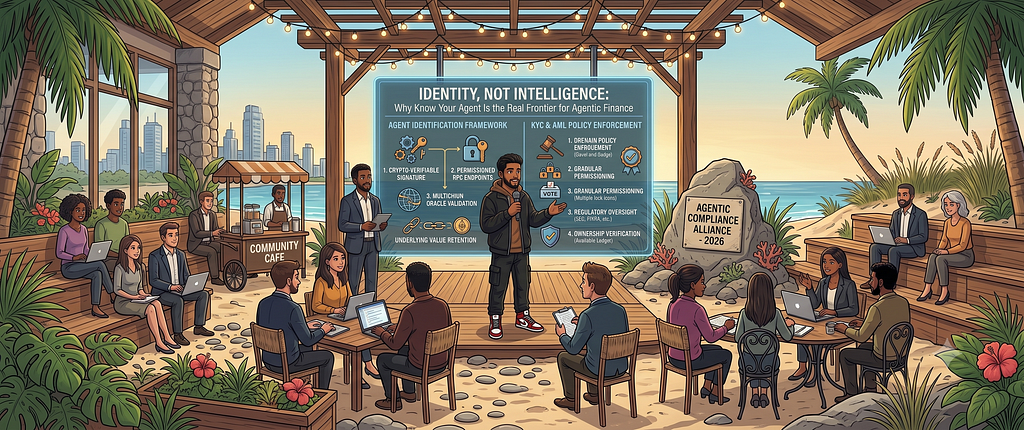
Your agent is the real frontier
The agent economy’s bottleneck is shifting from smarter models to identity. Agents need signed credentials tying them to a principal, their limits, and who is liable. a16z, and Circle co-founder Sean Neville, call this Know Your Agent. The winners in agentic finance will not be the smartest agents. They will be the accountable ones.
We keep asking whether AI agents are smart enough. For money, that is the wrong question. An agent can draft a flawless trade rationale, parse a whole market in seconds, and still be uninvestable, because no one can say who it is, what it is allowed to do, or who pays when it gets something wrong. The harder problem is not intelligence. It is knowing who an agent is and who is on the hook when it acts.
The argument
In its Big Ideas 2026 series, a16z argued the bottleneck for the agent economy is moving from intelligence to identity. The framing is blunt: in financial services, non-human identities already outnumber human employees by a wide margin, and yet those identities are effectively unbanked. They can act, but they cannot be trusted the way a person or a registered business can, because there is no standard way to check who stands behind them.
The firm calls the missing primitive Know Your Agent, or KYA, a deliberate parallel to Know Your Customer. Humans built KYC over decades: identity checks, credit history, the paper trail that lets a bank decide whether to extend you a loan. Agents have none of that yet. So merchants and platforms do the rational thing and block them at the firewall. a16z’s point is that the same industry that spent decades building KYC now has months, not decades, to build KYA, because agents are already trying to transact.
Sean Neville has made the same case from inside the problem. He co-founded Circle and helped create USDC, and his new company, Catena Labs, took itself out of stealth in 2025 to build what he calls an AI-native financial institution, backed by a Series A led by a16z crypto. Catena has shipped an Agent Commerce Kit, a set of open protocols built on W3C web standards that let agents hold their own accounts, prove their identity, and pay for services through standardized paywalls. Different words, same instinct as a16z: an agent should carry signed credentials linking it to a principal (who is responsible), its constraints (what it may do), and its liability (who pays when it goes wrong).
Why accountability beats capability
In finance, the scarce resource is not a smarter model. It is trust that an action can be traced to someone accountable. This is worth sitting with, because it inverts how most people rank agents. A brilliant agent no one can identify is a liability. A modest agent with a signed identity and clear limits is bankable.
Think about how any real financial counterparty treats you. A bank does not extend credit because you seem clever. It extends credit because it can identify you, check your history, price your risk, and come after someone if the money disappears. Capability is table stakes. Accountability is the thing that unlocks access. Agents are about to run into the same wall. The market will not reward the agent that reasons best about a portfolio. It will reward the agent whose actions can be tied back to a named, liable human, and whose authority can be revoked the moment it misbehaves.
That is why identity, not intelligence, is the frontier. Intelligence is improving on its own, fast, and it is increasingly commoditized. Accountability is not. It has to be built, standardized, and adopted, and whoever builds the rails everyone trusts captures the value.
What Know Your Agent looks like
Strip it down and Know Your Agent has a few concrete properties.
Signed credentials, so an agent’s identity is cryptographically verifiable rather than merely asserted. A named principal, so there is always a specific person or business standing behind the agent. Scoped permissions, so the agent’s authority is bounded to defined actions and limits rather than open-ended. An audit trail, so every action is logged and traceable after the fact. And revocation, so that authority can be pulled instantly when something goes wrong, without unwinding the whole system.
None of these are exotic. They are the same controls that already govern employees, corporate cards, and API keys. What is new is packaging them into a portable identity an agent carries with it, one that a counterparty on the other side of a transaction can check before deciding to deal. That is the gap the industry is racing to close.
Where this fits in the wider agent economy
Zoom out and Know Your Agent is not a single product. It is a layer that a lot of the 2026 crypto and agent stack is converging on at once, from different directions.
The clearest signal is on the payments side. Coinbase’s x402 protocol revives the old HTTP 402 Payment Required status code and turns it into a way for agents to pay for things in stablecoins directly over the web, without accounts or manual checkout. It has moved from idea to real traffic quickly, and in April 2026 it was formalized under the Linux Foundation with members including Google, Visa, AWS, Circle, and Anthropic. But payment rails alone raise the identity question rather than answer it. Once agents can move money at machine speed, the pressing question becomes which agent, acting for whom, under what limits. That is why efforts like ERC-8004 are emerging alongside x402 to handle on-chain identity and reputation, the “who you are” half of a transaction whose “how you pay” half already works.
The second front is credentialing and permissions. A wave of agentic wallet providers is building policy layers that sit between an agent and its funds: spending caps, allow-lists, approval rules, and logs that decide what an agent can do before it does it. Catena’s Agent Commerce Kit is one attempt at the identity and account side. Others are focused on the wallet and policy side. Different teams, same shape: bound the agent’s authority, tie it to a responsible party, and keep a record.
Fensory, which I work on, is one early and basic example among these peers. It is a wallet an agent operates, but the user funds it and sets the caps, so the agent’s authority is bounded and traceable to the person who set the bounds. The user keeps custody. The agent does not move the user’s money on its own terms or act beyond the limits the user defined; it operates inside a fenced budget the user controls. Disclosure: I work on Fensory. It is not the full credentialing stack the a16z and Neville framing describes, and it does not claim to be. It is Know Your Agent at a basic level: authority that is capped, funded by a named person, and traceable back to them.
What ties all of this together is that no single piece is sufficient. Payment rails need identity to scale past hobbyist volume. Identity needs permissions to be safe. Permissions need an audit trail to be trusted. The reason a16z and Neville can say the same thing in different words is that they are describing one missing layer from different sides of it.
FAQ
What is Know Your Agent? Agents need signed credentials linking them to a principal, constraints, and liability (a16z, Sean Neville). It is the agent-world parallel to Know Your Customer.
Why is identity the bottleneck? In finance, trust and accountability matter more than raw capability. Merchants and banks block agents they cannot identify, so the industry has to build KYA the way it once built KYC.
How does this connect to agent payments like x402? Payment rails let agents move money, but they raise the identity question rather than solve it. Identity standards have to grow alongside the payment layer for agent payments to scale.
Do agents have real identity today? Mostly not yet. Early versions look like capped, user-funded wallets where authority is bounded and traceable to a named person.
Close
The winners will be whoever makes agents accountable, identifiable, bounded, and revocable. Intelligence is getting cheap. Trust is not, and that is where the real frontier of agentic finance sits.
Resources:
– a16z Big Ideas 2026
– Circle and Catena Labs on agent identity
– Coinbase x402 and the x402 Foundation
– Fensory.
Last updated: July 2026.
Identity, Not Intelligence: Why Know Your Agent Is the Real Frontier for Agentic Finance was originally published in Coinmonks on Medium, where people are continuing the conversation by highlighting and responding to this story.