
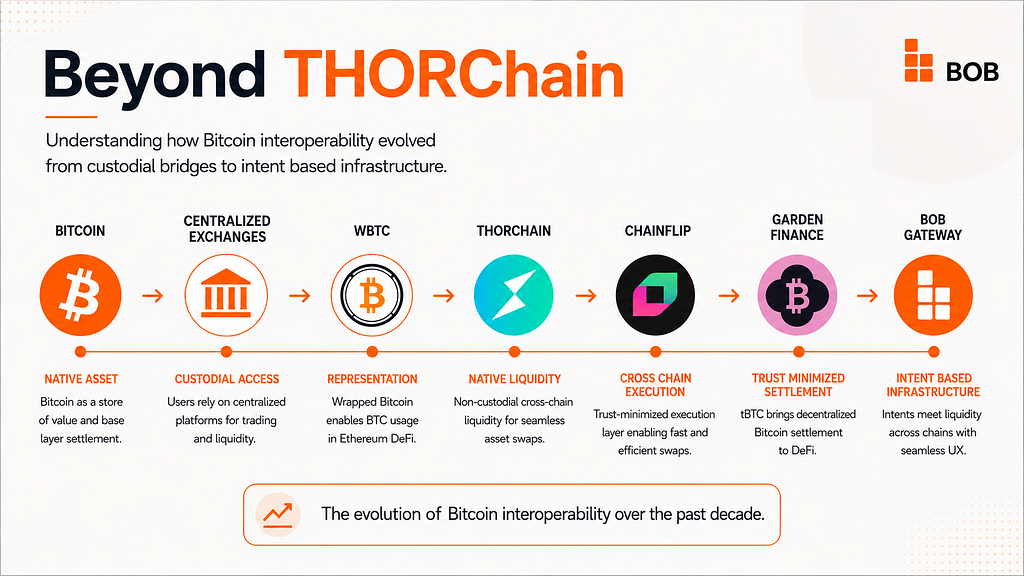
Bitcoin is the largest digital asset in the world, securing trillions of dollars in value and serving as the foundation of the cryptocurrency industry. Yet despite its dominance, Bitcoin has historically been one of the least interoperable blockchain networks.
That wasn’t an accident.
When Satoshi Nakamoto introduced Bitcoin in 2008, the objective wasn’t to build a blockchain capable of supporting decentralized applications or communicating with other networks. Bitcoin was designed to solve a much simpler problem: creating a peer to peer electronic cash system that could operate without trusted intermediaries. Its conservative scripting language and Proof of Work consensus prioritized security, decentralization, and reliability over programmability.
Those design decisions made Bitcoin exceptionally resilient.
They also made it difficult to integrate with the rapidly expanding world of decentralized finance.
As Ethereum, Solana, and other smart contract platforms introduced lending protocols, decentralized exchanges, perpetual markets, and automated financial applications, Bitcoin holders faced a difficult choice. They could either keep their BTC on the Bitcoin network and miss those opportunities, or move into custodial systems that required trusting third parties.
Neither option was ideal.
This challenge gave birth to one of the most important areas of innovation in crypto: Bitcoin interoperability.
Over the past decade, developers have proposed multiple approaches to solving this problem. Some relied on custodians to represent Bitcoin on other blockchains. Others built decentralized liquidity networks capable of moving native assets across chains. More recent protocols have focused on improving execution, reducing settlement risk, and simplifying the user experience through intent based systems.
This evolution has produced several of the industry’s most important interoperability protocols, including THORChain, Chainflip, Garden Finance, and BOB Gateway.
These protocols are often grouped together and described as competitors. As a result, one question appears repeatedly across research reports, developer forums, and social media:
What are the best THORChain alternatives?
At first glance, that seems like a straightforward question.
After spending time studying the architecture, documentation, and design philosophy behind each protocol, I came to a different conclusion.
I don’t think the question should begin with which protocol is better.
I think it should begin with which interoperability problem each protocol was designed to solve.
That distinction changes everything.
THORChain wasn’t built to solve every aspect of Bitcoin interoperability. It was designed to eliminate the need for wrapped assets by enabling native cross chain liquidity.
Chainflip focused on improving cross chain execution through a different market structure.
Garden Finance concentrated on minimizing trust during settlement using cryptographic mechanisms.
BOB Gateway builds on those innovations by simplifying how users interact with Bitcoin across multiple blockchain ecosystems through Bitcoin Intents, allowing users to express the outcome they want while the underlying infrastructure coordinates execution. As explained in the BOB Gateway: Connecting Bitcoin through Intents blog, the goal is to abstract away the complexity of cross chain interactions while preserving access to Bitcoin’s growing DeFi ecosystem.
This reveals something important.
The history of Bitcoin interoperability isn’t the story of competing protocols trying to replace one another.
It is the story of developers solving increasingly difficult problems, one layer at a time.
In this article, we’ll follow that evolution from the earliest custodial models to modern intent based infrastructure. Along the way, we’ll examine what each protocol contributes, the trade offs behind its design, and why understanding these differences provides a far better answer than simply ranking protocols from best to worst.
To understand why protocols like THORChain, Chainflip, Garden Finance, and BOB Gateway exist today, we first need to go back to the earliest days of Bitcoin interoperability, when the only bridge between Bitcoin and the rest of the crypto economy wasn’t a protocol at all.
It was trust.
For years, Bitcoin interoperability wasn’t powered by sophisticated cryptography or cross chain messaging.
It was powered by trust.
If a user wanted to trade Bitcoin for another asset, access liquidity on another blockchain, or participate in the broader crypto economy, the simplest option was to deposit BTC into a centralized exchange. The exchange became the bridge between Bitcoin and every other blockchain ecosystem.
This model solved an important problem.
Centralized exchanges dramatically improved accessibility by making it easy to buy, sell, and trade Bitcoin without understanding wallets, private keys, or blockchain infrastructure. They created deep liquidity, efficient price discovery, and a user experience that helped drive Bitcoin’s global adoption.
However, this convenience introduced a trade off that conflicted with one of Bitcoin’s core principles.
The moment users deposited their Bitcoin onto an exchange, they surrendered control of their private keys. Instead of relying on Bitcoin’s decentralized security model, they relied on the exchange to safeguard assets, process withdrawals, and remain solvent. Over the years, several high profile exchange failures reminded the industry why the phrase “Not your keys, not your coins” became such a widely accepted principle.
As decentralized finance began transforming Ethereum into a global financial platform, another limitation became impossible to ignore.
Bitcoin remained the largest cryptocurrency by market capitalization, yet it couldn’t participate directly in lending protocols, decentralized exchanges, derivatives, or yield strategies because it wasn’t designed to execute smart contracts or communicate with external blockchains.
Developers needed a way to bring Bitcoin into DeFi without asking users to sell their BTC.
The first widely adopted solution was Wrapped Bitcoin (WBTC).
Launched in 2019, WBTC introduced a straightforward but influential model. Instead of moving native Bitcoin onto Ethereum, custodians locked real BTC in reserve while issuing an equivalent ERC-20 token backed at a 1:1 ratio. Every WBTC represented one Bitcoin held in custody, allowing Bitcoin holders to interact with Ethereum based applications while maintaining exposure to Bitcoin’s price.
The impact was significant.
For the first time, Bitcoin became a productive asset within decentralized finance. Users could supply Bitcoin as collateral, provide liquidity to decentralized exchanges, participate in lending markets, and explore yield generating opportunities that previously existed only for Ethereum native assets.
More importantly, WBTC proved something the industry had suspected for years.
The demand for Bitcoin extended far beyond simply holding it.
People wanted to use Bitcoin across the broader blockchain economy.
Figure 1. Wrapped Bitcoin introduced a 1:1 backed representation of BTC on Ethereum, enabling Bitcoin to participate in decentralized finance.
Yet WBTC also exposed the next challenge.
Although it expanded Bitcoin’s utility, it didn’t remove trust from the system.
It simply shifted that trust.
Instead of relying on an exchange during trading, users now relied on custodians to securely hold the Bitcoin reserves backing every wrapped token. If those reserves were compromised or the custodial process failed, confidence in the wrapped asset would also be affected.
For many developers, this represented an important limitation.
Bitcoin had entered DeFi, but it hadn’t done so as native Bitcoin.
That realization sparked a new wave of innovation.
Rather than asking how Bitcoin could be represented on another blockchain, developers began asking a far more ambitious question.
Could Bitcoin remain native while moving seamlessly across different blockchain ecosystems?
That question marked the beginning of the next generation of Bitcoin interoperability.
And no protocol shaped that conversation more than THORChain.
THORChain didn’t emerge because Wrapped Bitcoin had failed.
It emerged because developers believed Bitcoin interoperability could be achieved with fewer trust assumptions.
Instead of creating another token that represented Bitcoin on a different blockchain, THORChain pursued a more ambitious objective: enabling users to swap native Bitcoin directly for native assets on other networks without relying on wrapped tokens or centralized custodians.
That distinction fundamentally changed how many developers thought about cross chain infrastructure.
According to the official THORChain documentation, the protocol operates as an independent Layer 1 blockchain built with the Cosmos SDK and secured through CometBFT consensus. Rather than acting as a bridge that holds tokenized representations of assets, THORChain coordinates swaps between native blockchains while allowing assets to remain on their respective networks.
Making this possible required more than simply connecting different chains.
THORChain introduced Bifrost, an interoperability layer that continuously observes supported blockchains, detects deposits, and relays that information to the network. Once validators reach consensus that a transaction has occurred, the protocol authorizes the corresponding outbound transaction.
Security is equally important.
Instead of allowing a single validator to control protocol funds, THORChain uses Threshold Signature Schemes (TSS) to distribute signing authority across multiple validators. According to the protocol’s documentation, outbound transactions require approval from a validator supermajority before assets can leave protocol vaults, significantly reducing the risks associated with centralized key management.
Liquidity also works differently from traditional decentralized exchanges.
Rather than maintaining separate pools for every trading pair, THORChain routes swaps through RUNE, the protocol’s native settlement asset.
A simplified transaction follows this path:
BTC → RUNE → ETH
Although this introduces an additional routing step, it concentrates liquidity around a common settlement asset instead of fragmenting it across hundreds of isolated pools. As more assets join the network, this model can improve capital efficiency by reducing the amount of liquidity required for every possible trading pair.
THORChain demonstrated something the industry had been working toward for years.
Bitcoin didn’t always need to be wrapped to participate in decentralized finance.
Native assets could move across blockchain ecosystems through decentralized coordination rather than custodial representations.
That achievement established THORChain as one of the most influential protocols in Bitcoin interoperability and helped redefine expectations for cross chain infrastructure.
Figure 2. THORChain coordinates native cross chain swaps through Cosmos SDK, Bifrost observers, protocol vaults, and Threshold Signature Schemes.
For many observers, THORChain appeared to solve Bitcoin interoperability.
But as adoption increased, another challenge became clear.
Native liquidity alone wasn’t enough.
As users began moving assets across multiple blockchain ecosystems more frequently, attention shifted from whether native swaps were possible to how efficiently those swaps could be executed.
Questions about execution quality, pricing, routing efficiency, and market competition became just as important as liquidity itself.
Those questions gave rise to the next stage in Bitcoin interoperability.
Rather than redesigning native liquidity, Chainflip set out to rethink how cross chain trades should be executed.
Chainflip entered the market with a different assumption.
If THORChain had shown that native cross chain liquidity was achievable, the next challenge wasn’t proving that assets could move between blockchains. It was ensuring those swaps happened as efficiently as possible.
In other words, the conversation shifted from liquidity to execution.
Although THORChain and Chainflip are often compared, their design priorities are not identical.
THORChain primarily optimizes for decentralized native liquidity.
Chainflip focuses on how cross chain trades are matched and executed.
According to the official Chainflip documentation, the protocol is built around a dedicated State Chain, an independent blockchain responsible for coordinating swaps across supported networks. Instead of relying on an automated market maker model, Chainflip introduces competitive market makers that compete to fulfill user orders. When a user initiates a swap, market makers bid to provide the best execution, creating a competitive environment designed to improve pricing and capital efficiency.
This architecture separates two responsibilities that are often combined in other systems.
Validators secure the protocol, monitor supported blockchains, and authorize transactions.
Market makers compete to execute trades.
By separating security from liquidity provision, Chainflip allows each component to evolve independently while encouraging competition for order flow.
From a technical perspective, this represents a different solution to the same broader problem.
THORChain asks:
How can native assets move across chains without custodians?
Chainflip asks:
Once native liquidity exists, how can trades be executed more efficiently?
Neither protocol makes the other obsolete.
Instead, they illustrate how Bitcoin interoperability has matured. As one generation solved a major bottleneck, the next generation focused on refining another part of the user experience.
Figure 3. Chainflip separates protocol security from trade execution through its State Chain architecture, allowing market makers to compete for order flow.
By this point, Bitcoin interoperability had progressed significantly.
Users no longer had to depend entirely on centralized exchanges.
They no longer needed wrapped representations for every interaction.
Native liquidity was possible.
Cross chain execution had become more sophisticated.
Yet one important question remained unanswered.
Even if a swap could be routed efficiently, how could both sides of the transaction settle securely without introducing unnecessary trust?
Execution and settlement are closely related, but they are not the same.
A trade can be matched perfectly and still fail if settlement isn’t completed securely across multiple blockchains.
That challenge inspired another generation of innovation.
Instead of focusing primarily on liquidity or execution, Garden Finance concentrated on making cross chain settlement as trust minimized as possible.
This is where the story of Bitcoin interoperability becomes even more interesting.
Rather than competing directly with THORChain or Chainflip, Garden Finance addressed a layer of the problem that neither protocol was specifically designed to solve.
Garden Finance begins with a simple observation.
Moving assets across blockchains is only half the problem.
The other half is ensuring those assets settle securely without requiring users to trust an intermediary.
In traditional finance, settlement refers to the final exchange of assets between two parties. Cross chain transactions face a similar challenge. A trade is only complete when both assets reach their intended destinations. If one side succeeds while the other fails, users are exposed to unnecessary risk.
Garden Finance was designed to minimize that risk.
Rather than relying on custodians or introducing another wrapped representation of Bitcoin, Garden uses Hash Time Locked Contracts (HTLCs), a cryptographic mechanism that allows two independent blockchains to complete an atomic exchange. Either both sides of the transaction succeed, or the transaction expires and participants recover their funds. This greatly reduces counterparty risk because neither participant has to trust the other to complete the swap.
While HTLCs have existed for years, Garden applies them to modern cross chain infrastructure in a way that prioritizes trust minimized settlement for Bitcoin.
According to the official Garden documentation, users submit an intent describing the outcome they want, while independent solvers compete to fulfill that request. Once a solver accepts the order, HTLCs coordinate settlement across the participating blockchains, ensuring that completion depends on cryptographic conditions rather than the discretion of a trusted intermediary.
This design represents another important step in the evolution of Bitcoin interoperability.
THORChain demonstrated that native liquidity could replace wrapped assets.
Chainflip refined how that liquidity could be executed more efficiently.
Garden Finance focused on ensuring the final settlement of those transactions remained as trust minimized as possible.
These aren’t competing answers to the same question.
They are answers to different questions that arise as Bitcoin interoperability becomes more sophisticated.
Figure 4. Garden Finance uses Hash Time Locked Contracts to coordinate trust minimized settlement between independent blockchain networks.
By now, a clear pattern begins to emerge.
Every major protocol we’ve examined solved one of the ecosystem’s biggest bottlenecks.
Centralized exchanges solved accessibility.
Wrapped Bitcoin introduced Bitcoin to decentralized finance.
THORChain unlocked native liquidity.
Chainflip improved execution.
Garden Finance strengthened settlement.
Each innovation made Bitcoin more interoperable than the generation before it.
Yet despite these technical advances, one obstacle continued to affect nearly every user.
Complexity.
A newcomer still had to understand wallets, networks, bridges, gas fees, routing, confirmations, and transaction sequencing before interacting confidently across multiple chains.
The infrastructure had become remarkably sophisticated.
The user experience had not.
This is where the conversation shifts once again.
Instead of asking how to improve liquidity, execution, or settlement individually, BOB Gateway asks a different question.
What if users never had to think about those underlying mechanics at all?
That question represents the latest stage in the evolution of Bitcoin interoperability.
For years, developers concentrated on improving the underlying infrastructure. Every generation of protocols reduced another technical barrier, making Bitcoin more useful across multiple blockchain ecosystems.
But there was one challenge that technology alone hadn’t solved.
Most users don’t think in terms of liquidity routing, settlement mechanisms, or cross chain execution.
They simply want to accomplish a task.
Swap Bitcoin.
Stake Bitcoin.
Deposit Bitcoin into DeFi.
Earn yield.
The path those assets take is far less important than the outcome.
This is the problem BOB Gateway was designed to address.
Rather than introducing another bridge or another liquidity protocol, BOB Gateway builds on the progress made by earlier interoperability solutions and focuses on simplifying the user experience through Bitcoin Intents.
As explained in BOB’s “Gateway: Connecting Bitcoin Through Intents” blog, the idea behind Bitcoin Intents is straightforward. Instead of requiring users to manually select bridges, compare routes, coordinate transactions across multiple chains, and manage the technical details of execution, users simply specify the result they want. A decentralized network of solvers then determines the most efficient way to fulfill that request using the available infrastructure.
This changes the role of interoperability itself.
Earlier protocols asked users to interact directly with the underlying technology.
BOB Gateway asks the technology to adapt to the user’s objective.
That shift may seem subtle, but it represents an important evolution in blockchain design.
The internet didn’t become mainstream because people understood TCP/IP.
Cloud computing didn’t achieve global adoption because users understood distributed infrastructure.
Successful technologies become invisible.
The same principle increasingly applies to Bitcoin interoperability.
According to the BOB Gateway documentation, Gateway is designed as an intent and RFQ based protocol that gives users a single entry point into Bitcoin DeFi while abstracting much of the complexity involved in cross chain interactions. Instead of replacing protocols like THORChain, Chainflip, or Garden Finance, Gateway is designed to work alongside the growing interoperability ecosystem, making those innovations easier to access.
This distinction is critical.
BOB Gateway is not another answer to the same question THORChain was trying to solve.
It represents the next layer in the stack.
THORChain focused on native liquidity.
Chainflip refined execution.
Garden Finance strengthened settlement.
BOB Gateway focuses on orchestration and user experience, allowing people to benefit from advances in interoperability without needing to understand every protocol operating behind the scenes.
Figure 5. BOB Gateway introduces Bitcoin Intents, allowing users to express the outcome they want while the underlying infrastructure coordinates execution.
Looking back, the answer to our original question becomes much clearer.
The best THORChain alternative isn’t determined by which protocol has the most features or the highest trading volume.
It depends on which interoperability problem you’re trying to solve.
If the objective is native liquidity without wrapped assets, THORChain remains one of the most influential protocols in the industry.
If execution quality and competitive pricing are the priority, Chainflip introduces a different architectural approach.
If trust minimized settlement is the primary concern, Garden Finance offers a specialized solution built around cryptographic guarantees.
If the goal is making Bitcoin DeFi significantly easier to use, BOB Gateway points toward a future where users interact with outcomes rather than infrastructure.
Viewed individually, these protocols appear to compete.
Viewed together, they tell a very different story.
They represent successive milestones in the evolution of Bitcoin interoperability, with each generation solving a limitation that the previous generation left behind.
That perspective leads to a more meaningful conclusion than simply ranking protocols from best to worst.
Conclusion
When I first started researching this topic, I expected to find a clear winner.
Like many people entering Bitcoin DeFi, I assumed the goal was to identify the protocol that would eventually dominate cross chain interoperability.
The deeper I went into the documentation, architecture, and design philosophy behind each protocol, the more that assumption changed.
The question isn’t which protocol is better.
The question is which problem each protocol was built to solve.
That distinction explains why the Bitcoin interoperability landscape has evolved the way it has.
Centralized exchanges made Bitcoin accessible to millions of users but required them to surrender custody.
Wrapped Bitcoin proved there was enormous demand for using BTC in decentralized finance, but it still relied on custodial infrastructure.
THORChain demonstrated that native liquidity could exist without wrapped assets, fundamentally changing expectations for cross chain swaps.
Chainflip showed that execution itself could be redesigned through competitive market making and a dedicated State Chain.
Garden Finance strengthened settlement by using cryptographic guarantees to minimize trust during the final stage of a transaction.
And today, BOB Gateway builds on those innovations by asking a different question altogether:
What if users didn’t need to understand any of this infrastructure to benefit from it?
That shift is what makes BOB Gateway particularly interesting.
Rather than attempting to replace THORChain, Chainflip, or Garden Finance, Gateway recognizes that interoperability has already matured into a sophisticated ecosystem. Its contribution is to reduce the complexity exposed to users by introducing Bitcoin Intents, allowing people to focus on the outcome they want while the underlying infrastructure coordinates the execution.
In many ways, this mirrors the evolution of the internet itself.
Early internet users needed to understand servers, networking, and manual configuration. Today, billions of people use cloud applications every day without thinking about the infrastructure that makes them possible.
Blockchain technology appears to be following a similar path.
The protocols that shaped the first generation of interoperability focused on making cross chain interactions technically possible.
The next generation is focused on making those same interactions feel effortless.
That is why I no longer think “What are the best THORChain alternatives?” is the most useful question.
A better question is:
How has Bitcoin interoperability evolved, and what role does each protocol play in that evolution?
Viewed through that lens, THORChain, Chainflip, Garden Finance, and BOB Gateway are not simply competing products.
They are complementary innovations that address different layers of the same challenge.
As Bitcoin continues expanding beyond its native blockchain, that layered approach may ultimately become the defining characteristic of its interoperability stack.
The future is unlikely to belong to a single protocol.
It is more likely to belong to an ecosystem where specialized infrastructure works together to make Bitcoin more liquid, more accessible, more secure, and ultimately easier for anyone to use.
References
Satoshi Nakamoto. Bitcoin: A Peer-to-Peer Electronic Cash System.https://medium.com/media/9c8fb9b51c650a2cad0f08ed3b9450f5/hrefWrapped Bitcoin (WBTC)
Bitcoin’s Passport to DEFI | WBTC
THORChainIntroduction | THORChain DocsTechnology Overview | THORChain DocsChainflipChainflip Docs – Chainflip documentationProtocol Overview | ChainflipGarden Finance
BOBWhat is BOB? | BOB Developer Docs – The Bank of BitcoinGateway Overview – BOB Gateway APIBOB Gateway – The Easiest Way to Access Native BitcoinBOB Ecosystem – The Bank of Bitcoin | Swap, Save, Earn & Borrow on BTC
Beyond THORChain: What Are the Best THORChain Alternatives? was originally published in Coinmonks on Medium, where people are continuing the conversation by highlighting and responding to this story.