
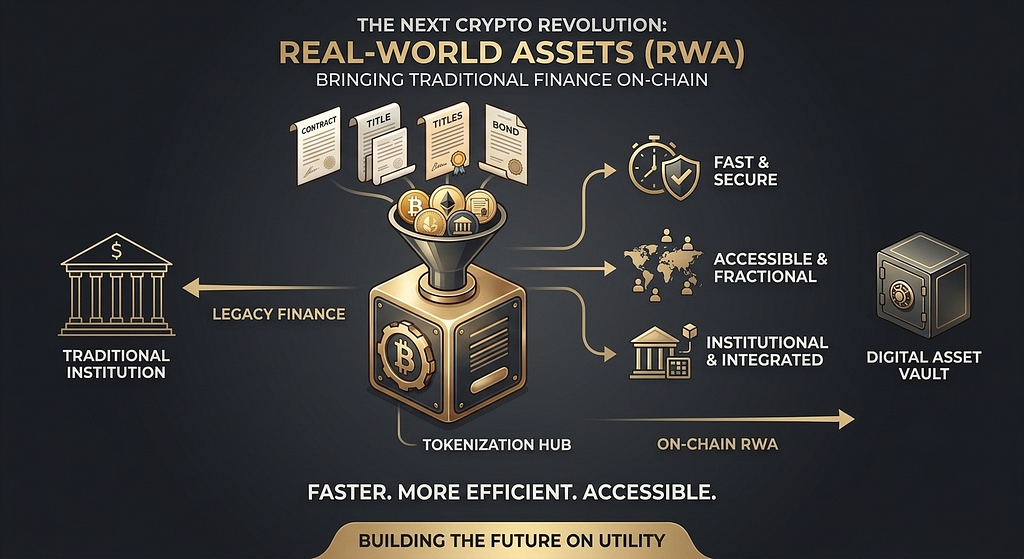
Why the future of blockchain may depend on bringing traditional finance on-chain
For years, the crypto industry has created thousands of digital assets.
New tokens.
New protocols.
New ecosystems.
But after more than a decade of development, one question remains:
How does blockchain move from a digital experiment into a global financial system?
The answer may not come from creating more cryptocurrencies.
It may come from connecting blockchain with the assets that already exist in the real world.
From Digital-Native Assets to Real-World Value
The first generation of crypto was built around native digital assets.
Bitcoin introduced decentralized money.
Ethereum introduced programmable finance.
DeFi created new financial applications.
These innovations changed how people think about ownership and value.
But the world’s largest financial markets are still built around traditional assets:
Real estateBondsFundsCommoditiesEquitiesPrivate market assets
The next stage of blockchain adoption may come from bringing these existing assets into digital environments.
Why Tokenization Matters
Tokenization is not simply about creating another digital token.
It represents a different way of representing ownership and transferring value.
Traditional financial markets often involve:
Multiple intermediariesSlow settlement processesLimited accessibilityGeographic restrictions
Blockchain introduces new possibilities:
Faster Settlement
Assets can move through programmable networks with fewer delays.
Greater Accessibility
Certain investment opportunities may become available to a wider range of participants.
Improved Transparency
Ownership records can become more visible and easier to verify.
The goal is not replacing traditional finance overnight.
It is improving how financial systems operate.
Institutions Are Looking Beyond Speculation
For many years, institutions viewed crypto mainly as a high-risk investment category.
That perception is changing.
More financial organizations are exploring blockchain because they see practical advantages:
EfficiencyTransparencyAutomationGlobal connectivity
The conversation is shifting from:
“Should we invest in crypto?”
to:
“How can blockchain improve financial infrastructure?”
This is a significant change.
The Future Financial System Will Be Hybrid
A common misunderstanding is that blockchain will replace traditional finance completely.
The reality may be more balanced.
The future financial ecosystem will likely combine:
Traditional financial expertise
Blockchain technology
Digital asset infrastructure
The winners will not necessarily be companies that reject existing systems.
They will be companies that understand how to connect old and new worlds.
Exchanges May Become Gateways Between Traditional and Digital Assets
As more real-world assets move on-chain, digital asset platforms may evolve.
The exchange of the future may not only support crypto-native assets.
It may become a broader marketplace connecting:
Digital currenciesTokenized assetsInstitutional productsGlobal financial services
This transformation will require more than trading technology.
It will require:
✅ Security
✅ Compliance
✅ Scalability
✅ Better user experiences
The Biggest Challenge Is Not Technology
Blockchain technology has already proven that digital ownership is possible.
The bigger challenges are:
Trust
Will users and institutions feel confident?
Regulation
Can innovation operate within clear frameworks?
User Experience
Can complex technology become simple?
Technology creates opportunities.
But adoption depends on solving real human and business problems.
The Next Era of Crypto Will Be Built on Utility
The early crypto market was driven by speculation and experimentation.
The next era will be driven by usefulness.
The industry is moving toward applications that solve real problems:
Faster paymentsBetter financial accessMore efficient marketsImproved asset management
The future of blockchain will not be measured by how many tokens exist.
It will be measured by how much real value it creates.
Final Thoughts
The biggest blockchain opportunity may not be creating new digital assets.
It may be transforming the assets and financial systems that already exist.
The next generation of Web3 will be built by companies that can connect:
Traditional finance + Digital assets + User-friendly technology
Because the future of finance will not be completely old or completely new.
It will be a combination of both.
At SoonTech, we focus on building scalable Web3 solutions that help businesses participate in the evolution of digital finance through secure and efficient technology.
#SoonTech #Web3 #Blockchain #Crypto #DigitalAssets #FinTech #Tokenization
The Next Crypto Revolution Won’t Be About Tokens — It Will Be About Real-World Assets was originally published in Coinmonks on Medium, where people are continuing the conversation by highlighting and responding to this story.