
Not the channels. The channels are the easy part. It’s who owns distribution, what counts as proof, and what happens to your funnel when the “customer” can see your treasury wallet.
Web3 Marketing
A few months back I sat in on a call between a growth marketer and a founder who’d just brought her on to run acquisition for a token launch. She’d spent six years running paid search for SaaS companies and could recite CAC math in her sleep. About twenty minutes in, she stopped mid-sentence and asked, “wait, you don’t have a landing page with a signup form?” The founder laughed.
His entire acquisition plan ran through a Discord server, forty KOLs on X, and a Telegram group that had grown to 30,000 people without a single dollar of paid media.
Neither of them was doing it wrong. They were describing two different sports that happen to use the same ball. That’s the honest answer to “what’s really different” between Web3 marketing and traditional marketing it isn’t the tools, it’s the physics underneath them. Once you see where the physics actually diverges, the channel questions (should we be on Discord, should we still run Meta ads) answer themselves.
A few months back I sat in on a call between a growth marketer and a founder who’d just brought her on to run acquisition for a token launch. She’d spent six years running paid search for SaaS companies and could recite CAC math in her sleep. About twenty minutes in, she stopped mid-sentence and asked, “wait, you don’t have a landing page with a signup form?” The founder laughed. His entire acquisition plan ran through a Discord server, forty KOLs on X, and a Telegram group that had grown to 30,000 people without a single dollar of paid media.
Neither of them was doing it wrong. They were describing two different sports that happen to use the same ball. That’s the honest answer to “what’s really different” between Web3 marketing and traditional marketing it isn’t the tools, it’s the physics underneath them. Once you see where the physics actually diverges, the channel questions (should we be on Discord, should we still run Meta ads) answer themselves.
The four places the playbooks actually split
Not “which app do you post on” the underlying mechanics
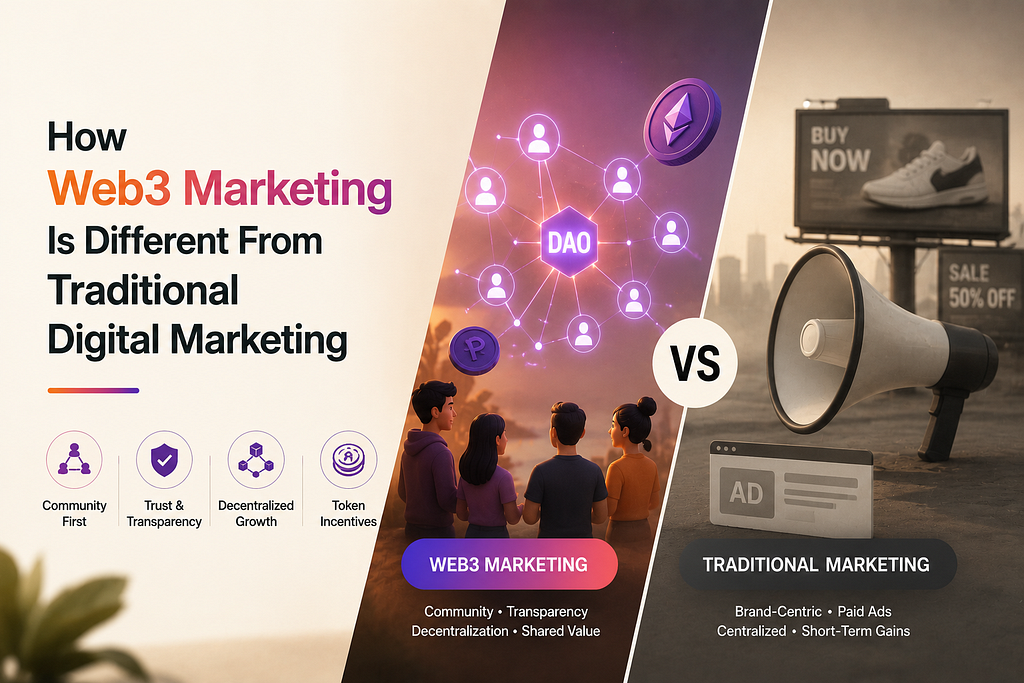
Traditional marketing assumes a few things that quietly stop being true in Web3. It assumes the brand owns its distribution (an email list, a follower count, an ad account). It assumes the product mostly works and the job is persuasion, not proof. It assumes conversion happens on a page you control. And it assumes measurement lives inside a walled garden a pixel, a CRM, a dashboard only you can see.
Traditional marketing runs on
Owned channels: email list, ad account, CRMPersuasion-first messaging the product mostly speaks for itself once trust is builtA single conversion event on a page you controlClosed-garden analytics: pixels, UTM tags, CRM attribution
Web3 marketing runs on
Borrowed / community-owned channels: Discord, X, Telegram — the community is the distribution layerProof-first messaging -audits, treasury data, and on-chain traction have to come before persuasionConversion is a wallet action: a swap, a mint, a stake, a claimPublic, verifiable on-chain attribution anyone can check the ledger, including your competitors
That last point is easy to underestimate. In traditional marketing, your funnel data is private. In Web3, a decent chunk of it is sitting on a public blockchain that anyone with a Dune Analytics dashboard or a Nansen wallet-labeling subscription can inspect. That changes what “trust me” means. You’re not asking someone to believe your case study you’re inviting them to go check the transaction themselves.
The old playbook pushed announcements, influencer posts, and airdrops. The new one has to link every campaign back to something a stranger can independently verify.
Funnel vs. flywheel
The shape of the customer journey isn’t the same shape
Traditional marketing thinks in funnels wide at the top, narrow at the bottom, and every stage designed to filter people out until only paying customers remain. Web3 growth behaves more like a loop. A community member becomes a holder, a holder becomes a contributor, a contributor becomes the next campaign’s distribution channel, and the loop feeds itself again. Paid media can kick-start a loop, but it can’t replace the incentive structure that keeps it spinning that’s usually token design, governance rights, or plain social status inside the community.
What it actually costs to acquire someone
This is where the difference stops being theoretical. Digital customer acquisition cost in traditional industries has been climbing hard up 40–60% between 2023 and 2025 by most estimates, and one widely cited analysis puts the eight-year increase at 222%.
Financial services brands are paying close to $784 per customer through paid digital channels; B2B SaaS with a sales-led motion averages around $11,400 a customer, against roughly $702 for self-serve. Even a straightforward LinkedIn ad campaign is averaging near $982 per acquisition, compared with about $150 for a referral.
Web3 acquisition, when it’s routed through community and creator channels instead of paid impressions, tends to land somewhere else entirely. One 2026 study of token promotion campaigns found Instagram Reels-style creator content converting at roughly $6.14 per acquisition against $22.80 for a comparable banner ad.
That tracks with the broader creator-economy pattern: traditional digital ads are averaging about $72.40 per acquisition industry-wide, versus roughly $53.20 through influencer and creator partnerships, with micro-influencer campaigns coming in around 6.7 times cheaper than celebrity-led ones.
The translation ledger
Same marketing job, different name on each side of the chain
Most of what looks foreign about Web3 marketing is actually a familiar concept wearing a new name. It helps to just line the two up.
Where they’re actually the same
Don’t throw out everything you learned in traditional marketing
It’s tempting to treat Web3 as a different discipline requiring a whole new skill set. Mostly it doesn’t. Good segmentation is still good segmentation. Search and answer-engine optimization still decide whether anyone finds you before a competitor does. Clear positioning saying exactly who this is for and why it’s better than the obvious alternative still separates projects that scale from ones that stall. What changes is the proof standard and the speed: Web3 audiences expect the receipts in public, and they expect them fast, because the whole point of the ledger is that nobody has to take your word for it.
The teams doing this well in 2026 aren’t abandoning fundamentals, they’re front-loading them. Utility-first messaging — leading with real use cases and verifiable on-chain results instead of speculation is becoming the baseline expectation rather than a differentiator, as the on-chain real-world-asset market alone grew from roughly $5.5 billion to $18.6 billion over the course of 2025.
Final Thoughts
Most brands aren’t choosing one world or the other they’re translating a traditional growth strategy into something that works inside a Discord server, a KOL network, and an on-chain audience at the same time. That’s the specific overlap Inoru’s KOL marketing team works in daily, pairing structured content and SEO/GEO strategy with the community and creator relationships that actually move Web3 audiences.
Web3 Marketing vs. Traditional Marketing: What’s Really Different? was originally published in Coinmonks on Medium, where people are continuing the conversation by highlighting and responding to this story.