
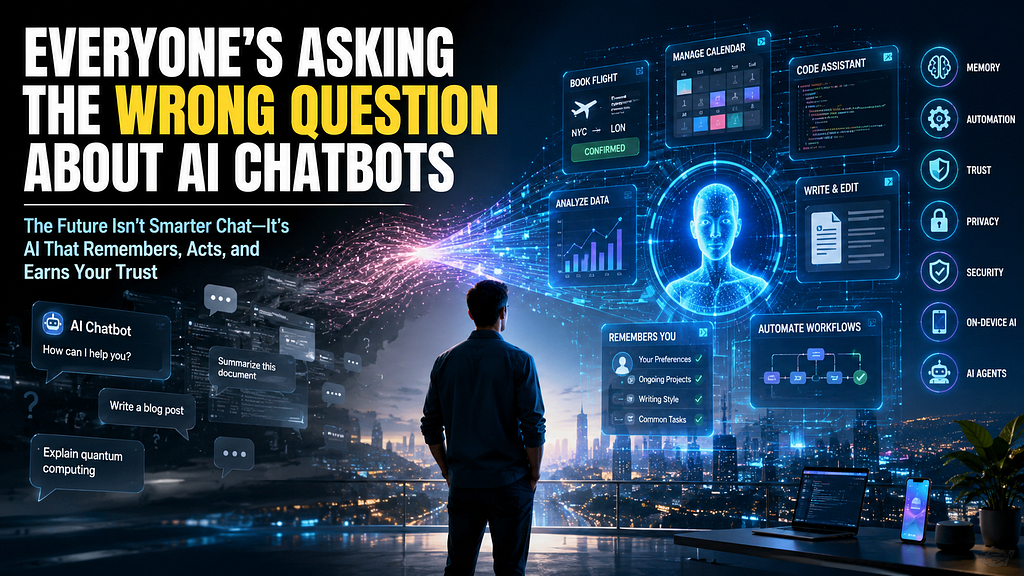
Forget “which one is smarter.” The real shift is happening quietly, under the hood, and most people won’t notice until it’s already changed how they work.
I keep seeing the same debate pop up: is Claude smarter than Gemini, is Chat GPT still ahead, whatever. Honestly? Wrong question entirely. The stuff that’s actually going to matter is happening quietly, in places most people aren’t even looking.
I’ve been using these tools since they were basically novelties the kind of thing you showed your coworkers as a party trick. Ask around now and most people will tell you the future is “better answers” or “smarter writing.” That’s not really where this is going.
The bigger shift is in what these things fundamentally are, not how well they perform on some benchmark. Here’s my read on it, based on where the money and the engineering effort have actually been going.
Image Generated by chatgpt
We’re moving past chatbots into agents that do stuff
Right now you type a question, you get an answer, that’s the whole interaction. That model has an expiration date on it.
The next phase is AI that actually does things instead of just describing them: books your flight, cleans up your spreadsheet, pushes a code fix. This isn’t a prediction; it’s already happening in early form. The labs have shipped versions of this that can browse the web, click through interfaces, run code.
What’s holding it back isn’t capability, it’s trust. Nobody wants software that deletes the wrong file or emails the wrong person by mistake. So a lot of what’s coming isn’t going to be flashier intelligence — it’s going to be boring stuff like permission systems, confirmation steps, undo buttons. The unglamorous plumbing that makes people comfortable handing over real responsibility.
Memory that doesn’t reset every conversation
Most AI still forgets you exist the second you close the tab. A few companies have bolted memory features on top, but it’s early.
What’s coming is assistants that actually track your ongoing projects and how you write and what you keep running into problems with — without you re-explaining your whole situation every single time. That’s genuinely useful. It also raises uncomfortable questions about data retention and consent. My guess is the tools that win here won’t just remember more — they’ll let you actually see what’s stored and delete it, rather than just saying “trust us.”
Multimodal stops being a bragging point
“It can look at pictures now” used to be a headline feature. Soon that’ll just be table stakes. Voice, video, live camera feeds — these are going to merge into one conversation rather than sitting in separate menus you have to hunt for.
Point your phone at something broken, get spoken help back instead of typing out three paragraphs describing the problem. This stuff already exists in rough form. What’s actually improving is speed and reliability, not whether it’s possible at all.
A quieter race: running well on your own device
There’s a whole separate competition happening that has nothing to do with which model tops the leaderboard. It’s about which company can get something genuinely useful running on your phone without needing a data center behind it.
On-device matters because it’s faster, it’s private, and it’s cheaper to run. Expect a split forming — giant models for heavy lifting, small efficient ones baked directly into your phone for everyday tasks.
Personality is turning into an actual product decision
Most assistants sound pretty interchangeable right now — competent, a little bland. That’s going to change. Some will stay blunt and no-nonsense. Others will lean warm, or get tuned specifically for law or medicine or teaching.
This matters more than it sounds like it should, because tone is tied directly to trust, and trust is what decides whether someone actually uses this thing for something that matters health, money, their kid’s homework.
Regulation is going to shape this more than any competitor will
This is the part that gets ignored in most of these takes. Governments in the US, EU, and across Asia are actively writing the rules right now around transparency, copyright, data use. These aren’t theoretical debates. They decide what actually ships.
Expect more labeling on AI-generated content, clearer ways to opt out of training data, tighter restrictions around healthcare and hiring and anything involving kids. The companies that get ahead of this instead of fighting it are probably going to end up with an advantage that outlasts a few missed product launches.
In the end, it’s a trust problem, not an intelligence problem
Benchmark scores make for good headlines. They don’t decide who actually wins long-term. What decides that is whether people trust a tool enough to hand it something real.
That trust gets built through consistency and honesty about limitations and through how a company handles it when something breaks. An assistant that says “I’m not sure” when it isn’t sure will probably earn more loyalty over years than one that scores a point higher on some test nobody outside a research lab has heard of.
So what should you actually expect?
Not some dramatic leap forward. More like a slow accumulation of smaller changes tools that remember more, act more on their own, run faster locally, and get shaped as much by regulators as by engineers. What you’re using today is a rough draft, not a finished product.
The real race isn’t about who has the smartest model. It’s about who builds something boring enough, reliable enough, that you stop noticing you’re even using it.
Curious what you think — five years from now, do these feel more like tools to you, or more like teammates? Drop your take below.
Everyone’s Asking the Wrong Question About AI Chatbots was originally published in Coinmonks on Medium, where people are continuing the conversation by highlighting and responding to this story.