
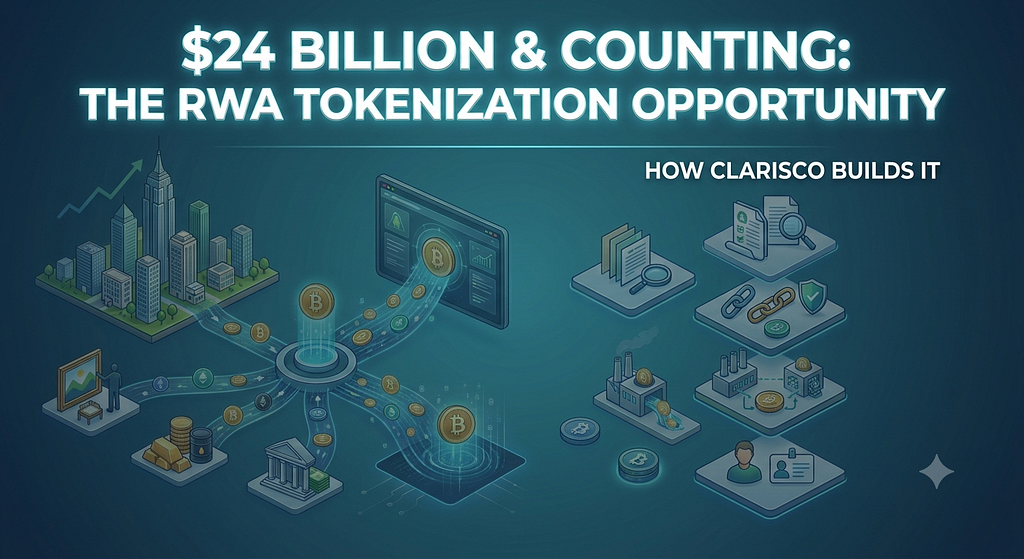
$24 Billion and Counting: Why RWA Tokenization Platform Development Is the Biggest Opportunity in Blockchain Right Now — And How Clarisco Builds It
There is a quiet revolution happening in global finance, and most people outside of blockchain circles have barely noticed.
Real-world assets — commercial real estate, private equity, commodities, fine art, infrastructure debt, carbon credits — are being converted into digital tokens on the blockchain. These tokens represent fractional ownership of physical assets, and they can be traded 24/7, settled instantly, and accessed by investors who would never have had a seat at the table under the old system.
The numbers behind this shift are staggering. Tokenized real-world assets grew 256.7% over just fifteen months, climbing from $5.42 billion in January 2025 to over $19 billion by March 2026. BlackRock, Franklin Templeton, Apollo, and Hamilton Lane all have live tokenized products. Analysts project the market could reach anywhere from $16 trillion to $30 trillion by 2030.
This is not a speculative trend. It is a structural transformation of how assets are owned, traded, and managed.
And at the center of it sits one critical piece of infrastructure: the tokenization platform itself. Which is exactly why RWA tokenization platform development has become one of the most important — and most misunderstood — categories in blockchain.
What RWA Tokenization Actually Is (and Why It Matters)
Let’s cut through the jargon for a moment.
RWA tokenization is the process of taking a physical, illiquid asset — say, a $40 million commercial building — and representing ownership of that asset as digital tokens on a blockchain. Instead of one buyer needing $40 million, thousands of investors can each buy a fraction. Those tokens can then be traded on secondary markets, creating liquidity for an asset class that traditionally takes months to sell and requires lawyers, brokers, and custodians at every step.
Think about what that unlocks.
A real estate developer can raise capital faster by issuing tokens to a global investor base instead of waiting for a single institutional buyer. A fund manager can offer investors actual liquidity in a private equity product — something that was essentially impossible before. A commodity producer can tokenize gold reserves and create an entirely new distribution channel.
Smart contracts handle the heavy lifting automatically — executing issuance and redemption protocols, distributing dividends, enforcing transfer restrictions, running compliance checks — all without the manual overhead that makes traditional asset management so expensive and slow.
The blockchain handles the rest: transparent ownership records, immutable transaction history, and 24/7 settlement with no intermediaries slowing things down.
The opportunity is massive. But capturing it requires something very specific: a production-grade tokenization platform built by a team that understands both the technology and the regulatory landscape. And that is where most projects run into trouble.
Why Most RWA Tokenization Projects Fail Before They Launch
Here is something the hype cycle does not mention: the vast majority of RWA tokenization initiatives never make it to production.
Some fail because they treat tokenization as a simple smart contract deployment. It is not. A tokenized asset that cannot be traded on a secondary market is just an expensive PDF. A platform without embedded compliance is a regulatory time bomb. A token without reliable price feeds and oracle infrastructure is guessing at valuations.
Others fail because they hire a generic blockchain development shop that has never navigated the intersection of securities law, KYC/AML requirements, multi-jurisdictional compliance, and institutional-grade custody. RWA tokenization development is not a standard DeFi project. It sits at the intersection of traditional finance and decentralized infrastructure, and it demands a team that speaks both languages fluently.
This is the gap that a specialized real world asset tokenization development company fills — and it is the gap that separates platforms which actually go live from projects that quietly die in a staging environment.
What to Look for in an RWA Tokenization Development Company
If you are evaluating partners for real world asset tokenization platform development, here are the things that actually matter — not in theory, but based on what separates the projects that ship from the ones that stall.
Compliance-first architecture. KYC, AML, transfer restrictions, accreditation checks, and jurisdiction-specific rules need to be embedded in the platform’s core architecture — not bolted on after the smart contracts are written. If compliance is an afterthought, you will be rebuilding later. Or worse, you will be dealing with regulators.
Built-in secondary market infrastructure. Tokenizing an asset without providing liquidity is like building a stock exchange with no trading floor. The platform needs ATS and DEX integration, liquidity pool architecture, and OTC desk connectivity so token holders can actually trade after the primary issuance.
Multi-chain flexibility. The right chain depends on the asset class, the investor base, and the regulatory environment. A good RWA tokenization development company builds chain-agnostic platforms with cross-chain bridge capabilities — supporting Ethereum, Polygon, BNB Chain, Solana, Avalanche, and permissioned networks — without requiring a rebuild for each deployment.
Oracle integration. Real-time asset pricing, NAV feeds, and off-chain data verification are non-negotiable for institutional-grade tokenization. Integration with oracle networks like Chainlink and Pyth is table stakes.
Revenue model engineering. Your platform needs to generate revenue from day one. That means architecture supporting fees on asset onboarding, primary token sales, secondary market trades, and ongoing management — creating a compounding revenue loop as trading volume grows.
Dual-audited smart contracts. Every contract should be reviewed by an independent security firm before going near investor funds. Period.
If the RWA tokenization development company you are talking to cannot check every one of these boxes, keep looking.
How Clarisco Handles RWA Tokenization Platform Development
Clarisco is a full-stack real world asset tokenization development company that has delivered 140+ blockchain projects with zero security incidents across 32 jurisdictions. Their RWA tokenization platform development practice combines advanced blockchain engineering with institutional-grade legal structuring and regulatory expertise — working directly with asset managers, family offices, real estate developers, fund operators, and sovereign wealth entities.
Here is what the actual development process looks like.
It starts with asset structuring and legal design. Clarisco works with legal coordinators and compliance officers to determine the right token standard, ownership structure, and regulatory framework for the specific asset class and target jurisdictions. This is the step that most generic blockchain shops skip entirely — and it is the step that determines whether the project survives contact with regulators.
Next comes smart contract development and audit. Clarisco builds the token contracts, compliance modules, distribution logic, and governance mechanisms. Every contract is independently dual-audited before deployment. The platform is chain-agnostic by architecture — deployable on Ethereum, Polygon, BNB Chain, Solana, Avalanche, or permissioned chains without rebuilding.
Then the investor-facing platform takes shape. This includes the onboarding portal with KYC/AML and accreditation verification, the primary token distribution system, investor dashboards, and reporting tools. The user experience here matters more than most people realize — institutional investors and accredited individuals expect a polished, compliant interface, not a rough DeFi frontend.
The secondary market module comes next. Clarisco builds in ATS and DEX integration, liquidity pool architecture, and OTC desk connectivity so tokens can actually trade after issuance. This is what solves the liquidity problem that kills most tokenization projects.
Finally, the platform goes live with real-time oracle feeds (Chainlink, Pyth, or custom solutions), ongoing compliance monitoring, distribution automation, and investor reporting — all managed through Clarisco’s post-launch support stack.
Every RWA tokenization development engagement gets a dedicated project manager, lead engineer, legal coordinator, and compliance officer. Single-threaded accountability. No ambiguity about who owns what.
What Can You Tokenize?
Clarisco’s real world asset tokenization platform development covers every major asset class that benefits from fractional ownership and blockchain-based liquidity.
Real estate — commercial properties, residential developments, REITs, and mixed-use portfolios. Private equity and venture capital — fund interests, LP positions, and carried interest structures. Commodities — gold, silver, oil, agricultural products, and strategic reserves. Carbon credits — environmental assets tokenized for compliance and voluntary carbon markets. Fine art and collectibles — high-value physical assets made accessible to a broader investor base. Infrastructure and debt instruments — bonds, revenue-sharing agreements, and project finance structures.
The common thread across all of these: they are traditionally illiquid, expensive to trade, and locked behind high minimum investments. RWA tokenization development breaks down every one of those barriers.
The Revenue Model That Makes This Worth Building
One thing Clarisco gets right that a lot of RWA tokenization development companies overlook is revenue engineering.
Every platform Clarisco builds is architected to generate income from the moment assets go live on-chain. The revenue model typically includes a flat fee or percentage on every asset onboarded and tokenized. A cut of every token sold during primary issuance. A percentage on every subsequent trade in the secondary market. And ongoing management and compliance fees.
This creates a compounding, self-reinforcing revenue loop. As more assets come on-chain and trading volume grows, the platform generates increasing returns — without proportional increases in operational cost. For asset managers, fund operators, and entrepreneurs building tokenization businesses, this is the economic engine that makes the entire model viable.
Why Clarisco Specifically?
There are a growing number of firms marketing themselves as an RWA tokenization development company. So why Clarisco?
Three reasons stand out.
First, the track record is real. 140+ delivered projects. Zero security incidents. 32 jurisdictions. This is not a team figuring things out on your project — they have done this before, at scale, in environments where mistakes mean regulatory action or lost investor funds.
Second, they operate as a true real world asset tokenization development company — not a generic blockchain shop that added “RWA” to the services page last quarter. The combination of blockchain engineering, securities-law expertise, compliance infrastructure, and institutional client experience is genuinely rare.
Third, the platforms they build actually generate revenue. A lot of RWA tokenization platform development ends with a working demo. Clarisco’s work ends with a production system that onboards assets, distributes tokens, facilitates trading, and creates income streams from day one.
Is RWA Tokenization Right for Your Business?
If you manage, own, or invest in illiquid assets — real estate, private equity, commodities, infrastructure, carbon credits, fine art — the question is not whether tokenization is relevant to you. It is when you will move on it.
The market grew almost fivefold in three years. BlackRock and Franklin Templeton are already live. The regulatory frameworks are maturing. The infrastructure is ready.
What is missing, for most firms, is the platform.
Clarisco builds it — from legal structuring and smart contracts to investor portals and secondary markets. End to end. Compliance-first. Revenue-ready.
$24 Billion and Counting: Why RWA Tokenization Platform Development Is the Biggest Opportunity in… was originally published in Coinmonks on Medium, where people are continuing the conversation by highlighting and responding to this story.