
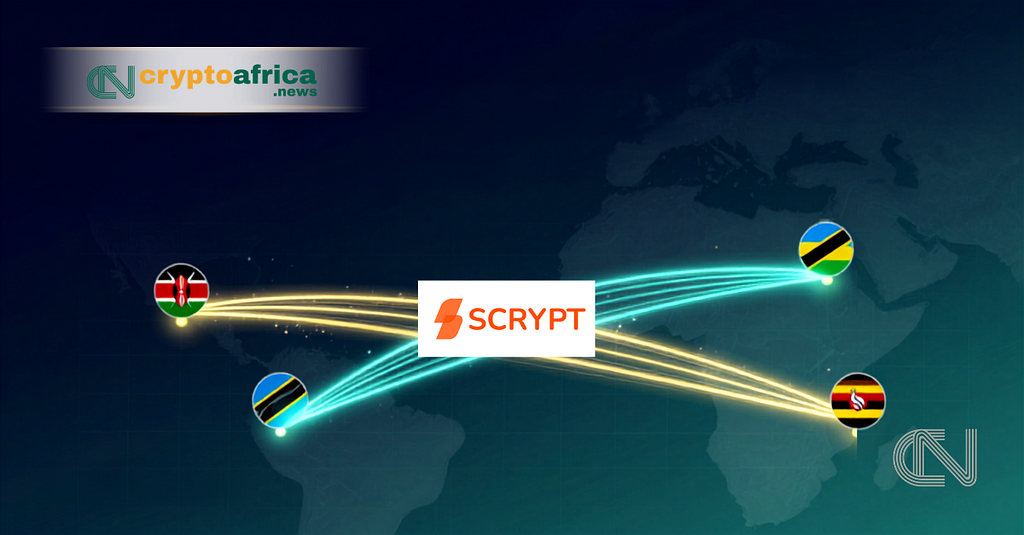
Scrypt has expanded its licensed stablecoin settlement infrastructure into Kenya, Tanzania, Rwanda, and Uganda.Businesses can now convert local currencies directly into stablecoins without first sourcing US dollars.The move reflects a broader shift toward stablecoins becoming enterprise payment infrastructure rather than speculative crypto assets.
Doing business across African borders has long been defined by a frustrating paradox. To send money to a neighbour, you almost always have to route it through an ocean. Historically, a business trying to settle an invoice across East African borders had to convert local currency to US dollars, route it through European or US banks, and then convert it back to the destination local currency. That process was expensive and inefficient.
SCRYPT, a Swiss-licensed digital asset infrastructure provider, is directly targeting this inefficiency. The company announced the expansion of its stablecoin settlement rails into four core East African markets. The markets are Kenya, Tanzania, Rwanda, and Uganda.
Through this expansion, SCRYPT’s institutional clients can now settle transactions between local currencies in these markets and stablecoins in real time. The network directly supports the Kenyan Shilling, the Tanzanian Shilling, the Rwandan Franc, and the Ugandan Shilling.
SCRYPT’s FINMA-regulated corridors offer businesses a compliant local-currency-to-stablecoin flow.
The Core Problem: Navigating the USD Liquidity Squeeze
One recurring pain point for businesses in Africa is structural liquidity. US dollar shortages are a persistent challenge in emerging markets. Central banks, striving to preserve foreign exchange reserves, frequently ration access to the dollar.
When an East African importer needs to pay a global supplier, they cannot simply wire their local currency. As of 2017, only 20% of all cross-border commercial payments sent by African banks remained within the continent.
It often requires converting local fiat to scarce US dollars or Euros. Those funds move through sluggish correspondent banking systems before finally getting to the recipient. Banks in North America, mainly the US, received 39.5% of all payments sent by Africa in 2017. More than 80% of the transactions sent from Africa to the United States had their final beneficiary in another region. One of the two main regions where the payment was eventually made was Africa.
Scrypt Aims to Simplify the Process
This path is slow, often taking three to five business days, and expensive. Africa is the most expensive continent to send money to and within. Cross-border transactions through traditional channels can cost between 7% and 20% of the transaction value. Sending 200 dollars to East Africa, where SCRYPT has recently expanded, costs an average of 9.9%.
This cost, driven by foreign exchange spreads of 3% to 8% applied by banks and payment intermediaries, and correspondent banking fees of USD 15–50 per transaction at each intermediary hop, often heavily impacts businesses’ profit margins.
The World Bank estimates that cheaper cross-border payments could improve trade and generate USD 292 billion in income gains for Africa.
SCRYPT’s stablecoin settlement rails simplify this trajectory into a streamlined, single-step corridor. Local currency is converted directly into stablecoins such as USDC or USDT.
This removes the intermediate US dollar conversion step, thereby reducing costs and settlement times and taking operational pressure off local treasury teams.
From Speculative Asset to Treasury Tool
The true narrative of this expansion is about the maturation of blockchain technology into enterprise financial plumbing.
Stablecoin adoption in Africa is on the rise. Initially driven by speculative trading, stablecoins found a use case as a hedge against currency volatility in many African countries by the early 2020s. Nigeria, the continent’s largest market, accounts for an estimated 60% of all stablecoin inflows.
Today, stablecoins have moved from primarily being used for trading in Africa to being critical tools for treasury management and the movement of working capital.
Africa as a Stablecoin Laboratory
SCRYPT’s expansion aligns with a broader trend across the continent. African fintech infrastructure is actively being rebuilt around stablecoin rails.
Ripple has invested in Flutterwave to accelerate RLUSD-powered settlement. Circle Ventures has separately backed Flutterwave’s USDC strategy. Visa, M-PESA, and Onafriq have piloted stablecoin-based payments in the DRC. AEON has expanded crypto payments into Zambia. Polygon has formed partnerships focused on stablecoin payments in Africa. HyperFX has used cNGN and other stablecoins for instant FX settlement.
Almost every major infrastructure announcement in African fintech recently has centred around stablecoin-powered payments.
Why East Africa is the Perfect Sandbox
The East African Community is a powerhouse of intra-regional trade. It is characterised by a highly entrepreneurial SME sector and a robust mobile money penetration across Kenya, Uganda, Rwanda, and Tanzania.
In 2025, East Africa had an estimated 537 million registered mobile money accounts. Mobile money transaction value grew 23% to $806 billion over 61 billion transactions, the largest in the continent. Businesses in this corridor are uniquely positioned to adopt digital ledger technology.
However, trading smoothly with global counterparties in Europe, the Gulf, and Asia has always been limited by the availability of foreign exchange. Placing regulated stablecoin settlement atop these highly digitised economies is what SCRYPT plans to do.
There is some progress with regulation in East Africa, although it remains uneven. Kenya has moved the furthest in the region in terms of regulations, enacting its VASP Act in 2025. Tanzania and Rwanda are currently developing their own regulatory guidelines.
What This Means for the Future of African Fintech
SCRYPT’s East African corridors hint at three major shifts for the regional payment ecosystem.
First, the battle is moving entirely to infrastructure. The real battle is happening at the structural settlement layer. Companies are now competing to own the most compliant, high-throughput rails that connect local businesses to international networks.
Second, banks could become silent consumers of this technology. Rather than viewing digital assets as a threat to their business model, progressive African banks can take a leaf out of the books of global payment icons like Mastercard and Visa to leverage stablecoins behind the scenes. By using B2B settlement corridors, banks can optimize their internal liquidity and manage foreign exchange risk exposure. They could also offer faster international transfers to their enterprise clients without locking up large reserves in correspondent accounts.
Third, stablecoins are becoming invisible. In the near future, the average consumer may not even realise they are using blockchain technology. To them, the process will simply feel like a local currency transfer. It’ll settle in minutes rather than days, and users will get a transparent conversion rate and drastically lower fees.
SCRYPT’S corridors and other similar developments don’t completely eliminate FX or regulatory friction. They do not completely replace banks, but they are promising solutions and alternatives. For SCRYPT, measurable adoption data, rather than the announcement itself, will be the real test of how much friction it actually removes.
Originally published at https://cryptoafrica.news on July 17, 2026.
Scrypt Expands Stablecoin Settlement Rails Across Kenya, Tanzania, Rwanda, and Uganda was originally published in Coinmonks on Medium, where people are continuing the conversation by highlighting and responding to this story.