
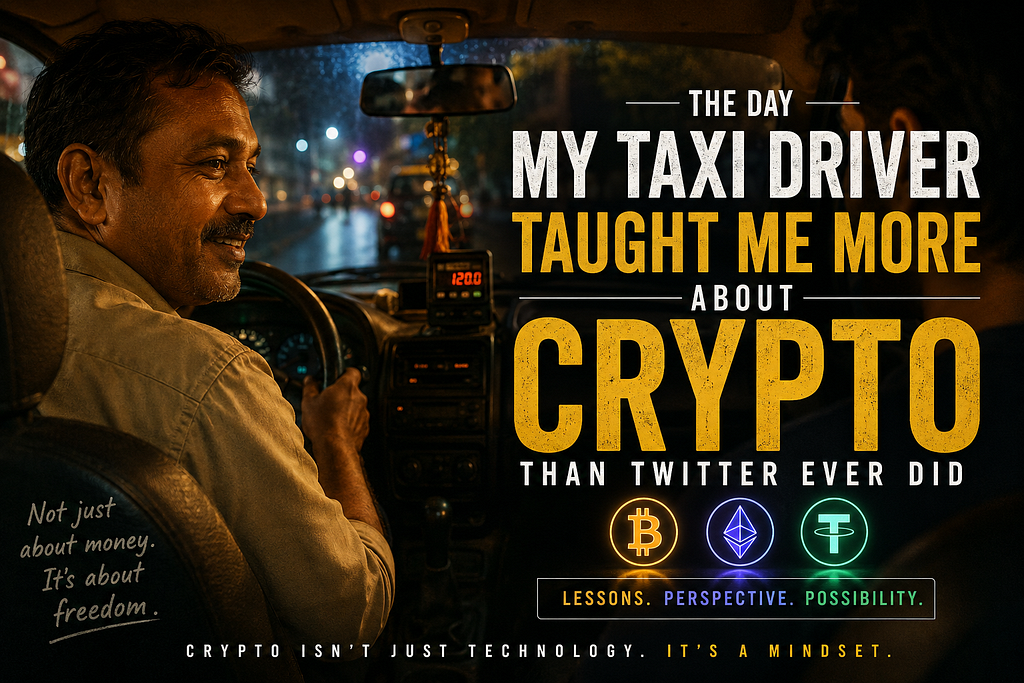
A few months ago, I booked a late-night cab after a long day at work.
Nothing unusual. Just another tired ride home through traffic, notifications, and unfinished thoughts.
Image generated by ChatGPT
The driver looked to be in his late 40s. Calm voice. Old Bollywood songs playing softly in the background.
Halfway through the ride, my phone buzzed with a crypto market alert.
Bitcoin was down again.
I laughed quietly and said, “Another bad day for crypto.”
The driver looked at me through the mirror and smiled.
“Sir, bad day for traders maybe… not for believers.”
That one sentence changed the entire ride.
And honestly, it changed the way I think about crypto.
Everyone Talks About Money. Very Few Talk About Hope.
I asked him if he invested in crypto.
He nodded.
Not proudly.
Not like those fake “financial gurus” online.
Just normally.
Like someone talking about saving money for their children.
He told me he started learning about Bitcoin during the pandemic.
At first, he didn’t understand anything.
Wallets.
Gas fees.
Private keys.
Blockchains.
NFTs.
Altcoins.
“It all sounded like rocket science,” he said.
But one day his nephew explained something simple:
“Crypto is not just digital money. It’s digital ownership.”
That line stayed with him.
And honestly, it stayed with me too.
Because most people enter crypto thinking only about profits.
🚀 “Which coin will 100x?”
📈 “When will the bull run start?”
💰 “Which meme coin should I buy?”
But beneath all the noise, crypto started because people wanted something deeper:
Control. Freedom. Access.
Not everyone in the world trusts banks.
Not everyone even has access to banks.
But almost everyone now has a smartphone.
That changes everything.
The Internet Changed Information. Crypto Wants To Change Value.
Back in the early 2000s, the internet transformed how humans shared information.
You no longer needed a newspaper company to publish your thoughts.
You didn’t need a TV channel to create content.
The internet gave ordinary people a voice.
Crypto is trying to do something similar with money and ownership.
That’s why the technology matters beyond charts.
A musician can sell music directly to fans.
An artist can prove ownership digitally.
A freelancer can receive payments globally without waiting days for banks.
For many people in developing countries, crypto isn’t a trend.
It’s an alternative.
And that perspective is often missing online.
Social Media Made Crypto Look Like a Casino
The driver laughed when I asked if he follows crypto influencers.
“Too much noise,” he said.
And honestly… he’s right.
Open any social media platform today and crypto feels like chaos.
Every day there’s:
• A new “expert”
• A new prediction
• A new coin
• A new fear
• A new scam
• A new millionaire story
The market moves 5%, and suddenly everyone becomes a philosopher.
The dangerous part is that many newcomers think crypto is only about getting rich quickly.
But most real wealth in crypto wasn’t built overnight.
It was built through patience.
The people who survived multiple crashes usually had one thing in common:
They stopped treating crypto like gambling.
I Asked Him Why He Still Believes
After all the scams, crashes, hacks, and negativity… I asked him why he still invests.
He thought for a few seconds before answering.
Then he said:
“Because every new technology looks foolish before it becomes normal.”
That answer hit harder than I expected.
Because history repeats itself.
People once laughed at online shopping.
People doubted digital payments.
People mocked electric cars.
Now they’re part of everyday life.
Does that mean every crypto project will succeed?
Absolutely not.
Most won’t.
Some are useless.
Some are scams.
Some exist only because hype creates temporary money.
But sometimes people make the mistake of confusing bad projects with bad technology.
Those are two different things.
The Biggest Lesson Crypto Taught Me
Crypto didn’t just teach me about finance.
It taught me about human psychology.
Fear spreads faster than facts.
Greed destroys patience.
Hype creates blindness.
And perhaps the biggest lesson:
Most people want freedom… until freedom requires responsibility.
Traditional banking protects people from some mistakes.
In crypto, you become responsible for your own assets.
Lose your private key?
Nobody can help you.
Send funds to the wrong address?
Gone.
That level of responsibility scares many people.
But it also creates independence.
And maybe that’s why crypto feels bigger than just an investment.
It feels philosophical.
The Quiet Builders Always Win
Before ending the ride, the driver told me something interesting.
He said the smartest people in crypto are usually the quietest ones.
Not the loud influencers.
Not the people posting screenshots.
Not the ones screaming “to the moon.”
The real builders are often invisible.
Developers improving infrastructure.
Engineers securing networks.
Founders solving real problems.
While the internet debates prices every day, thousands of people are quietly building the future of decentralized technology.
And whether crypto succeeds fully or not…
That innovation is already happening.
Maybe Crypto Is Still Early
We often assume the world we live in now is the final version.
But it never is.
Technology keeps evolving.
The internet evolved.
Mobile phones evolved.
Artificial intelligence is evolving right now.
Crypto is probably still in its awkward phase.
Confusing.
Messy.
Overhyped.
Misunderstood.
But sometimes revolutions look messy before they look obvious.
The Ride Ended, But The Thought Stayed
When we reached my destination, I paid for the ride and thanked him.
Before leaving, he smiled again and said:
“Sir, maybe crypto will fail. Maybe it won’t. But the idea behind it is too powerful to disappear.”
I walked home thinking about that sentence.
Because beyond the charts and speculation, crypto represents something deeply human:
The desire to own your future.
And maybe that’s why millions of people still believe in it despite every crash.
Not because they’re chasing quick money.
But because they’re chasing possibility.
Final Thoughts
Crypto is not perfect.
It has scams.
Volatility.
Manipulation.
Confusion.
But every powerful innovation begins imperfectly.
The internet once looked chaotic too.
The important thing is learning to separate noise from value.
Maybe the future of crypto won’t look exactly like today’s headlines.
Maybe it will become quieter, more useful, and more integrated into normal life.
Or maybe entirely new systems will emerge from the foundations being built today.
No one truly knows.
But one thing feels certain:
The conversation around ownership, decentralization, and financial freedom is no longer going away.
And strangely enough…
The person who reminded me of that wasn’t a billionaire investor.
It was a taxi driver playing old songs on a quiet night ride home.
The Day My Taxi Driver Taught Me More About Crypto Than Twitter Ever Did was originally published in Coinmonks on Medium, where people are continuing the conversation by highlighting and responding to this story.