
Beyond the Query🔥
SQL is a domain-specific language designed for managing and manipulating data in relational and semi-structured form. It is sometimes referred to as Structured Query Language. At its core, SQL provides a declarative way to define, query, and manipulate data. Pronounced “sequel” or “S-Q-L”, SQL has been the gold standard for over four decades, enabling everything from simple data retrieval to complex analytics on petabytes of information.
SQL’s syntax is human-readable and concise, making it accessible even to non-programmers. A basic example:
SELECT name, age FROM customers WHERE age > 30 ORDER BY name;
This query retrieves the names and ages of customers older than 30, sorted alphabetically.
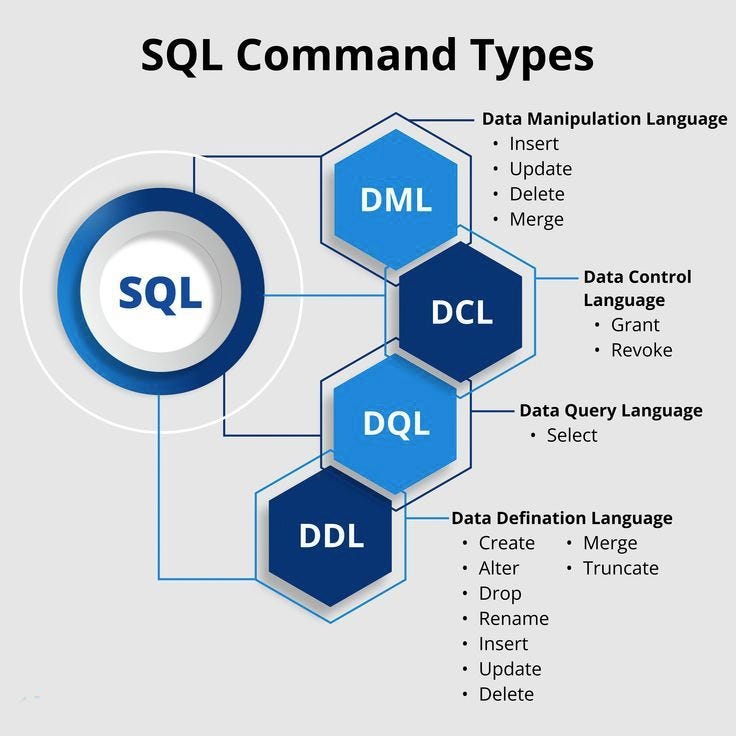
Key Components of SQL:
Eras of SQL Progress:
1986–1989: ANSI/ISO formalized the framework, unifying databases and adding data integration protections.1992: SQL-92 overhauled readability by introducing explicit Outer join syntax and scalar subqueries.1999–2003: The language became highly programmable with standard Triggers, recursive queries, and analytical Window Functions.2011–2023: Modern updates integrated temporal data tracking, native JSON processing, and graph query capabilities.
To understand why SQL survives, you have to look at its core tradition — the foundational, mathematical design principles established in the 1970s. While tech trends come and go, SQL’s core remains untouched because it relies on strict, predictable physics for data.
Core Characteristics of Traditional SQL:
Tabular Storage: Data is housed in tables, where each table represents an entity (like “Customers”).
Relations (Foreign Keys): Tables are linked together using primary and foreign keys, minimizing data duplication and enforcing consistency.
ACID Compliance: Transactions are Atomic, Consistent, Isolated, and Durable, meaning incomplete or erroneous operations are fully rolled back to prevent data corruption.
Rigid Schema: You must define table columns and data types before entering any data.
The Core Tradition: The Unshakable Foundation of SQL
Every few years, the tech industry tries to declare the death of SQL. When NoSQL databases burst onto the scene, critics claimed relational databases were relics of the past. Today, as Generative AI and vector databases dominate the headlines, the same skeptics suggest that traditional querying is obsolete. Yet, the reality is exactly the opposite: the most advanced tech architectures of tomorrow are quietly being built on the foundational queries of yesterday. Far from fading away, core SQL is actively adapting to next-gen tech.
SQL stores structured data in strict tables, while NoSQL stores unstructured data in flexible formats.
The Reality Check: The Tech Survival Story
Tech trends die out in years, sometimes even months. How has a single database language managed to survive, adapt, and dominate the industry for half a century? The answer lies in its mathematical foundation and universal design. SQL was built to handle relational logic, and no matter how complex our applications become, data inherently retains relationships. Instead of replacing SQL, next-gen technologies are building bridges to it.
The Adaptation: How SQL Meets Modern Innovation
SQL is no longer just about selecting rows from a simple table. It has evolved to sit at the center of modern cutting-edge tech stacks:
AI & Vector Databases: Artificial Intelligence requires vector embeddings to understand unstructured data like images and text. Instead of forcing developers to abandon SQL, modern extensions (like pgvector in PostgreSQL) allow engineers to run complex similarity searches and machine learning queries using standard SQL syntax.Cloud-Native Scaling: Modern cloud data warehouses like Snowflake, Google BigQuery, and Amazon Redshift process petabytes of data in seconds. The engine under the hood is wildly advanced, but the steering wheel remains core SQL.Real-Time Streaming: In the era of instant data, tools like Apache Kafka and Flink use “Streaming SQL” to analyze data live as it is generated, proving that SQL is fast enough for the modern web.
Why SQL Remains Irreplaceable
There is a reason the tech industry keeps returning to SQL. First, it offers ACID compliance — a technical standard that guarantees absolute data accuracy and reliability. For industries like finance, healthcare, and e-commerce, a minor data glitch can cause catastrophic failure; SQL ensures this doesn’t happen. Second, it is a universal language. Every time a new data tool is invented, its creators eventually add a SQL interface simply because it is the global standard that millions of developers already master.
The Horizon: The Superpower of Tomorrow
We aren’t moving into a “post-SQL” era; we are entering an age of intelligent, SQL-driven data. For developers, data scientists, and engineers entering the competition landscape today, mastering core SQL isn’t just about maintaining legacy systems. It is about controlling the data pipelines that feed the AI models of tomorrow.
SQL has outlasted every major tech wave in history. As we push further into the frontier of next-gen tech, one thing is certain: the future will still be queried.
Real-Time SQL Applications with AI:
Integrating Generative AI and streaming engines into standard database architectures has enabled real-time SQL applications to process, analyze, and act on live data streams with human-like contextual reasoning.
Example : Instant Hospital Triage & Threat Classification
Emergency services and IT security operation centers use autonomous classification layers to group and route live ticket queues.
The Core Workflow: Incoming emergency patient notes or cyber threat logs trigger Change Data Capture (CDC) events. A native database classification function evaluates the unstructured text as it lands, mapping the ticket priority level to optimize staff allocation queues instantly.
— Classifies inbound unstructured emergency logs on arrival
INSERT INTO categorized_emergencies
SELECT
log_id,
raw_notes,
aura.AI_CLASSIFY(raw_notes, ARRAY[‘Critical’, ‘Urgent’, ‘Routine’]) AS priority_level
FROM inbound_emergency_stream;
Final Thoughts:🙏
SQL is keep on updating integrating with AI and ready to provide tremendous outcomes in future. Below mentioned are the some the advantages of future AI-streaming SOL Engines over Traditional static SQL systems;
Thus SQL will survive for centuries …
Career Diversion : My Journey with Imarticus Learning💡
Being a non-Tech student I was little confused to change my career from HR to Data Analyst, but Imarticus Learing gave the hope and trust to build confidence on the new path.The mentor allocated for me Mr.Abi Ezhilan Sir was very genuine and guided me to join the course by explaining the scope for data science in upcoming years, and thanking my trainer Mr.Arun Upadhyay Sir for his efforts to train us intensively.
Core SQL Adapting to Next-Gen Tech was originally published in Coinmonks on Medium, where people are continuing the conversation by highlighting and responding to this story.