
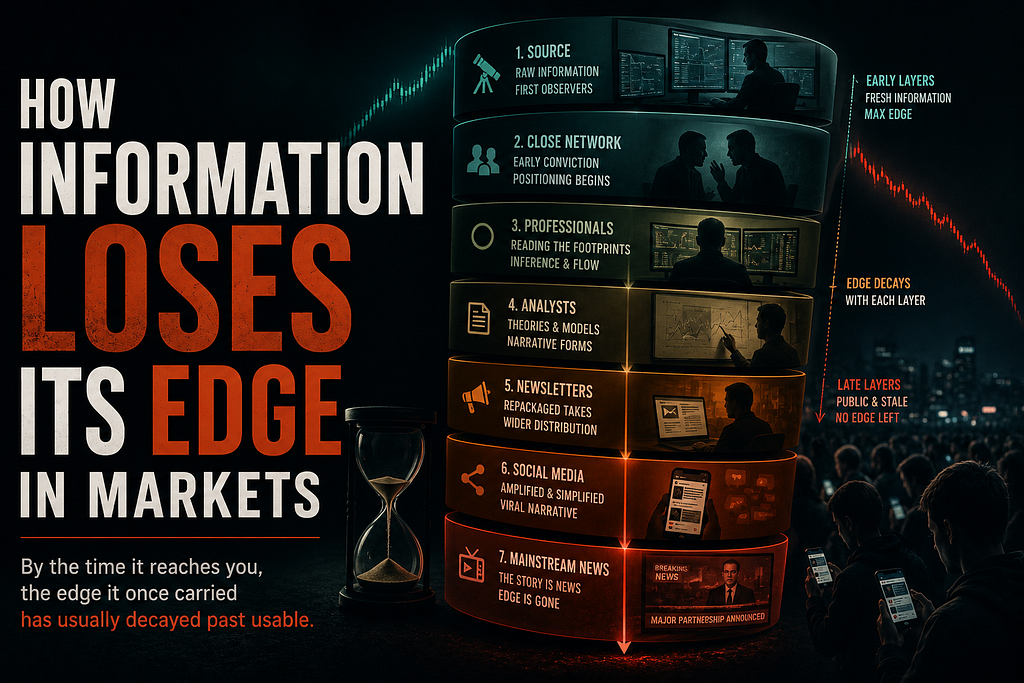
Every piece of information has a half-life. By the time it reaches you, the edge it once carried has usually decayed past usable.
This is not a complaint about being late. It is a description of how information moves through markets. The same headline that feels urgent at 9:00 was already known at 8:45, traded at 8:30, and structurally positioned for at some point earlier in the week. The version you receive is the final, most-public iteration of a story that has been circulating, in different forms, through different participants, for a long time.
The trader who acts on widely-known information is not acting on information. They are acting on a residue of it.
The Layers Information Passes Through
Markets are not flat. Information does not arrive simultaneously to all participants. It moves through layers, and at each layer, the pricing power of that information decays.
At the earliest layer, there is the source. A protocol team aware of a vulnerability. A market maker watching unusual order flow on a counterparty’s books. A custody desk seeing redemptions from a fund. These participants are not predicting anything. They are observing the raw inputs that will, eventually, become a story for everyone else.
The next layer is the close network. People one or two relationships away from the source. They do not have the same certainty, but they have enough conviction to act. Their positioning starts shifting the price in small, often unattributable ways.
After that come professional traders who read the order book carefully. They cannot see the source, but they can see the footprints. Unusual buys at calm hours. Aggressive bids on low liquidity. A widening spread that does not match the surface narrative. These traders act on inference, not knowledge.
Then come analysts, who construct theories from price action and on-chain data. Then retail-focused newsletters, which repackage those theories. Then social media, which amplifies the conclusion without the reasoning. Then mainstream coverage, which announces it as news.
By the time the story is news, the price has moved through every prior layer of positioning. The information has been priced six times before it reaches the seventh layer.
Why the Late Layer Is the Loudest
There is a paradox in how information feels. The earliest layers operate quietly. A few orders. A few conversations. No headlines. The latest layers operate loudly. Trending posts. Push notifications. Television segments.
The volume of attention is inversely correlated with the freshness of the information. By the time something is loud, it is also stale.
This creates a structural illusion. Loudness feels like signal. The trader watching social media sees activity, conversation, urgency, and reads it as evidence that something is happening. Something is happening, but it is the discussion of an event, not the event itself. The event already occurred when the first layer began positioning.
The decay is not always visible in the chart, but it is usually visible in price before the headline. The market does not wait for confirmation. It responds to the early layers, drifts during the middle layers, and often reverses by the time the last layer arrives. This is the entire structure behind why markets move before news. The price is not predicting. It is reflecting positioning that the public layer has not yet seen.
What Decayed Alpha Looks Like
When a trader acts on information that has already passed through most of the layers, they are not buying edge. They are buying the appearance of edge. The signal is real. The reasoning is sound. But the position has already been taken by others, and those others now need someone to sell to.
The late entrant is the exit liquidity for the early layer.
This dynamic is most visible during news-driven moves. A protocol announces a partnership. Price spikes on the headline. The trader who entered on the headline often watches price fade for the rest of the session. The move that looked like the beginning was actually the end. The earlier participants who positioned during the rumor phase used the headline-driven enthusiasm to distribute.
Nothing about this is conspiratorial. It is the natural consequence of how information propagates. If you can see the headline, the headline has already been processed by the market.
The Internal Dynamics of Each Layer
It would be wrong to suggest each layer is a homogeneous group acting in coordination. They are not. Within each layer, participants disagree about magnitude, timing, and interpretation. Some early actors take small positions. Some take large. Some hedge. Some scale.
But what is consistent across layers is the type of information available. The early layers have access to raw inputs. The middle layers have access to inferred patterns. The late layers have access to confirmed narratives. Each type of information is less actionable than the one before it, because the price has already absorbed the earlier interpretations.
By the time the narrative is confirmed, the actionable phase is over. What remains is positioning around the resolution, not around the discovery.
The Trap of Feeling Informed
The most expensive feeling in markets is the feeling of being informed.
A trader reads three articles, watches two interviews, and follows a thread that summarizes a complex situation. They feel they understand. They feel prepared. They take a position based on what they now know.
The problem is that the act of being able to read those three articles means the information is already public. The thread exists because someone wrote it, which means someone else read it first, which means the conclusion the trader is now reaching was reached by others days or weeks earlier.
Feeling informed is a sign that the information has fully decayed. The market did not wait for the trader to read the thread. It moved during the period when only the source knew. By the time the trader arrives at a confident interpretation, the price reflects a different stage of the cycle, often the stage where early positioning is being unwound.
A good study in this is the exploit was expected — a clean example of how informed participants act on information before the public layer ever sees it, and how the headline arrives at the moment the early layer is exiting.
Why Decay Cannot Be Outrun
A common response to this problem is to try to move faster. Refresh feeds more frequently. Subscribe to more sources. Watch more screens. The reasoning is that if late information is decayed, then earlier information must be better, and the way to access earlier information is to consume more of it.
This logic fails because the constraint is not consumption speed. It is layer position. A trader on social media can refresh every second and still be in the seventh layer. The earlier layers are not faster versions of the same channel. They are different channels entirely.
The professional desk does not learn about the order flow from Twitter. They see the order flow directly. The custody team does not learn about redemptions from a newsletter. They process the redemptions. No amount of faster consumption moves a participant from a downstream layer to an upstream one.
Speed within a layer is not the same as access to a higher layer.
What Remains When Information Decays
If information decays past usable by the time most traders see it, what is actually tradable? The honest answer is: structure, behavior, and price itself.
Structure does not decay. The architecture of how markets move, how liquidity gathers and disperses, how participants behave at certain types of levels, remains valid across cycles. It is not faster information. It is a different kind of information entirely.
Behavior does not decay either. The way crowds react to losses, to rallies, to news cycles, is consistent over time. A trader who studies behavior is not racing against the information layer. They are operating on a different axis.
Price itself is the most honest layer. Price reflects all the positioning that has already happened, including from the earliest layers. A trader who reads price carefully is not trying to predict what comes next. They are trying to see what has already been decided.
These are slower, less exciting forms of analysis. They do not produce the urgency that headline trading produces. But they do not depend on being early to information, because they do not depend on information in the conventional sense.
The Discipline of Knowing You Are Late
Most traders are in the late layer most of the time. This is not a personal failure. It is a structural fact of how information distributes.
The useful response is not to pretend otherwise. It is to assume lateness as the default, and to design behavior around it. If you are late, the headline is not a buy signal. It is, more often, a sign that the move you are reading about is in its distribution phase. The trader who acts on the headline is providing liquidity to the participants who acted weeks earlier.
This does not mean acting on news is always wrong. It means acting on news as if it were fresh information is always wrong. The information is not fresh. The price has already absorbed it through six earlier layers.
The trader who understands this stops chasing the feeling of being informed. They stop refreshing feeds for an edge that the feed cannot provide. They start watching structure, behavior, and price, because these are the few layers that do not decay between the source and the screen.
The half-life of information is short. The half-life of structure is long. Most traders spend their effort optimizing for the wrong one.
Every day I track one thing: where market structure and crowd sentiment disagree — and which one leads. Today’s read:
Daily on swaphunt.dev. Same on @SwapHunt. Not financial advice.
How Information Loses Its Edge in Markets was originally published in Coinmonks on Medium, where people are continuing the conversation by highlighting and responding to this story.