
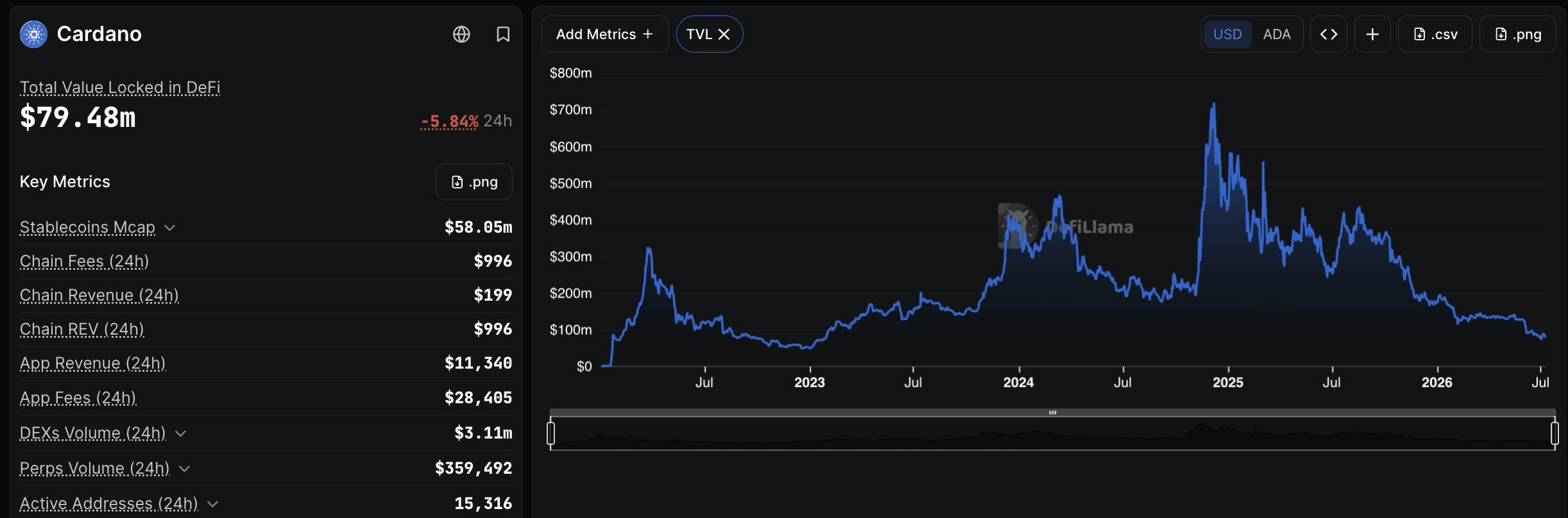
Ethereum researchers have published a paper proposing native UTXO (Unspent Transaction Output) support for the network’s execution layer, and Cardano founder Charles Hoskinson responded on X with a pointed claim: Cardano has been running this model for over a decade, and Ethereum is arriving late without acknowledgment.
In a July 7 tweet, Hoskinson said: “It’s not like I’ve been literally working on this topic for over 10 years of my life and launched a cryptocurrency that was number three on CoinMarketCap with millions of users to deploy it.”
This war of words between Cardano and Ethereum comes as ADA is outperforming ETH on the day, up +0.7% over the past 24 hours, compared to Ethereum’s +0.4% over the same timeframe.
It’s not like I’ve been literally working on this topic for over 10 years of my life and launched a cryptocurrency that was number three on coinmarketcap with millions of users to deploy it. It’s literally a crime in the Ethereum inner circles to mention Cardano. EUTXO is the… https://t.co/3F3l6cg0JE
— Charles Hoskinson (@IOHK_Charles) July 7, 2026
What the Ethereum Paper Actually Proposes
The research document identifies a structural cost in Ethereum’s account model: every time a new address receives ETH or an ERC-20 token for the first time, it generates permanent state storage that accumulates indefinitely as the user base grows.
The paper proposes using native UTXOs specifically for simple payment transactions that do not require persistent account storage, projecting a roughly 99.8% reduction in permanent state for those payments.
The key mechanical distinction is that a UTXO is created once, spent once, and then removed. It leaves no residual footprint on the network’s state. Critically, the proposal does not replace Ethereum’s existing account model; smart contract activity would continue operating exactly as it does today.
This is a targeted patch for a specific scalability problem, not a wholesale architectural shift. The paper has not been formalized as an Ethereum Improvement Proposal (EIP) and carries no confirmed implementation timeline.
Double top or Double bottom
Which one will play out for $ETH? pic.twitter.com/L3arwnGl3I
— Ted (@TedPillows) July 9, 2026
Hoskinson’s Prior Art Argument
Hoskinson stated on X that he has spent over ten years developing Cardano’s eUTXO (Extended Unspent Transaction Output) model, which showcases a scalable proof of concept.
Unlike Bitcoin’s UTXO, Cardano’s design incorporates datums, redeemers, and script context, allowing smart contracts to function as deterministic local state machines without needing to access the global blockchain state.
This determinism is key, as a transaction’s validity relies solely on its inputs, leading to predictable fees and enhanced parallelism across UTXO sets, while minimizing front-running risks.
Hoskinson highlighted that Cardano achieved the third position on CoinMarketCap, with millions of users testing this model’s viability.
It’s important to note that the ten-year timeline pertains to research and design, while Cardano’s smart contract functionality, fully utilizing eUTXO, launched with the Alonzo upgrade in September 2021 and was developed through IOHK’s research pipeline.
DISCOVER: Best Meme Coin ICOs to Invest in 2026
Cardano Community Reaction and the Convergence Argument
Dori, a figure in the Cardano community, asserted that Ethereum’s permanent state growth creates structural weaknesses by increasing node storage costs and concentrating validation power.
He linked Ethereum’s account model to issues like MEV, reentrancy attacks, and limits on parallel transaction processing, suggesting that eUTXO design effectively addresses these problems.
From a neutral perspective, both Ethereum and Cardano tackle similar challenges of state locality and transaction processing, albeit through different approaches. Other projects, like Ergo and Nervos CKB, have also adopted UTXO-style models.
The debate over blockchain architecture focuses on trade-offs relevant to specific use cases. Meanwhile, Ethereum’s account model offers an advantage in synchronous DeFi composability, which is crucial for complex multi-step financial transactions.
EXCLUSIVE: Earn $10 USDC Via Binance Sign-Up
Leios and What Comes Next for Cardano
$ADA Big rally the past week and the stand-out within the majors.
Usually coins like these moving does tend to be a decent sign for overall altcoin risk appetite, but I’d want to see a follow up leg to properly confirm this.
One leg up is generally met with a decent amount of… pic.twitter.com/0iUDYQF0Xt
— Daan Crypto Trades (@DaanCrypto) July 6, 2026
The debate lands at a moment when Cardano is pursuing its most significant throughput upgrade yet. Hoskinson has said the planned Leios upgrade could increase Cardano’s transaction throughput by up to 60 times, a level he argues would put the network’s processing speed on par with the XRP Ledger.
He also flagged that progress depends on governance approval from the Cardano community, introducing a procedural dependency that makes the timeline uncertain.
If Leios delivers on that projection, it would substantially close the performance gap that has historically been cited as a constraint on ADA-based DeFi adoption.
Whether Ethereum’s native UTXO research ever moves from paper to protocol, the conversation it has sparked is already doing work, forcing a precise comparison of two mature blockchain architecture philosophies that have been talking past each other for years.
EXPLORE: Best Crypto Presales With Asymmetric Upside in the Current Market
The post Cardano’s eUTXO Model Takes Center Stage as Ethereum Eyes UTXO Adoption appeared first on 99Bitcoins.