
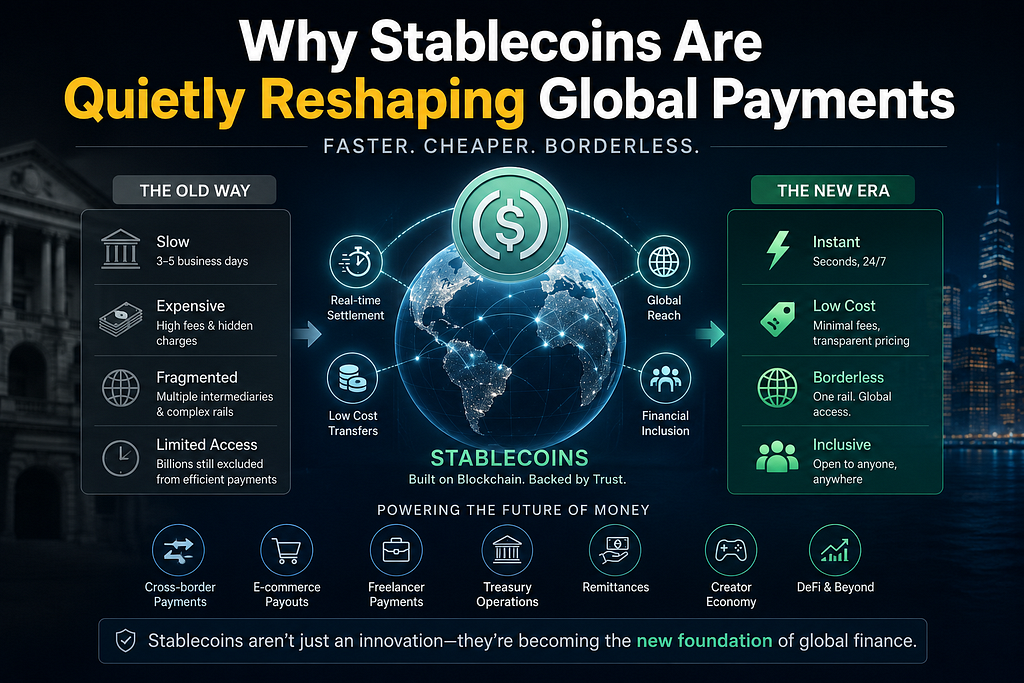
From slow bank wires and high fees to instant, borderless value transfer.
You’ve felt the frustration. You send money to family abroad and watch days tick by while banks take their cut. Or your small business waits weeks for an international invoice to clear, with fees eating into thin margins. Meanwhile, a new kind of digital dollar is moving quietly in the background fast, cheap, and available 24/7.
Generative AI
Stablecoins cryptocurrencies pegged to stable assets like the U.S. dollar are no longer just a crypto curiosity. They’re reshaping how money moves around the world, one transaction at a time. And unlike volatile Bitcoin, they’re designed for real utility rather than speculation.
The Pain Points Stablecoins Actually Fix
Traditional cross-border payments are painfully outdated. SWIFT transfers can take 3–5 business days. Fees often range from 3% to 7% (or higher for smaller amounts). Add currency conversion losses, intermediary banks, and time-zone headaches, and the system feels built for another century.
Enter stablecoins like USDT (Tether), USDC (Circle), and newer players like PYUSD. They combine the stability of the dollar with the speed and transparency of blockchain technology.
I remember talking to a freelance designer in Nigeria who now gets paid instantly in USDC by clients in Europe and the U.S. No more waiting for Western Union or dealing with unfavorable exchange rates. “It changed my life,” he told me. “Money hits my wallet in minutes, and I can convert it locally when I need to.”
This isn’t one-off. According to recent industry reports, stablecoin transaction volumes have surged into the trillions annually, often surpassing traditional payment rails in certain corridors.
How Stablecoins Are Powering Real-World Use Cases
1. Remittances — The Killer App Migrant workers send over $800 billion home every year. Stablecoins are slashing costs and time dramatically. Families in Latin America, Africa, and Southeast Asia are receiving money faster and keeping more of it. Platforms like Stellar, Ripple, and even Telegram-integrated wallets make this seamless.
2. Business Payments and Trade Companies are using stablecoins for B2B payments. A supplier in Vietnam can get paid the same day by a buyer in Germany without currency risk or banking delays. This is especially powerful for small and medium enterprises (SMEs) that previously struggled with international trade finance.
3. DeFi and Everyday Finance Stablecoins serve as the “cash” of decentralized finance. You can lend, borrow, earn yield, or simply hold value without moving in and out of volatile crypto. Many people in high-inflation countries use them as a digital savings account.
4. Global Commerce and Creator Economy Freelancers, content creators, and online merchants increasingly accept stablecoins. Payment processors like Stripe and Shopify are integrating them, making borderless commerce smoother than ever.
Why This Shift Feels So Powerful
The beauty of stablecoins lies in their simplicity. They act like digital cash you can send anywhere with internet access. No bank account required in some cases just a smartphone wallet.
This has huge implications for financial inclusion. The World Bank estimates that nearly 1.4 billion adults remain unbanked. Stablecoins lower the barrier dramatically. A farmer in rural Kenya or a shopkeeper in the Philippines can participate in the global economy without jumping through traditional banking hoops.
From a business perspective, the efficiency gains are massive. Reduced settlement times mean better cash flow. Lower fees improve margins. Transparency on the blockchain reduces fraud and reconciliation headaches.
The Challenges We Can’t Ignore
Of course, it’s not all smooth sailing. Regulatory uncertainty remains a big question mark. Governments are still figuring out how to oversee stablecoins balancing innovation with consumer protection, anti-money laundering rules, and monetary policy concerns.
There are also risks: some stablecoins have faced scrutiny over reserves, and smart contract vulnerabilities exist (though major ones like USDC have strong transparency). Adoption still faces hurdles around volatility of local currencies when converting, user education, and infrastructure in certain regions.
But the momentum is undeniable. Major institutions banks, payment giants, and even central banks exploring their own CBDCs are paying close attention.
What the Future Holds
We’re likely heading toward a hybrid financial system where stablecoins complement and in many cases compete with traditional rails. Imagine instant settlement for international trade, programmable money that executes contracts automatically, or seamless payroll for global remote teams.
As blockchain scalability improves and more traditional finance players integrate stablecoins, their role will only grow. Circle, Tether, and others are already processing volumes that rival some mid-sized banks.
For individuals, this means more control over your money. For businesses, it means faster, cheaper operations. For the global economy, it could mean more inclusive growth.
The Quiet Revolution You Should Know About
Stablecoins won’t replace your bank overnight, but they’re already eating away at the edges of an inefficient system. The transformation is happening quietly in wallets, on-chain transactions, and everyday stories of people getting paid faster and keeping more of their earnings.
Next time you groan at another slow international transfer or high remittance fee, remember: better options are already here. They’re borderless, instant, and increasingly accessible.
Whether you’re a freelancer, business owner, or just someone who sends money home, understanding stablecoins might soon become as essential as knowing how to use mobile banking.
What’s your experience with international payments or stablecoins? Have you tried sending or receiving USDC or USDT? Share your thoughts in the comments I’d love to hear real stories from the ground.
Why Stablecoins Are Quietly Reshaping Global Payments was originally published in Coinmonks on Medium, where people are continuing the conversation by highlighting and responding to this story.