
From Bitcoin giants to the first prediction markets treasury — a field guide to the digital asset treasury (DAT) companies of 2026, and the one metric that now separates them.
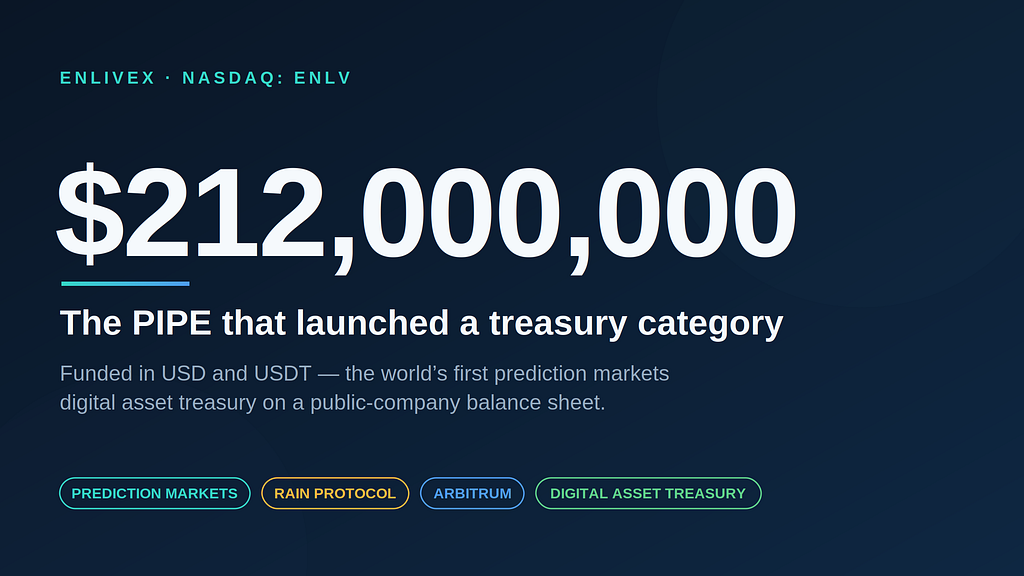
The $212 million PIPE that launched a new treasury category. Nasdaq: ENLV.
For four years, the crypto treasury trade was simple. Buy Bitcoin. Announce it. Watch the stock follow the coin.
In 2026, that trade broke.
By 2026, dozens of public companies held a cryptocurrency on their balance sheet, according to Coinpaper.
Then the Bitcoin downturn that began in October 2025 did something the bull market had hidden. It exposed which digital asset treasury companies were built to compound, and which were only holding.
So here is the 2026 crypto treasury companies list. Who holds what, how the market is now pricing them, and why one name on this list does not look like the others.
What is a crypto treasury company, and what does “who holds what” really mean?
A crypto treasury company, often called a digital asset treasury or DAT, is a public company that holds a cryptocurrency as a primary reserve asset on its balance sheet. Investors buy the stock to get regulated exposure to the asset without touching an exchange or a wallet.
The model was pioneered by Strategy, formerly MicroStrategy, back in 2020. By 2026 it had earned a name analysts now use freely: Treasury 2.0. As BingX put it in a February 2026 review, the sector has moved past simple holding toward active balance sheet management — using the underlying asset to generate yield, issue credit, and manage supply.
Holding an asset and putting it to work are no longer the same thing.
Two kinds of crypto treasury: passive Bitcoin holdings versus a productive prediction markets treasury.
Two kinds of crypto treasury: passive Bitcoin holdings versus a productive prediction markets treasury.
Which public companies hold the most crypto in 2026?
Here is the short version of who holds what, sorted by primary reserve asset.
Strategy (Nasdaq: MSTR) is the original and still the largest. It held 847,363 BTC as of June 22, 2026, roughly 4% of all the Bitcoin that will ever exist, according to BitcoinTreasuries.com. Michael Saylor’s company remains the reference point for the entire category.Metaplanet is the “MicroStrategy of Asia.” The Japanese firm held around 35,000 BTC in early 2026, per Coinpaper, taking the Bitcoin treasury model to public markets in Tokyo.Twenty One Capital (Nasdaq: XXI) is a Bitcoin-native vehicle backed by Tether and SoftBank, with roughly 43,500 BTC on its balance sheet by early 2026, according to Coinpaper.BitMine Immersion (BMNR) is the largest corporate holder of Ethereum, still adding to its position through 2026, per The Motley Fool.Forward Industries (Nasdaq: FORD) runs the largest Solana treasury and announced a $4 billion at-the-market program, according to Arkham research.Hyperliquid Strategies (PURR) is the largest corporate holder of the Hyperliquid token, and one of the rare 2026 names whose shares actually rose.Enlivex (Nasdaq: ENLV) is the outlier. Not Bitcoin. Not Ethereum. The first treasury built around a prediction markets token.How a new treasury category formed, from Bitcoin reserves in 2020 to the first prediction markets treasury in November 2025.
Notice the pattern. The list began as Bitcoin-only. By 2026 it spans Ethereum, Solana, and Hyperliquid — plus one company that left the crowd entirely.
Why is mNAV the number that separates the winners from the losers?
If you learn one metric from this list, learn mNAV: the ratio of a company’s market value to the net asset value of the crypto it holds.
When mNAV sits above 1, the market pays a premium for the treasury. When it falls below 1, the stock trades for less than the crypto it owns.
In 2026, the premiums vanished. According to The Motley Fool in June 2026:
Strategy traded near 0.63 mNAV, with shares down 43% on the year.BitMine sat around 0.97, its shares down 51%.Hyperliquid Strategies was the exception at 1.86, up roughly 98% over the prior year.
The takeaway is blunt. A treasury full of a passive asset is worth the asset, and often less. Once the premium disappears, a pure holding company has no obvious way to earn it back. The market now pays up only for treasuries that do something with what they hold.
What makes Enlivex (Nasdaq: ENLV) different from every other name on this list?
Enlivex is the one company on the crypto treasury companies list that does not hold Bitcoin, Ethereum, or Solana. It holds RAIN.
RAIN is the token of Rain, a decentralized prediction markets protocol built on Arbitrum. Enlivex became the first U.S.-listed company to adopt a prediction markets token as its primary reserve asset when it raised a $212 million PIPE in late 2025, according to The Block.
The $212 million PIPE at a glance. Source: Enlivex press release, November 24, 2025.
The structure is built to behave differently from a passive holder.
The asset is designed to be productive. The Rain protocol runs a fee-linked buyback-and-burn mechanism, so as trading activity flows through the network, RAIN supply is reduced. More than 100 million RAIN tokens had already been burned by late May 2026, per Enlivex disclosures reported by StockTitan.The holdings are real and growing. Enlivex reported holding about 79.6 billion RAIN tokens valued at roughly $1.16 billion as of May 27, 2026, up from $567 million a month earlier, according to company treasury updates.How the Rain protocol works on Arbitrum, from market creation to buyback-and-burn. Source: Rain protocol documentation.There is a second engine. Enlivex is a quality longevity company. Its clinical asset, Allocetra™, is a macrophage reprogramming therapy for age-related knee osteoarthritis, a condition affecting more than 32.5 million Americans, per Enlivex. Reported Phase II data showed a 72% reduction in pain and a 109% improvement in function across more than 250 treated patients, according to the company, and the first U.S. patient in its Phase 2b trial has now been dosed, per StockTitan. The company frames this therapeutic program as the biological floor beneath the treasury.There is institutional cover. Former Italian prime minister Matteo Renzi joined the Enlivex board after the raise closed, according to The Block — a governance signal rarely attached to a micro-cap.One Nasdaq equity, two engines: Allocetra™ on the healthspan side and the RAIN treasury on the wealthspan side.
That combination produced an unusual headline. Enlivex reported full-year 2025 net income of $1.23 billion and diluted EPS of $25.48, driven by unrealized appreciation in its treasury and treasury-related assets, according to the company’s March 2026 results.
Those are mark-to-market figures, and RAIN is volatile — but no passive Bitcoin holder posted a number like it that year.
Our goal was not to buy into a valuation that has already reached maturity. — Shai Novik, Executive Chairman, to The Block
How big is the prediction markets opportunity behind the RAIN treasury?
This is the part most crypto treasury lists miss. The asset Enlivex holds is tied to one of the fastest-growing categories in finance.
Prediction markets let people trade event contracts on real-world outcomes. The category went mainstream through 2026.
Combined monthly volume on Kalshi and Polymarket rose from under $5 billion in September 2025 to about $24 billion by April 2026, according to a Pew Research Center analysis of data from The Block.Kalshi raised $1 billion at a $22 billion valuation, and Intercontinental Exchange, parent of the NYSE, completed a $2 billion commitment to Polymarket, per reporting compiled by Global.gi.According to Citizens Bank, the industry is running at a $3 billion annual revenue run-rate, with a path to $10 billion by 2030.Prediction markets went vertical: combined monthly Kalshi and Polymarket volume, 2025 to 2026. Sources: Pew Research Center analysis of The Block data; company announcements.
Rain sits inside that wave as infrastructure rather than as a single venue. In March 2026 the Rain Foundation launched an AI agent interface that lets anyone create a prediction market from a single prompt — the kind of feature an AI-native audience tends to notice.
What should you check before trusting any crypto treasury stock?
Use this the next time a company announces a treasury.
mNAV. Are you paying a premium, or buying the assets at a discount?Productivity. Does the asset generate yield, fees, or supply reduction — or does it only sit there?Capital discipline. Is the treasury creating value, or just recycling capital?Disclosure. Are holdings reported on a clear, regular cadence?A second engine. Is there a real business beneath the crypto, or only the crypto?
Most names on the 2026 list pass two or three of these. Very few pass all five.
The one-line takeaway
The lesson of 2026 is short. Holding is not a strategy. What you hold, and whether it works, is the strategy.
The Bitcoin giants proved the category. The downturn proved the difference. And somewhere between a clinical trial and a prediction market, the crypto treasury companies list found its first genuine outlier.
Enlivex Ltd. (Nasdaq: ENLV) is a quality longevity company powered by a prediction markets treasury. This article is for information only and is not investment advice. Figures are as reported on the dates cited and change with market prices.
The 2026 Crypto Treasury Companies List: Who Holds What was originally published in Coinmonks on Medium, where people are continuing the conversation by highlighting and responding to this story.